
A buyer-level walkthrough of a fiber optic cable datasheet: optical, geometric, structural, mechanical, test and commercial rows, with a worked G.652D example and a supplier question list.
Every serious fiber optic cable purchase starts with the same document: the datasheet. It is usually a two- to four-page PDF with a part number, a wall of parameter tables, a stack of standard references, and a footer that most buyers never read. Yet that single document determines whether the cable that arrives at your warehouse will pass acceptance testing, whether your link budget holds across the route, and whether a dispute six months later is resolved in your favor or in the supplier's. Between a buyer who reads the fiber optic cable datasheet line by line and one who only checks the price, the price-focused buyer often ends up paying more — in re-pulled routes, failed acceptance tests, and restocking fees.
This guide is written for B2B procurement teams, network engineers, and project managers who buy fiber optic cable from manufacturers or through distributors, often across borders and often without the chance to inspect the goods before they ship. It walks through a fiber optic cable datasheet in the order a professional buyer should read it: the cover and part number, the optical and geometric parameters, the construction details, the mechanical and environmental limits, the test references, the packaging data, and the commercial rows that sit quietly at the bottom of the page. Along the way it flags the values that must match your project conditions, the numbers that are only meaningful together, and the questions worth asking the supplier before you put your signature on the sheet.
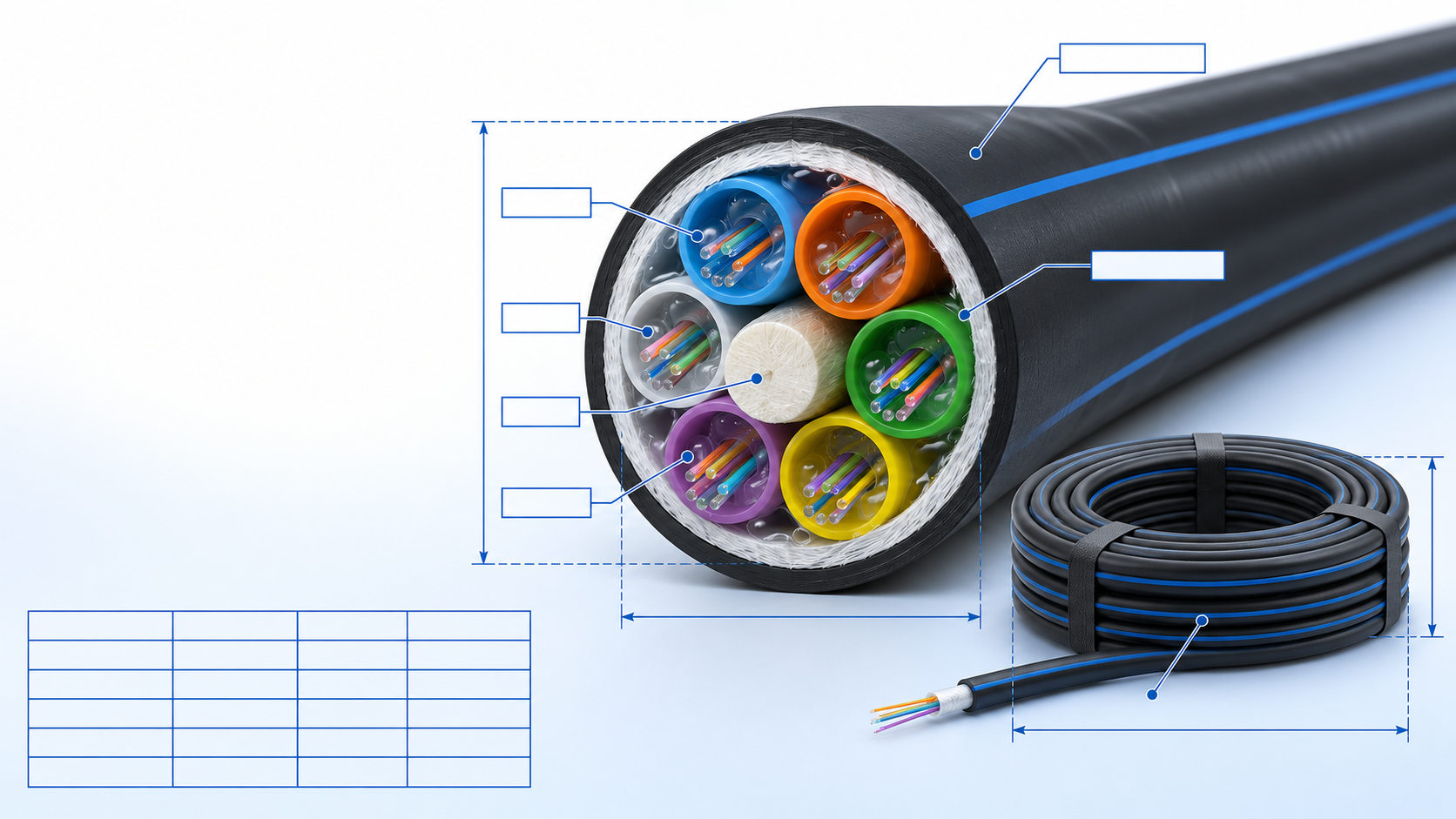
Why the Fiber Optic Cable Datasheet Decides the Deal Before the Sample Does
Buyers often treat the datasheet as a formality and rely on a sample to make the final judgment. A sample is useful, but it answers a narrower question than most buyers think. A one-meter sample tells you how the cable handles, how the jacket feels, and what the cross-section looks like. It cannot tell you the attenuation uniformity along a 4 km drum, the temperature behavior at the coldest point of your route, or whether the tensile rating on the sheet was tested with the method your acceptance specification assumes. Those answers live only in the datasheet — and in the production records behind it.
There is also a contractual dimension. In cross-border B2B trade, the datasheet usually becomes the technical annex to the purchase order. When a reel arrives and the measured attenuation is above what your design assumed, the first question in the dispute will be: which document did both parties sign up to? If the datasheet was never formally reviewed and approved, the discussion drifts into opinion. If it was reviewed, the parameter row is quoted and the claim is decided on evidence. Buyers who treat the fiber optic cable datasheet as an approval document, not a brochure, recover their position quickly; buyers who skip the step negotiate from weakness.
Finally, the datasheet is where a supplier's discipline shows. A well-built sheet states the fiber class, the test references for each parameter, which values are typical and which are guaranteed, and the conditions under which each limit applies. A sloppy sheet hides behind adjectives. If you want a broader view of how the datasheet fits into the whole selection process, the guide on how to choose the right fiber optic cable for your network project covers the upstream decisions; this article zooms into the document itself.
The Anatomy of a Fiber Optic Cable Datasheet: Nine Blocks Every Buyer Should Find
Datasheet layouts differ between manufacturers, but the information content is remarkably consistent. Before reading any single value, scan the sheet and locate the following nine blocks. If one of them is missing, that is already a finding worth recording.
- Product identification: part number, product name, fiber type and count range, and a revision or issue date.
- Optical parameters: attenuation, bandwidth or dispersion, mode field diameter, cable cutoff wavelength.
- Geometric parameters: cladding and coating diameters, tolerances, non-circularity.
- Cable construction: tube design, filling, strength member, armor layer if any, jacket material.
- Mechanical limits: tensile load (short and long term), crush resistance, impact resistance, minimum bend radius.
- Environmental limits: operating and storage temperature range, water-blocking performance.
- Standards references: the IEC and ITU-T documents against which each parameter is measured.
- Packaging and ordering data: drum lengths, reel type, jacket marking, order quantity rules.
- Commercial and warranty notes: lead time, minimum order quantity, and the warranty statement.
Hold this checklist in mind through the rest of the article. The order of the blocks also suggests the order of your review: identify the product first, confirm the transmission numbers second, and only then judge the mechanical and commercial rows — because the mechanical values only matter once you know the fiber class is right for the link.
Part Numbers and Cover Data: Reading the Title Line Like a Specification
The first line of a fiber optic cable datasheet is usually a part number such as "GYTA 24B1" or a manufacturer-specific code. These strings look opaque, but they encode the exact decisions you would otherwise have to confirm one by one. In common industry naming, a code such as GYTA or GYTS describes the outdoor cable structure (loose tube, metal strength member, with a tape or wire layer), while the number that follows gives the fiber count, and a suffix such as B1 or B1.3 identifies the single mode fiber class under ITU-T G.652. Indoor constructions use their own families, and drop cables use yet another.
Three things on the cover deserve more attention than they usually get. First, the fiber class symbol: "single mode" is not specific enough. G.652D and G.657A2, for example, are both single mode fibers but they bend differently and behave differently in tight indoor routes — the comparison between G.657 and G.652D explains where each belongs. Second, the fiber count range: a sheet that says "2–288 cores" is describing a product family, not a single cable; your ordered configuration gets its own dimension and weight figures. Third, the revision date and document number: parameters on an undated sheet are hard to enforce, because the supplier can answer a later dispute by pointing to a newer revision you never saw. Ask for the revision that will be attached to your purchase order, and file it.
A practical habit: before reading further, write down the part number, the fiber class, the count you intend to order, and the datasheet revision. Everything you check from this point on — attenuation, bend radius, temperature range — should be checked for that specific configuration, not for the family in general. A parameter that is true for a 12-core build can shift for a 144-core build, because diameter and weight change with the core count.
Optical Parameters: The Transmission Numbers That Decide Your Link Budget
The optical block is where the datasheet either earns your trust or loses it. For single mode cable, the parameter that dominates most link budgets is attenuation, stated in dB/km at the wavelengths your equipment uses — typically 1310 nm and 1550 nm for G.652D fiber. A typical datasheet row for a G.652D outdoor cable reads: ≤0.36 dB/km at 1310 nm and ≤0.22 dB/km at 1550 nm, measured per IEC 60793-1-40. That is a typical industry value for this fiber class; the limit that governs your order is the one stated on the datasheet issued with the reel, so always confirm against the specifications subject to datasheet before you freeze a link budget.
Attenuation only becomes meaningful when you multiply it by your route length. On a 40 km span, 0.36 dB/km at 1310 nm consumes about 14.4 dB of budget from fiber attenuation alone; at 1550 nm the same span consumes about 8.8 dB. Neither figure includes splices, connectors, or the margin you should hold back — the worked method for that is in our guide to calculating a fiber optic link loss budget. The datasheet value is the raw material of that calculation, which is why a difference of 0.05 dB/km between two suppliers' sheets is not cosmetic: on 40 km it is 2 dB of budget, which can be the difference between a link that passes and one that fails at 10G.
For multimode constructions, the optical block shifts to attenuation and bandwidth. OM3 and OM4 cables are typically specified at ≤3.5 dB/km at 850 nm, with overfilled-launch bandwidth of ≥1500 MHz·km for OM3 and ≥3500 MHz·km for OM4. Those bandwidth figures, not the attenuation, decide how far your 10G, 40G, or 100G optics can reach — and the differences between OM3, OM4, and OM5 matter more indoors than most buyers expect. When you read a multimode datasheet, check which launch condition the bandwidth was measured with; an optimized-launch figure and an overfilled-launch figure are not comparable.
Two more optical rows deserve a habit-level check. The zero dispersion wavelength (1300–1324 nm for G.652D) confirms the fiber is tuned for the transmission window your equipment assumes. The cable cutoff wavelength (typically ≤1260 nm) indicates the fiber operates as true single mode across your transmission band; a cutoff drifting upward can show up as modal noise on short links. Neither row usually decides a purchase alone, but both should be present — their absence is a sign the sheet was written for a brochure, not for an acceptance test.
| Optical parameter | Typical G.652D value | What a buyer checks |
|---|---|---|
| Attenuation at 1310 nm | ≤0.36 dB/km | Multiply by route length; add splices, connectors, margin |
| Attenuation at 1550 nm | ≤0.22 dB/km | Governs long-haul and CWDM/DWDM links |
| Mode field diameter | 9.2 ± 0.4 µm at 1310 nm | Splice loss consistency between fiber batches |
| Cable cutoff wavelength | ≤1260 nm | Single mode operation across the band |
| Zero dispersion wavelength | 1300–1324 nm | Match with transceiver assumptions |
Typical industry values shown for orientation; the acceptance limits for your order are those printed on the datasheet supplied with the cable.
Geometric Parameters: Small Numbers with Splicing Consequences
The geometric block looks like a copy of the fiber manufacturer's data, and buyers routinely skip it. That is a mistake, because geometry is where two cables with identical attenuation can still behave very differently on the splicing table. The key rows are cladding diameter (125 ± 1 µm), coating diameter (245 ± 10 µm), mode field diameter, and cladding non-circularity (typically ≤1.0%). Fusion splicers align fibers by core position inferred from these geometries; a fiber held to tighter tolerances fuses more consistently, which shows up directly in your splice loss statistics during OTDR acceptance testing.
Coating diameter matters for a different reason: it decides what diameter of splice protection sleeve and what machine settings your crews can standardize on. If your organization has standardized on 250 µm fusion procedures and a supplier's sheet states a non-standard coating, that mismatch will surface as slow termination work on site, not as a failed parameter. Geometric consistency is also why we advise keeping the fiber class and, where possible, the fiber source stable across a multi-stage project — the reasoning is the same one behind choosing patch cord specs by insertion loss and return loss rather than by connector color.
When reviewing the geometric block, look for tolerances, not just nominal values. A sheet that states "125 µm cladding" without a tolerance tells you nothing enforceable. A sheet that states 125 ± 0.7 µm (a tightened grade some suppliers offer) is making a specific, testable claim — and a useful one for projects where splice statistics are contractually reported.
Structural Parameters: Reading the Cable from the Inside Out
The construction block describes how the cable is built, and it is the section where a datasheet can be honest in a way a photograph never is. Read it from the fiber outward, and ask one question per layer: what does this layer protect against?
Tube and filling. Loose-tube construction places fibers inside gel-filled tubes that isolate them from mechanical stress and block longitudinal water travel; tight-buffered construction leaves each fiber with its own firm buffer for direct termination. The choice between them changes your termination method on site, so if the datasheet says "tight-buffered or loose-tube" as a family, pin down which one your order uses before you plan the crews' work — our comparison of tight-buffered and loose-tube cable for indoor networks covers that decision in depth.
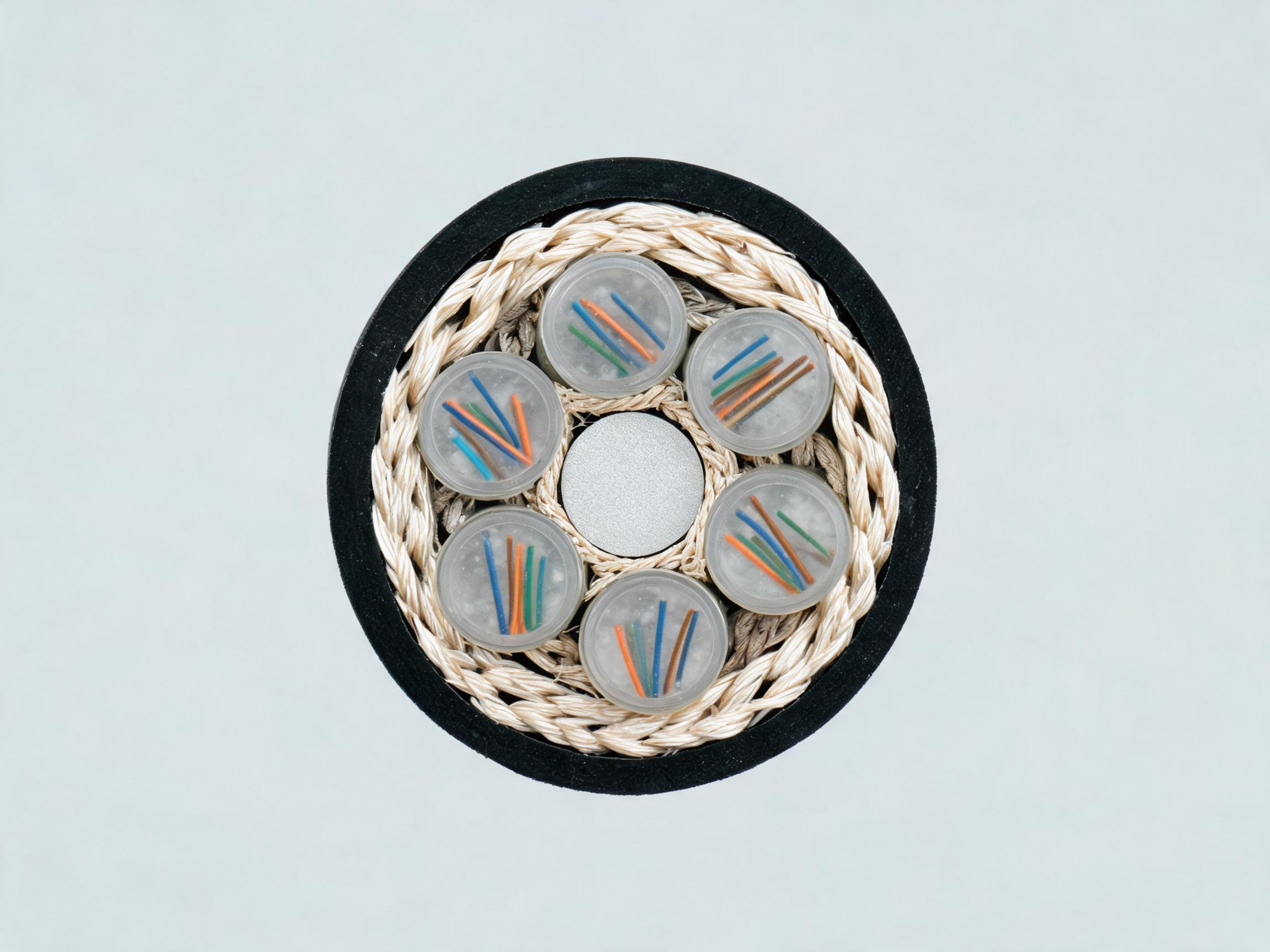
Strength member. Steel wire carries tensile load and suits high-pull routes; FRP (fiberglass reinforced plastic) keeps the cable all-dielectric, which matters near power lines or where you need to eliminate metallic path concerns. The datasheet may allow either; your route decides. Note that the mechanical tables later in the sheet are typically stated for one strength member option, with a reduced tensile rating for the other — on many loose-tube families, FRP builds carry roughly 20–25% lower short-term tensile ratings at the same core count. If you order FRP and copy the steel figures into your pulling plan, the sheet will pass your acceptance test and your installation will still be wrong.
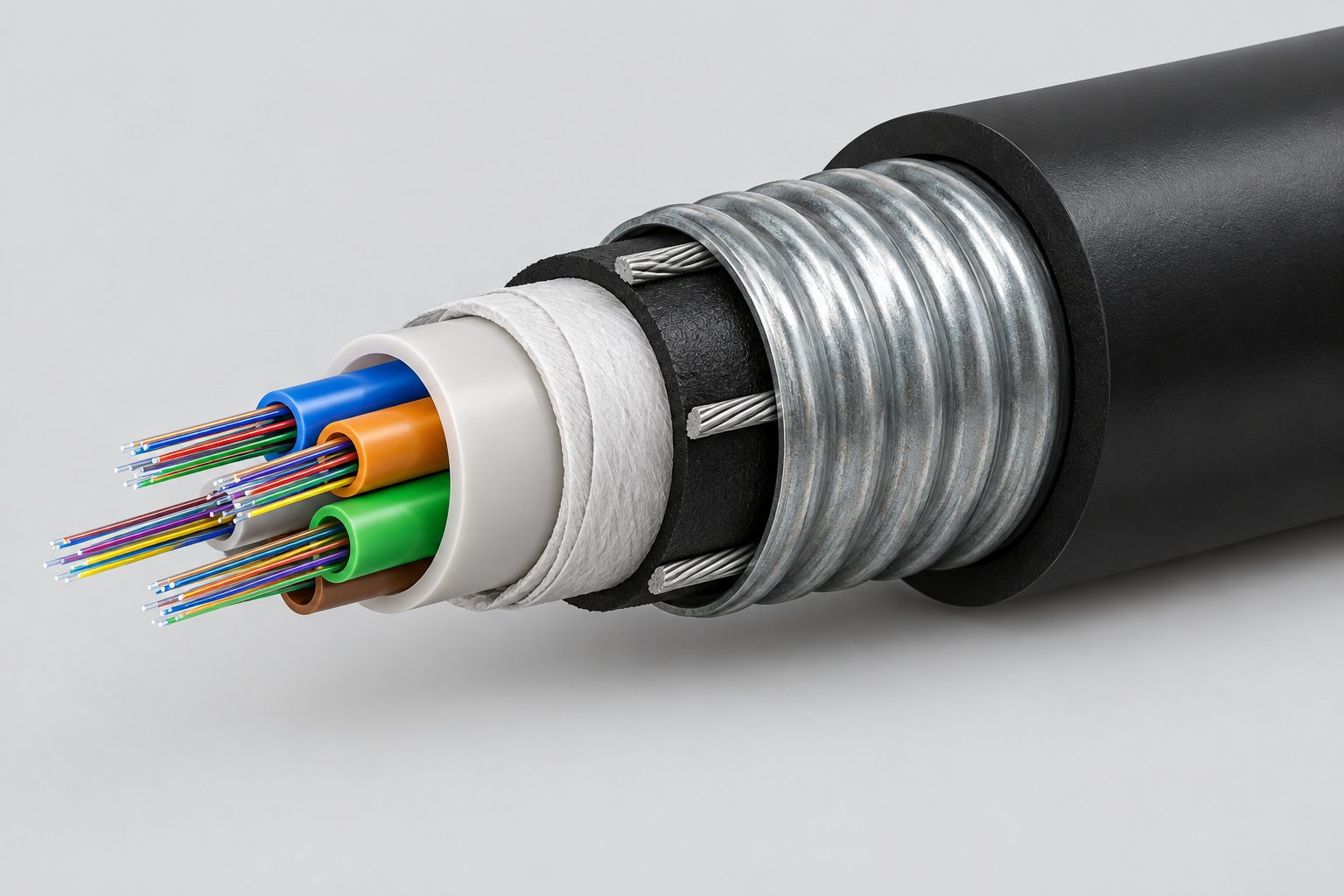
Armor and jacket. Steel tape or corrugated steel armor sits between the core and the jacket on direct burial and rodent-prone routes; the jacket itself is usually black PE outdoors or LSZH indoors. The datasheet's jacket row should name the material, not just the color — "PE" and "LSZH" behave very differently in fire and in cold. Where the application is aerial, a figure-8 self-supporting construction or ADSS has its own structure rows, and the same inside-out reading applies.
A structural row to read with care is water blocking. Sheets may state "gel-filled tubes", "water-blocking yarn", or a combination. These are not interchangeable: tube gel protects the tube interior, while core water-blocking elements protect the interstices. For direct burial, you want the sheet to show protection at both levels, and for the limits to be stated against a standard test rather than as an adjective.
Mechanical and Environmental Limits: Where Most Datasheet Disputes Start
If optical parameters decide whether the link works, mechanical and environmental limits decide whether the cable survives its own installation. This is also the block where disputes start, because these are the rows installers can violate without anyone noticing until months later. Read them as installation constraints, not as marketing figures.
Tensile load is stated in two figures: short term (typically the limit during pulling) and long term (the limit while the cable is installed and in service). For a loose-tube outdoor family, a representative datasheet shows short-term ratings from about 1,500 N for small core counts up to about 2,700 N for 216–288 core builds, with long-term values roughly 40% lower; armored constructions go higher, with steel-wire armor typically rated up to about 6,000 N short term. These are family-level planning figures — the values for your ordered configuration are restated on the specification sheet issued with the order. Your pulling plan must keep the winch load inside the short-term figure; our contractor's guide to cable pulling without exceeding tension and bend limits shows how that is done in practice with dynamometers and controlled pulls.
Minimum bend radius is stated as a multiple of cable outer diameter, and it is stated in two conditions. A common pattern is 20 × diameter while under pulling load and 10 × diameter once installed and fixed; armored constructions often read 20 × under load and 15 × installed. Work the arithmetic with your actual cable diameter: for a 12 mm armored cable, 20 × means about 240 mm of radius during the pull and 15 × means about 180 mm after installation. A manhole corner, a tray edge, or a duct bend that cannot hold that radius is the wrong place to route the cable — no parameter on the sheet can rescue a layout that ignores this row.
Crush resistance (often stated in N/100 mm, commonly in the 1,000–3,000 N range for standard outdoor builds and up to about 4,000 N for steel-wire armored builds) tells you how the cable tolerates backfill and surface loading. Impact resistance (often 3 N·m on outdoor sheets) covers point impacts during handling. Both are measured under specific IEC 60794-1 test methods, which is why the standards column next to these rows matters: a crush figure without a method reference is a sentence, not a specification.
Operating temperature is the row buyers most often fail to check against their own route. Outdoor loose-tube families are commonly rated from −40 °C to +70 °C, while indoor distribution constructions are frequently rated from −20 °C to +70 °C. If your route crosses a region with winters below −20 °C, an indoor-rated construction installed outdoors — a surprisingly common procurement slip — will not announce its failure at acceptance time; attenuation drift appears over the first cold season. Match the row to the coldest and hottest point of the route, including enclosed ceilings and rooftops, not to the average climate of the city.
| Mechanical / environmental row | Typical range on datasheets | Buyer's cross-check |
|---|---|---|
| Tensile, short term | 1,500–2,700 N (loose tube, by core count); up to ~6,000 N (steel wire armor) | Compare with pulling plan and winch capacity |
| Tensile, long term | ~40% below short term | Aerial sag and duct residency must stay below it |
| Min. bend radius | 20 × OD pulling; 10–15 × OD installed | Multiply by your cable's actual diameter |
| Crush resistance | 1,000–4,000 N/100 mm by construction | Burial depth and traffic above the route |
| Operating temperature | −40 to +70 °C outdoor; −20 to +70 °C indoor families | Coldest point of the route, not the average climate |
Typical planning figures for common constructions; confirm the exact limits for the ordered configuration against the datasheet supplied with the order.
Test References: What the IEC and ITU-T Numbers on the Sheet Actually Mean
A professional fiber optic cable datasheet rarely has bare numbers; each parameter row points to the standard and test method behind it. Understanding three families of references turns the standards column from decoration into a verification tool.
IEC 60793 covers the fiber itself and its measurement methods. Attenuation is typically measured per IEC 60793-1-40, geometry per -1-20 and -1-21, mode field diameter per -1-45, dispersion per -1-42, and cutoff wavelength per -1-44. When a datasheet cites these methods, you know the supplier's numbers are reproducible in a third-party lab — which matters if a claim ever needs independent verification. IEC 60794 covers the cable: mechanical tests such as tensile behavior, crush, and impact sit in the 60794-1-21 series, so a crush rating citing that method is directly comparable across suppliers. ITU-T recommendations define the fiber classes: G.652 for standard single mode (with D as the low-water-peak subtype) and G.657 for bend-insensitive fibers used in tight FTTH and indoor routes.
How should a buyer use the column? First, check that every load-bearing number has a reference. Second, check that the references are the current-generation method numbers, not vague citations like "per IEC" or "per international standards". Third, use the references to structure your acceptance testing: the attenuation figure measured per IEC 60793-1-40 by the factory is directly comparable with what your OTDR and insertion-loss measurements will show on site. Our article on what certifications to require from a fiber optic cable manufacturer before ordering extends this review to ISO 9001, CE/RoHS documentation and third-party test reports — the datasheet is the per-product layer of that same evidence stack.
Marking, Reel and Packaging Data: The Forgotten Rows of the Datasheet
The packaging block is the most-skipped section of the sheet and a recurring source of logistics friction. Read it for four items. Jacket marking: the sheet should state what is printed on the jacket — manufacturer, product code, fiber count and type, and sequential meter marks. Meter marks are how your crew verifies delivered length and how your acceptance team correlates OTDR events with positions on the route; a sheet that promises sequential marking is making a commitment your site team will rely on. Drum lengths: outdoor cable is commonly supplied in 2 km, 4 km, and 6 km standard drum lengths, and the sheet or order confirmation should state which length applies to your build, because splice count and drum count both follow from it. Reel and protection data: wooden drums, moisture-barrier wrapping, and steel strapping are the normal export standard, and dimensions and gross weight per reel are what your freight forwarder needs — a 4 km reel of a high-core-count outdoor cable is not a hand-loadable item. Packing plan: for containerized orders, the reel diameter determines how many drums fit per layer; asking for the packing plan before booking the container avoids the classic re-booking delay.
Our buyer's guide to how fiber optic cable is packed and shipped for export walks through the inspection points at delivery — reel condition, drum label versus order, and length verification — which are exactly the commitments the packaging rows of the datasheet encode. Read the two together and the delivery bay becomes part of your quality process rather than a handover point where documentation goes to die.
The Commercial Rows: MOQ, Lead Time and Warranty in Writing
Most datasheets end with a short commercial block, and professional buyers read it as carefully as the optical table, because it defines what happens when something goes wrong. Three rows matter most.
Minimum order quantity. MOQ is typically configuration-dependent: as planning references, standard outdoor core counts are often quoted from around 10 km per order, armored builds from around 2,000 m per configuration, and indoor distribution cable from around 1,000 m — with trial quantities negotiable for a first order. Treat these as typical ranges and confirm the figure for your configuration with the quotation; our overview of MOQ and lead time when ordering fiber optic cable and patch cords explains how manufacturers set these floors.
Lead time. Standard configurations typically dispatch in the range of 15–20 working days after order confirmation, with custom core counts or sheath options scheduled individually; armored and large-count builds can run 10–25 working days depending on construction. The datasheet may not carry this row at all — in which case the proforma invoice should, and the two documents together become your schedule reference.
Warranty. Read the warranty sentence as a specification, not as reassurance. Nexora's fiber optic cables carry a 12-month warranty from shipment date covering manufacturing defects, with claims handled against the reel label, delivery documents and fault description; confirmed defects are replaced or credited. Note what the warranty scope excludes — damage from installation beyond the rated bend radius or tensile load, field termination errors, or storage outside the stated temperature range — and you will see that the warranty rows quietly reference the mechanical rows you read earlier. The limits and the warranty are one system: stay inside the sheet's limits and the warranty stands behind you. Our article on what a 12-month warranty really covers for fiber optic buyers unpacks the claim mechanics.
Worked Example: Reading an Outdoor G.652D Datasheet Line by Line
Let's apply everything above to a realistic case: a buyer is reviewing the datasheet for a outdoor G.652D single mode fiber optic cable for a 40 km metro backbone, planning to order a 48-core build on 4 km drums, direct burial along most of the route with one duct section through an urban crossing.
Line 1 — identification. The sheet states a loose-tube, gel-filled construction on ITU-T G.652D fiber, 2–288 cores, black PE jacket, and a document number with a revision date. The buyer records: family sheet, so configuration-specific figures must be confirmed at order. Lines 2–3 — optical. Attenuation ≤0.36 dB/km at 1310 nm and ≤0.22 dB/km at 1550 nm per IEC 60793-1-40; mode field diameter 9.2 ± 0.4 µm; cable cutoff ≤1260 nm. The buyer multiplies: 40 km × 0.36 = 14.4 dB of fiber attenuation at 1310 nm, 40 × 0.22 = 8.8 dB at 1550 nm — before splices, connectors, and margin. With roughly 11 splice points on a 48-core cable (4 km drums over 40 km) at a typical 0.05–0.1 dB per fusion splice, plus connectors at both ends, the buyer can now judge whether the transceiver budget has room. The sheet did not make that judgment for them; it provided the numbers that make the judgment possible.
Lines 4–5 — mechanical, per configuration. The mechanical table gives, for the 24–48 core band, a short-term tensile rating of about 1,800 N and long-term about 700 N, cable diameter 10.5–12.0 mm, and weight 110–150 kg/km — typical figures for the steel-wire strength member build, with FRP noted as roughly 20–25% lower on tensile. The buyer's pulling plan for the duct section must stay under the short-term figure, and the bend radius rows (20 × OD pulling, 10 × OD installed) translate to roughly 210–240 mm during the pull for a ~11–12 mm cable — which the urban crossing's manhole layout can hold, but only just, and only in the larger of the two chambers. Line 6 — environment. Operating temperature −40 °C to +70 °C comfortably covers the route's climate. Line 7 — packaging. Standard drums of 2, 4, and 6 km: choosing 4 km drums gives 10 reels, and at ~110–150 kg/km each reel weighs roughly 440–600 kg — a forklift-and-pallet operation, planned with the forwarder in advance.
Line 8 — commercial. The buyer confirms MOQ and lead time for the 48-core build with the quotation, notes that every reel is attenuation- and continuity-tested before dispatch with the test report available on request, and files the warranty statement — 12 months from shipment date covering manufacturing defects — together with the datasheet revision as the technical annex to the purchase order. Total review time: under an hour. Without it, the same hour would have been spent later, on the phone, explaining to a contractor why the pulling plan needs to change.
Comparing Two Datasheets Without Getting Fooled
Procurement rarely evaluates one datasheet in isolation; the real skill is comparing two sheets side by side and refusing false equivalences. Three rules keep the comparison honest.
Rule 1: compare like test conditions. An attenuation figure measured per IEC 60793-1-40 and one stated "typical, factory measurement" are not the same class of claim. An overfilled-launch bandwidth figure and an optimized-launch figure are not comparable. When the conditions differ, ask the supplier to restate the value under the standard condition — most can, and the ones that cannot are telling you something.
Rule 2: compare the same configuration. A competitor's sheet quoting a 12-core diameter against another supplier's 48-core figure will always look thinner. Normalize by core count band, jacket material, and strength member before comparing diameters, weights, and tensile ratings.
Rule 3: compare presence, not only values. If one sheet states its temperature range, bend radius, crush method, and warranty, and the other states attenuation only, the second supplier has not quoted a better cable — it has quoted fewer commitments. In B2B purchasing, the breadth of the datasheet is itself a quality signal, because every row you can quote today is a dispute you do not have to argue tomorrow.
Red Flags: Signs a Fiber Optic Cable Datasheet Deserves a Second Look
- Numbers without methods. A crush rating with no IEC 60794-1 method citation cannot be verified or compared.
- Guaranteed and typical values mixed without labels. If the sheet does not distinguish them, assume the weaker reading — or ask.
- Missing temperature range. For any outdoor or unconditioned-space route, this omission is disqualifying.
- "Zero attenuation" or attenuation without wavelength. A figure without a wavelength is meaningless; a "zero loss" claim is a brochure, not a spec.
- No revision date or document number. The sheet cannot be enforced in a dispute if it cannot be identified.
- Internal contradictions. A jacket row that says LSZH while the application row says direct burial suggests copy-paste assembly.
- Bend radius stated as a fixed millimeter figure. Bend radius scales with cable diameter; a fixed figure hides which configuration it applies to.
- No warranty statement at all. Whatever the commercial documents say later, a sheet without a warranty row shifts every ambiguity to the buyer's side of the table.
None of these flags means the cable itself is bad. They mean the document is not yet at the standard where a professional buyer can approve it — and asking the supplier to correct the sheet is a reasonable, ordinary request that disciplined manufacturers expect.
Questions to Send the Supplier Before You Approve the Datasheet
- Which exact fiber class and count will be supplied against this datasheet, and will a configuration-specific sheet be attached to the order confirmation?
- Are the attenuation and mechanical figures guaranteed or typical, and what are the guaranteed values for the ordered configuration?
- Which IEC test methods were used for the mechanical ratings, and can the type-test or routine test reports be supplied with the shipment?
- Is the strength member steel wire or FRP for our build, and how does that change the tensile and bend rows?
- What drum lengths, reel dimensions, and gross weights apply, and can we get the packing plan for our container?
- Is jacket printing with sequential meter marks included, and what format do you use?
- What is the MOQ, lead time, and warranty statement for our configuration — confirmed in writing with the quotation?
- Which test report accompanies each reel at dispatch — attenuation, continuity, or both?
A supplier who answers these in writing has effectively co-authored your technical annex. A supplier who answers vaguely has told you, cheaply, where the risk in this transaction will live.
From Datasheet to RFQ: Turning the Sheet into an Order
The natural endpoint of datasheet review is a precise RFQ. Once you know which parameters govern your project, the request for quotation stops being "price for 20 km of fiber cable" and becomes a specification: fiber class, core count, construction, strength member, jacket, drum length, marking format, test report requirements, and the datasheet revision to be attached to the order. Our checklist on what information to include in a fiber optic cable RFQ follows exactly this logic, and if the core count itself is still an open question, the guide on choosing the right fiber count walks through the sizing arithmetic before you commit.
For the products behind the examples in this guide, Nexora publishes datasheets with the parameter rows, test references, and warranty statements discussed above — see the outdoor G.652D cable, the armored fiber optic cable, the indoor distribution fiber optic cable, and the indoor tight-buffered cable. Reading those sheets against this article is a one-hour exercise that will make the next supplier conversation measurably sharper.
A Buyer's Checklist for Approving a Fiber Optic Cable Datasheet
- Part number, fiber class (not just "single mode"), core count, and revision date recorded.
- Attenuation multiplied by route length and compared against the link budget — at the right wavelength.
- Geometric tolerances present; splice and termination procedures compatible with the coating diameter.
- Construction read inside-out: tube, filling, strength member, armor, jacket — each matched to the route.
- Tensile (short and long term), bend radius, crush, and temperature checked against the installation plan and the coldest point of the route.
- Every load-bearing figure has an IEC or ITU-T reference; guaranteed vs typical values labeled.
- Packaging rows confirmed: drum length, marking, reel weights, packing plan.
- MOQ, lead time, and warranty (including exclusions) confirmed in writing; datasheet filed as the technical annex.
Fiber Optic Cable Datasheet FAQ
What is the most important parameter on a fiber optic cable datasheet?
There is no single one, but for most transmission designs attenuation per kilometer at your operating wavelength is the figure that enters the link budget first, and minimum bend radius is the figure most often violated on site. A professional review checks both against your own route, not against the sheet's neighbors.
Are datasheet values guaranteed or typical?
Disciplined datasheets label each value. Optical attenuation on quality sheets is typically a guaranteed limit per the cited IEC method, while many mechanical figures are stated as typical for the construction with the ordered configuration's values restated on the specification sheet issued with the order. If the sheet does not say, ask — and get the answer in writing before the purchase order.
Should I trust a datasheet from a supplier I have not bought from before?
Treat the datasheet as a claim, and verify the claim structure: test methods cited, revision date present, configuration-specific data available, warranty stated. First orders can also include sample evaluation and third-party testing of received goods. The certifications article covers the document stack beyond the datasheet itself.
What should I do if the delivered cable does not match the datasheet?
Raise the claim against the reel label, the delivery documents, and the datasheet revision you filed with the order. At Nexora, claims on the 12-month warranty from shipment date are assessed against exactly those documents, which is why keeping them with the shipment is part of the datasheet review process, not an afterthought.
Do multimode datasheets need the same review?
The structure is identical, but the decisive rows shift: bandwidth (with its launch condition) replaces dispersion as the parameter that limits distance, and indoor temperature and fire-performance rows carry more weight. Our OM3 vs OM4 vs OM5 guide covers the grade selection; the review method stays the same.
Reading a fiber optic cable datasheet well is not about memorizing parameters — it is about knowing which questions your route, your installers, and your acceptance team will ask months from now, and checking that the sheet answers them in writing. Buy the document as carefully as you buy the cable, and the cable tends to take care of itself.