
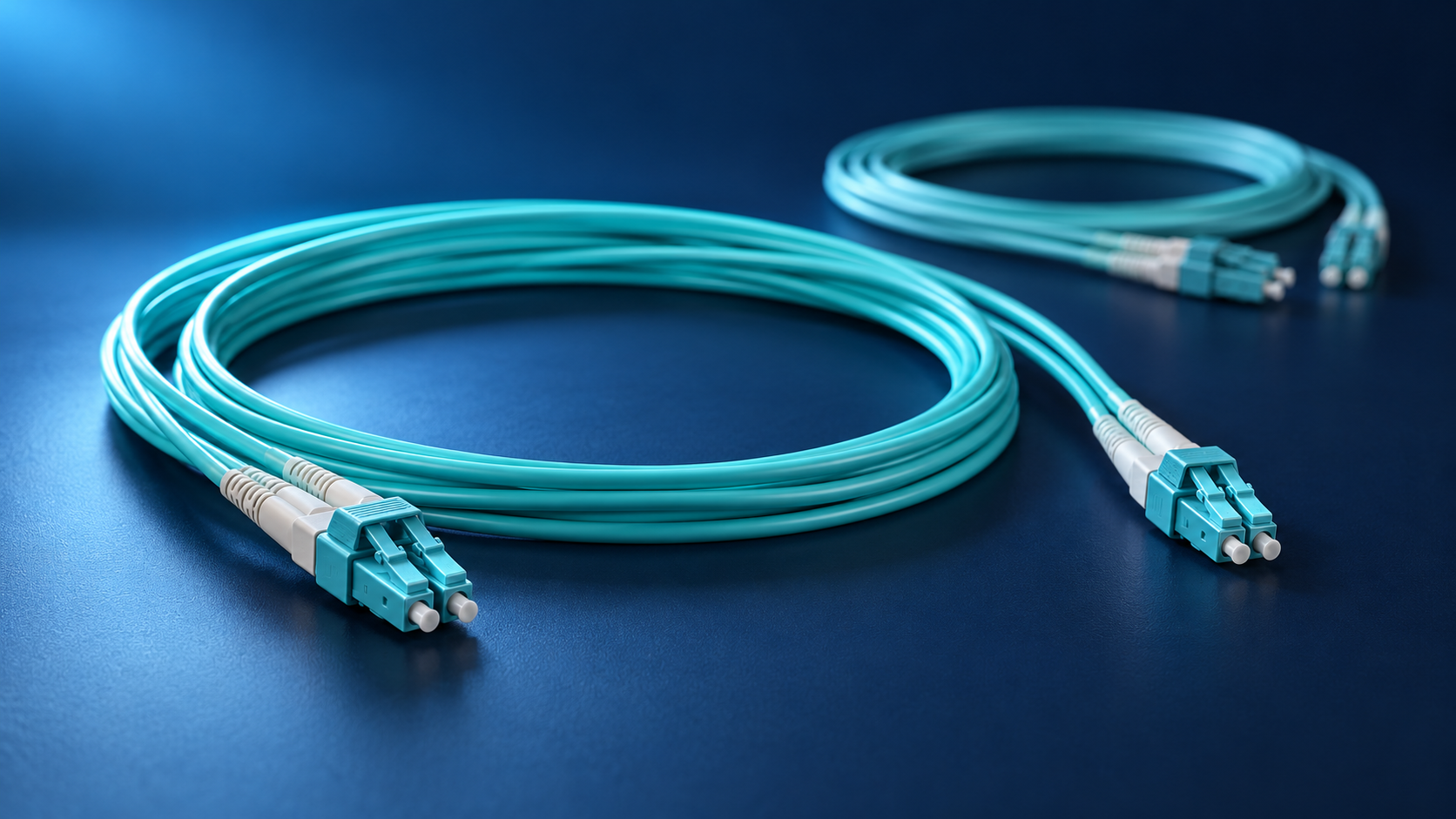
A buyer-focused comparison of OM3, OM4 and OM5 multimode fiber covering effective modal bandwidth, typical 10G and 40G/100G reach, channel grade discipline, patch cord and adapter choices, RFQ wording and warranty terms.
A purchase order for 400 multimode patch cords arrives with one line of description: "multimode patch cords, 50/125 µm, quantity 400." Nothing looks wrong. The quantity is clear, the delivery date is agreed, and the price is inside budget. The consequences only appear months later, when a link that was supposed to carry 10G over 400 metres tests out short, or when a plan to move to 40G forces a recabling project nobody costed.
The OM grade is where that decision lives, and in most companies the buyer makes it, not the network designer. Designers pick optics and distances. Buyers turn those choices into cable, cord and adapter specifications, and the grade written into the order sets the reach of every link in the channel, the upgrade path for the next planning cycle, and the unit price that comes back in the quotation.
This guide works through the OM3, OM4 and OM5 decision the way it appears in real procurement: what each grade actually specifies, where reach comes from, which parts of a channel can waste a good grade, how to write the RFQ so the delivery matches the design, and how to defend the specification when a client asks why the cheaper grade was not enough.
Why the OM Grade Decision Falls on the Buyer, Not the Link Designer
In a well run project, the grade is decided in one of four ways, and three of them are outside the buyer's control. The switch optics decide it, because a 10GBASE-SR port expects a laser optimized multimode fiber and a legacy FDDI grade cable will not deliver the reach. The installed base decides it, because extending an existing OM3 backbone with OM4 in one segment creates a mixed channel that behaves like its weakest part. The client's own standard decides it, since many operators publish an approved cable list and expect suppliers to match it. Only the fourth case, a new build with a free hand, is a genuine specification decision.
What the buyer is usually asked to confirm is narrower and more practical than "which grade is best." The real questions are whether the grade named in the bill of materials is sufficient for the distances on the drawing, whether the patch cords inside the channel carry the same grade as the cable, whether the quotation distinguishes OM3 from OM4 pricing clearly enough to compare suppliers, and whether the documentation will still make sense to the next engineer who reads it. Those four questions are answerable before the order is placed, and they are far cheaper to answer then.
One structural point is worth settling first, because it removes a lot of confusion later: single mode and multimode are two different cabling systems with different optics, and the OM grade question only exists inside the multimode branch. If the project has not yet decided between the two, the comparison in our article on how single mode and multimode compare is the right starting point. Everything below assumes the decision is multimode and the remaining question is which grade.
What OM3, OM4 and OM5 Actually Specify: Bandwidth, Not Speed
Vendors often describe the grades as speeds, which is imprecise and leads to bad orders. OM3 is not "the 10G fiber" and OM5 is not "the 100G fiber." The grades are defined mainly by bandwidth at specific wavelengths and by launch conditions that suit vertical cavity surface emitting lasers. Speed enters the picture only through the optics that run on top of that fiber and the distance the optics can tolerate for the bandwidth available.
All three grades are 50 µm core, 125 µm cladding multimode fibers of the laser optimized family. OM3 and OM4 differ in effective modal bandwidth at 850 nm, which is the wavelength almost every short reach Ethernet multimode link uses. OM4 roughly doubles the bandwidth of OM3 at that wavelength, and that extra bandwidth buys distance rather than a new protocol. OM5 keeps the OM4 bandwidth at 850 nm but adds a wideband specification across a wider span of short wavelengths, which is what makes short wavelength division multiplexing practical over useful distances.
The practical consequence for a buyer is that a supplier catalogue which lists "OM3 10G, OM4 40G" is giving you a marketing summary rather than a specification. A better comparison reads the bandwidth figure at 850 nm, the bandwidth figure at 1300 nm, and the expected reach for the specific optics you plan to deploy. When those three numbers are on the quotation or the datasheet, grades can be compared on substance. When they are not, price becomes the only visible difference, which is exactly how a project ends up buying the wrong grade to save a small amount per unit.
Two further points come up often in buyer enquiries. First, the bandwidth figure that matters is the effective modal bandwidth, not the overfilled launch bandwidth used for older grades, and the two numbers are not interchangeable. Second, multimode fiber is specified with a core and cladding tolerance, a numerical aperture and a coating geometry, and those mechanical details affect splice and connector performance as much as bandwidth does. A grade label says nothing about those tolerances, so the datasheet still has to be read.
A Bandwidth and Distance Table to Carry Into a Quotation
The table below collects the figures a buyer needs when checking a quotation or writing a specification. Every value is a typical industry figure offered for orientation, not a guarantee. Final values for a specific part number are those stated on the product datasheet and should be confirmed in writing before an order is released.
| Grade | Typical 850 nm effective modal bandwidth | Typical 1300 nm bandwidth | Typical 10GBASE-SR reach | Typical 40G/100G SR4 reach | Wideband note |
|---|---|---|---|---|---|
| OM3 | around 2,000 MHz·km | around 500 MHz·km | around 300 m | around 100 m | No wideband specification |
| OM4 | around 4,700 MHz·km | around 500 MHz·km | around 400 m | around 150 m | No wideband specification |
| OM5 | around 4,700 MHz·km plus wideband values at 880 nm and 953 nm | around 500 MHz·km | around 400 m | around 150 m | Wideband support for short wavelength division multiplexing |
Read the table as a screening tool, not as an approval. If a design calls for a 320 m run at 10G on OM3, the figure above suggests the link is outside the typical reach and the grade or the route has to change. If the same run is on OM4, it sits comfortably inside the typical reach with margin left for connector loss and splices. That is the kind of check a buyer can do in a minute against a bill of materials, and it catches the most expensive class of ordering error before the order exists.
For 25G, 40G and 100G links the reach figures shrink quickly because each lane carries more bandwidth over the same fiber. Typical published values for 40GBASE-SR4 and 100GBASE-SR4 sit near 100 m on OM3 and 150 m on OM4 and OM5, and 25GBASE-SR values are shorter still. Treat those as orientation figures and confirm them against the datasheet of the exact cable and cord you are buying, together with the optics vendor's link budget, because the reach printed on a transceiver datasheet assumes a clean channel with a defined number of mated connections.
Where the Grades Really Diverge: Effective Modal Bandwidth and the Worst-Case Channel
Mode delay is the mechanism behind every bandwidth number. A multimode fiber carries many paths of light, and light travelling along different paths arrives at slightly different times. If that spread grows too large relative to the bit period, pulses overlap at the receiver and the link closes. Laser optimized grades control the launch so that only a small set of modes is excited, and the fiber profile is tuned so those modes travel at nearly the same speed. Effective modal bandwidth is the measured result of that control at a given wavelength.
This explains two facts that surprise buyers. A 50 µm fiber can have high bandwidth at 850 nm and modest bandwidth at 1300 nm, because the profile is optimized for the shorter wavelength where inexpensive VCSEL optics operate. And the bandwidth figure is only meaningful together with the launch condition it was measured under, which is why a grade claim without a measurement basis is not a specification.
The worst-case channel is where grade decisions are won or lost. A channel is not the cable alone. It is the outlet cord, the patch panel cord, the horizontal or backbone run, possibly a splice or a conversion point, and the equipment cord. If the backbone is OM4 and one of the cords in the path is a general purpose OM2 cord that happened to be in the store room, the channel bandwidth drops toward the weakest element and the reach you paid for quietly disappears. Buyers who write "all cords in the channel to match cable grade" into the order prevent this. Buyers who specify only the cable do not.
Connector count has the same effect through loss rather than bandwidth, and it interacts with grade. Each mated pair adds insertion loss and each adapter adds a little more, so a link with four mated connections has less headroom than the same length of cable with none. On multimode links the losses are usually small against the reach margin, which is exactly why they get ignored until an upgrade pushes the link close to its limit. Our guide to how to calculate a fiber optic link loss budget sets out the arithmetic, and it is worth running before the grade decision is frozen rather than after.
OM5 and Short Wavelength Division Multiplexing in Practical Terms
Short wavelength division multiplexing sends several wavelengths between roughly 850 nm and 953 nm down one multimode fiber, which multiplies capacity without multiplying fiber count. That approach only works if the fiber performs at all of those wavelengths, and standard OM4 is specified at 850 nm and 1300 nm rather than across the wideband span. OM5 was written to fill that gap, and its wideband specification is the single feature that distinguishes it from OM4 in a purchase decision.
The commercial case for OM5 depends on whether sweeps of SWDM optics are actually planned. If a data centre expects to extend the life of duplex multimode cabling with SWDM transceivers, OM5 removes a wavelength risk that OM4 leaves open, and the premium is easy to justify. If the plan is parallel optics over MPO trunks, or a move to single mode for the next generation, then OM5 delivers nothing that OM4 does not already deliver at 850 nm, and the premium buys an option that may never be exercised.
There is a second, subtler reason buyers choose OM5: consistency in a tender. Some operators standardise on a single multimode grade across all sites so that any transceiver from the approved list can be deployed in any link. That is a legitimate reason to buy OM5 even where SWDM is not yet in use, and it is a reason to put in writing so that a later value engineering exercise does not silently swap the grade back.
Two cautions belong here. OM5 is backwards compatible in the sense that OM5 patch cords work in OM4 channels, but a mixed channel is still limited by its weakest element, so replacing a few cords does not upgrade a link. And any claim about guaranteed SWDM distance depends on the optics vendor's link model, not on the fiber alone, so it should be confirmed per deployment rather than inferred from a grade name.
Jacket Colour, Aqua and Lime Green, and What Colour Does Not Tell You
The conventional jacket colours are aqua for OM3 and OM4 and lime green for OM5. The convention exists so that technicians can sort a pile of cords quickly, and it is genuinely useful on site. It is not a specification. Two very different grades share aqua, which means colour can never distinguish OM3 from OM4, and colour tells you nothing at all about bandwidth, attenuation or core geometry.
Where colour is genuinely valuable is in preventing mix-ups during installation and in maintenance. A lime green cord in a rack of aqua cords is a visible flag that the channel contains OM5, and that flag helps the next person avoid pairing it with the wrong spare. Where colour becomes a risk is when it is used as the acceptance criterion. A delivered drum with aqua jacket proves only that someone chose aqua, and custom jacket colours are a normal outcome of OEM and ODM orders, including colours chosen to match a client's own cabling scheme.
The evidence that matters is the jacket printing and the test record. Jacket print normally carries the fiber type, the grade claim, the core and cladding size, the jacket material and fire rating, and a manufacturer identifier, and the test record ties those claims to measured values. When a delivery arrives with a jacket colour that does not match the order, the correct response is to check the print and the datasheet rather than to reject on sight, and to raise it with the supplier in writing so the discrepancy is documented either way.
Attenuation, Connector Loss and the Part of the Budget You Control
Attenuation and connector loss are the half of a link budget that a buyer can influence directly through specification and through installation discipline. Typical multimode attenuation sits near 3.0 dB per kilometre at 850 nm and near 1.0 dB per kilometre at 1300 nm, which means distance matters more than most buyers expect on long indoor runs. Confirm the values for the actual part number against the datasheet, because jacket construction, fiber grade and temperature range all shift them slightly.
Connector loss is smaller per event but multiplies quickly. A mated pair with clean, correctly polished end faces typically loses a few tenths of a decibel, and adapters add a small amount on top. Four mated connections in one channel therefore consume a meaningful part of a tight budget, and that is before any contamination or a damaged end face is involved. The practical rule is to design with margin: a link that passes the arithmetic with nothing to spare will fail in the field as soon as one connector is dirty.
Temperature and installation also matter, and they are the usual explanation for a link that passed on a cold morning and failed on a hot afternoon. Tight bends increase loss on multimode fiber, cable ties pulled hard enough to deform the jacket change the local geometry, and a cord bent behind a panel can behave very differently from the same cord laid in free air. None of this is grade dependent, which is why a generous grade choice combined with poor handling can produce a worse outcome than a modest grade installed well.
Patch Cords, Adapters and Polish Choices That Keep a Multimode Link Inside Budget
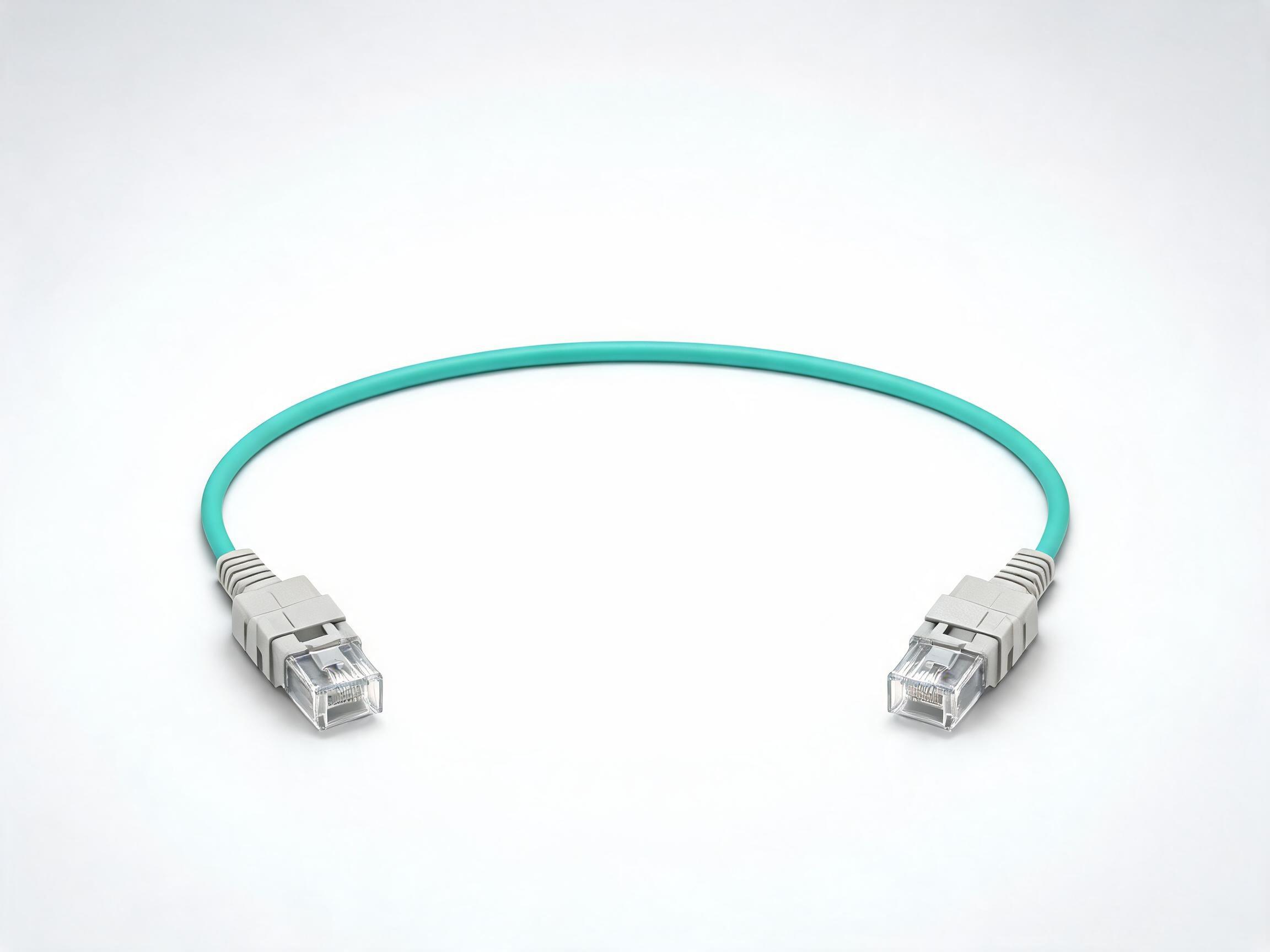
Inside a channel, the patch cords are where grade discipline usually breaks. They are the cheapest line in the bill of materials, they are often bought from a different supplier than the cable, and they are frequently specified by length and connector only. A buyer who fixes the cable grade and leaves the cords open has fixed half the problem.
Grade on the cord line should be explicit for the same reason it is explicit on the cable line. If the design assumes OM4 reach, every cord in the channel should be OM4, and the order should say so rather than relying on the supplier to infer it. Our SC-SC multimode OM3 patch cords and LC-LC duplex OM4 patch cords illustrate the two ends of that range: same aqua jacket convention, different bandwidth specification, and a quotation that should never be allowed to blur them.
Polish and end face choice also deserve attention on multimode. UPC is the usual choice because multimode links rarely need the higher return loss of an angled end face, and mixing UPC and APC on the same adapter creates a physical contact problem rather than a small loss penalty. Duplex orientation matters on LC patch cords, where A to B polarity has to be consistent through the channel, and a cord built with the wrong orientation will not be fixed by swapping ports later.
Adapters are the other component that quietly sets quality. A loose adapter allows ferrule movement, and ferrule movement produces variable loss and scratched end faces. Flange, mounting and colour convention all matter for installation, and the adapter should match the connector style and polish used on the cords. Nexora stocks LC/UPC duplex adapters and LC/APC duplex adapters alongside SC and FC variants, so a panel can be built to match the connector mix actually used on site instead of being adapted from whatever is available.
For buyers who need a short checklist to send with an enquiry, these five items cover most of the risk in the cord and adapter portion of a multimode order:
- Grade stated on every cord line, matching the cable grade in the same channel.
- Connector style, polish and duplex configuration stated per line, with polarity convention noted.
- Insertion loss and return loss limits requested per assembly, taken from the datasheet rather than a catalogue summary.
- Adapter style, flange type and colour convention specified to match the cords, with end face inspection requested.
- Test record, labelling and packaging agreed, so acceptance does not depend on a visual check of jacket colour.
Our notes on reading patch cord specs for insertion loss and return loss explain how to read the numbers suppliers quote, including the difference between a typical value and a maximum.
How an Upgrade Plan Should Drive the Grade Decision
Cable is the part of a network that is hardest to replace, so the grade decision is really an asset life decision. Patch cords and optics are swapped in minutes. Cable in a riser, in a ceiling void or buried between buildings is a construction project. That asymmetry justifies buying reach you do not need yet, provided the extra reach is real and the route can actually use it.
The usual upgrade path runs from 10G per link to 25G, then to 40G or 100G using parallel optics. On multimode, each of those steps reduces the usable distance on a given grade, and it reduces it quickly. A 300 m OM3 backbone that carries 10G comfortably may be limited to roughly 100 m for 40G or 100G, which is why so many OM3 backbones are extended with single mode rather than re-terminated in OM4 when the capacity step arrives. An OM4 backbone starts with more margin and stays usable longer at the higher rates.
Two documents make the decision durable. The first is the channel schedule, which lists every link with its length, grade, connector count and target rate, so the grade choice is visible link by link instead of hidden in a total quantity. The second is a short design note stating why a grade was chosen and what would have to change for a different grade to be acceptable. When the next procurement cycle opens, or when a client asks for a cheaper alternative, that note settles the question without re-running the whole analysis.
Where a project expects parallel optics at 40G or 100G over any distance worth measuring, the trunking decision moves up a level, because MPO based trunks and cassettes have their own polarity and loss rules. Our article on choosing MPO/MTP patch cords for high density cabling covers those constraints, and it belongs with the grade decision rather than after it.
When OM3 Is Still the Right Answer
OM3 remains a defensible purchase in several common situations, and saying so is not a sales compromise. It is the correct answer when the channel lengths are comfortably inside its typical reach, when the installed optics are already 10G and there is no funded plan to move beyond that, and when the cable serves a plant or campus area where a future upgrade would run on single mode anyway.
It also fits where the link is short by design. In-building runs under about 100 m, patch-heavy links inside a rack row, and distribution from a floor panel to work areas rarely need more than OM3 bandwidth. Paying an OM4 premium across thousands of short cords to solve a distance problem that does not exist is bad procurement, and a buyer who understands the reach figures can defend OM3 confidently when challenged.
The condition attached to OM3 is honesty about the upgrade path. If there is any realistic chance that the same cable will need to carry 40G or 100G over more than roughly 100 m, OM3 is the wrong buy, and the cost of discovering that after installation is far higher than the price difference between the grades. Documenting the assumption, rather than leaving it implicit, keeps that decision visible.
When OM4 Earns Its Premium
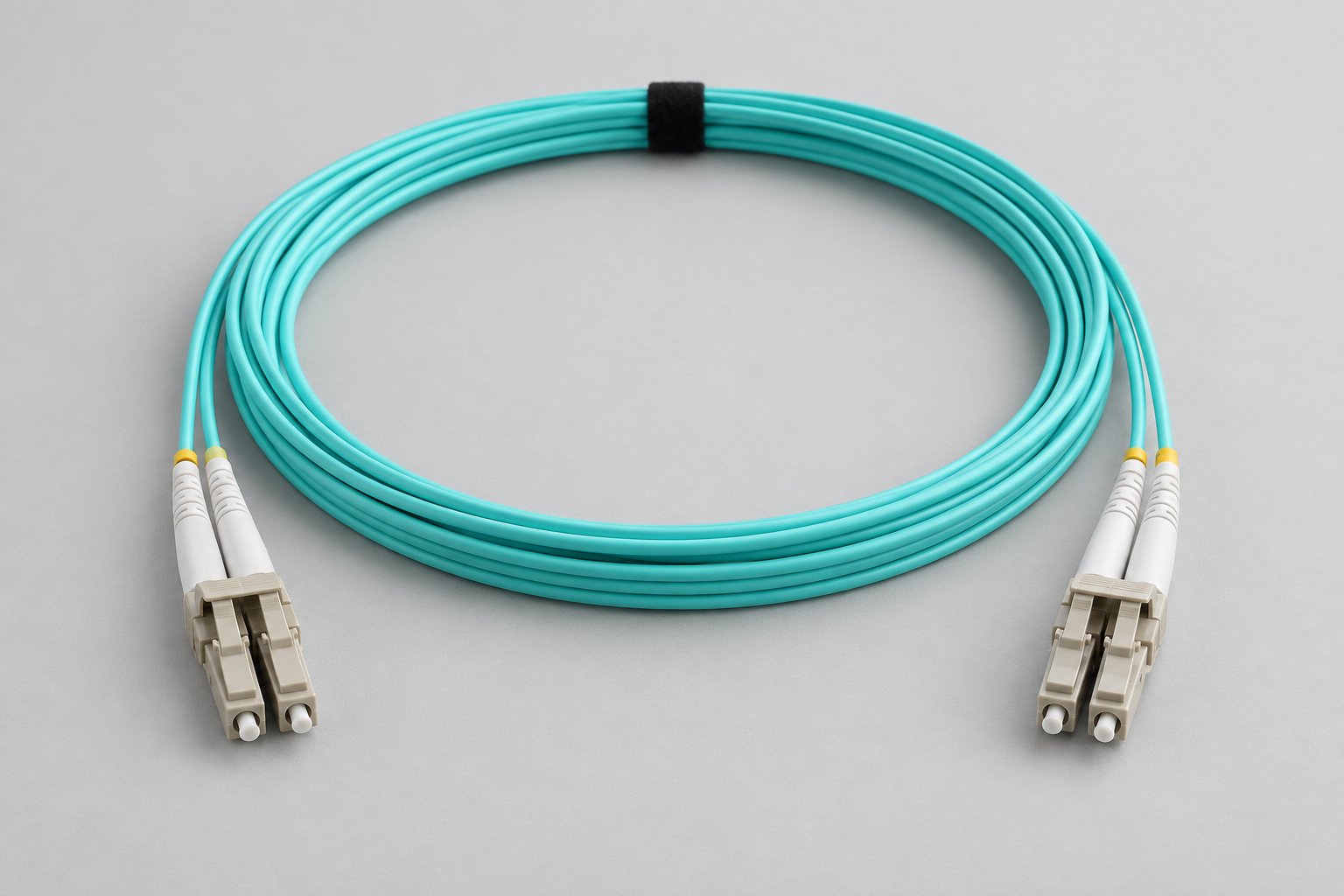
OM4 is the default choice for most new multimode builds, and the reason is margin rather than headline performance. Doubling the effective modal bandwidth at 850 nm moves the 10G reach from around 300 m to around 400 m and the 40G or 100G reach from around 100 m to around 150 m, and that extra distance absorbs the losses and routing detours that appear between the drawing and the finished installation.
It also buys time. A data hall built on OM4 trunks can usually support one generation of optics beyond the one it was designed for without touching the cable, which is exactly the property that keeps a cabling project out of the next capital cycle. For a buyer comparing quotations where OM4 costs a little more per unit, the comparison should be against the cost of one recabling project, not against the line item.
OM4 is also the grade most likely to be named in a client standard, which makes it the safest specification when the buyer has limited visibility into future plans. If a tender document names OM4, matching it avoids a value engineering discussion at delivery, and if the installed base is OM4, extending with OM4 keeps channels homogeneous and keeps test results comparable across sites.
When OM5 Is Justified and When It Is Premature
OM5 is justified where SWDM optics are part of the plan, where a single grade must serve every multimode link in a standardised estate, or where the operator intends to sweat duplex multimode cabling through a capacity increase instead of moving to parallel optics or single mode. In those cases the wideband specification is doing real work and the premium is proportionate.
It is premature where the design is already committed to MPO trunks, where the next capacity step will run on single mode, or where the client's own standard names OM4 and would treat OM5 as a deviation requiring approval. Buying OM5 into a project that cannot exploit it creates a spare parts mismatch, because the estate then holds two multimode grades that look different in colour but must be treated carefully during maintenance.
The decision is easier if the buyer separates two questions that are often merged. The first is technical: does this link need bandwidth beyond 850 nm at any point in its planned life. The second is commercial: does the operator want a single standard grade across all sites. A project needs a positive answer to at least one of them before OM5 makes sense, and having both is the strongest case of all.
Cost and Supply Questions That Matter in a B2B Order
Grade is only one input in a landed cost comparison, and often not the largest. The parts that move total cost more than the grade difference include the cord grade inside the channel, the connector count across the whole project, the reel or drum lengths offered and how much offcut they create, the fire performance and jacket material the site requires, and the volume of test documentation the buyer intends to request.
Connector count is worth singling out because it is easy to reduce at the design stage and expensive to fix later. Every additional mated pair adds components, adds installation labour and adds a failure point. Moving a consolidation point or choosing a longer cord can remove two connections from hundreds of links, and the saving usually dwarfs the premium between one grade and the next.
Reel and drum lengths belong in the same conversation. A route of 180 m that is supplied on 200 m drums leaves offcuts on every span, while a supplier able to provide lengths closer to the route reduces waste and joint count. Ask what lengths are available before comparing prices, because a lower unit price on an inconvenient drum length is frequently the more expensive option once waste and splicing are counted.
Documentation is the last cost line that buyers underestimate. Test records, labelling conventions and packing marks all consume supplier time, and a request for per-assembly test data on thousands of cords will be priced into the quotation whether it is itemised or not. Deciding which records are genuinely required, and which can be replaced by batch level data, keeps the quotation comparable between suppliers. Do not expect a price, minimum order quantity or lead time figure from an article; those are quoted per project against the actual specification.
Ordering Mistakes That Show Up on Site
Most multimode ordering problems are visible in the paperwork long before they reach site. The six below account for a large share of the disputes that reach a supplier's desk after delivery.
Grade Left Unspecified on the Patch Cord Line
The cable is specified precisely and the cords are not, so the supplier fills the cord line with the grade that is cheapest or most available. The channel then performs to the cord's grade rather than the cable's, and the shortfall appears as an unexplained reach problem rather than as a wrong delivery.
Cable and Cord Grade Mixed Within One Channel
A channel assembled from OM4 cable and OM3 cords is an OM3 channel in practice. This happens when cords are pulled from existing stock to save a purchase order, and it is invisible on the invoice. Writing "all cords in channel to matching grade" into the order and the acceptance checklist prevents it.
Polarity and Duplex Orientation Wrong on LC Patch Cords
Duplex LC cords must maintain a consistent A to B orientation through the channel. A cord built the other way cannot be corrected by swapping ports without breaking the pattern elsewhere in the link, so a small specification omission becomes a rework item on every affected run.
Colour Used as the Only Acceptance Check
Aqua covers both OM3 and OM4, so a visual check cannot confirm grade. Deliveries are accepted on colour, and the grade error is discovered during commissioning when a link fails its reach test. Acceptance should check jacket print, labelling and test records instead.
No Test Documentation Requested
Without a test record, a buyer has no evidence of insertion loss or return loss per assembly, and any later dispute becomes a matter of opinion. Batch level data plus sampling is often sufficient, but it has to be requested in the purchase order, not after delivery.
Connector Count Underestimated in the Loss Budget
Designs frequently count the cable and forget the consolidation point, the panel and the equipment cord. The arithmetic then shows comfortable margin that does not exist, and the link fails at the margin rather than at the grade.
What to Put in the RFQ for Multimode Cable and Patch Cords
A short, complete RFQ produces comparable quotations. The list below can be pasted into a document and filled in per line item, and it works for both cable and cord sections of a multimode order.
- Grade and fiber type per line, for example OM4, 50/125 µm, laser optimized.
- Connector style, polish and duplex or simplex configuration, with polarity convention for duplex cords.
- Length per assembly, with tolerance and measurement method for custom lengths.
- Jacket material and fire performance required by the site, plus any colour requirement.
- Insertion loss and return loss limits per assembly, referenced to the datasheet.
- Labelling format and packaging, including reel or drum length preferences and packing marks.
- Test records required, and whether batch level data or per-assembly data is expected.
- Quantity per line, required delivery date and destination, so freight can be quoted consistently.
Our article on what to include in a fiber optic cable RFQ expands each of these into the wording that avoids ambiguity, and it is worth reading alongside the grade decision because a well specified RFQ is what turns a grade choice into a delivered product.
Specification and Warranty Terms to Confirm Before You Sign
The last step before release is to confirm the terms that sit behind the grade claim. Nexora fiber optic products carry a warranty of 12 months from shipment date, and that period should be checked against the project schedule rather than assumed. A cable delivered early and installed late spends part of its warranty window in storage, so a project with a long fit-out should raise the delivery timing with the supplier before shipment instead of after.
Ask what the warranty covers and what it excludes. Handling, storage conditions, installation practice and environmental exposure are the usual boundaries, and knowing them in advance prevents a claim that fails on a technicality. For a plain explanation of scope and limits, see our article on what the product warranty covers.
Ask also which document governs performance. Performance values published in a blog article, a catalogue summary or an email are typical industry figures offered for orientation, and the binding figures are the ones on the datasheet for the exact part number. Getting that confirmed in writing, together with the test criteria that will be used at acceptance, removes almost every dispute that can arise about a grade claim later.
Finally, agree the acceptance method while the order is still open. If the buyer intends to test a sample of assemblies, say so, and agree the pass criteria and the instrument reference. Cleaning and end face inspection before testing make a material difference to results, as our guide to cleaning and inspecting connectors before acceptance explains, and building that step into the acceptance plan avoids rejecting good product for a removable speck of dust.
Frequently Asked Questions About OM3, OM4 and OM5
Can OM4 patch cords be mixed with OM3 cable in one channel?
They will work electrically, but the channel performs to the OM3 cable because the weakest element limits bandwidth. Mixing is safe as a temporary measure and a poor long term choice, since it hides the real grade of the link from the next person who maintains it.
Is OM5 a drop in upgrade for an OM3 or OM4 installation?
OM5 cords connect to the same optics and connectors, so nothing physically prevents their use. The benefit only appears where the transceivers use wavelengths beyond 850 nm. In an OM4 channel with 850 nm optics, OM5 behaves like OM4.
Does an aqua jacket prove the fiber grade?
No. Aqua is used for both OM3 and OM4, and custom colours are normal on OEM and ODM orders. Jacket printing and the datasheet for the part number are the evidence, and the test record is what ties them to measured results.
How do I handle a tender that specifies a grade the installed cable does not meet?
Document the existing grade, note the reach implication in writing, and offer the compliant option for the new segments. Extending with the higher grade does not raise the existing links, so the tender wording may need a clarification rather than a substitution.
Which connector polish should I choose for multimode, UPC or APC?
UPC is the usual choice for multimode links, because the return loss benefit of an angled end face is rarely needed at these distances. Whichever polish is chosen, it must be consistent through the channel, since UPC and APC end faces cannot be mated to each other.
How far ahead of the pull should I order custom length patch cords?
Custom lengths should be ordered once the channel lengths are measured, not estimated from the drawing, and before the equipment cord schedule is finalised. Production and transport time should be agreed with the supplier against the installation date rather than assumed.
If you are working through a multimode specification now, send the channel list with grade, connector style, duplex configuration and quantities for cable, patch cords, pigtails and adapters, and we will quote against the exact requirement rather than a generic catalogue line.