
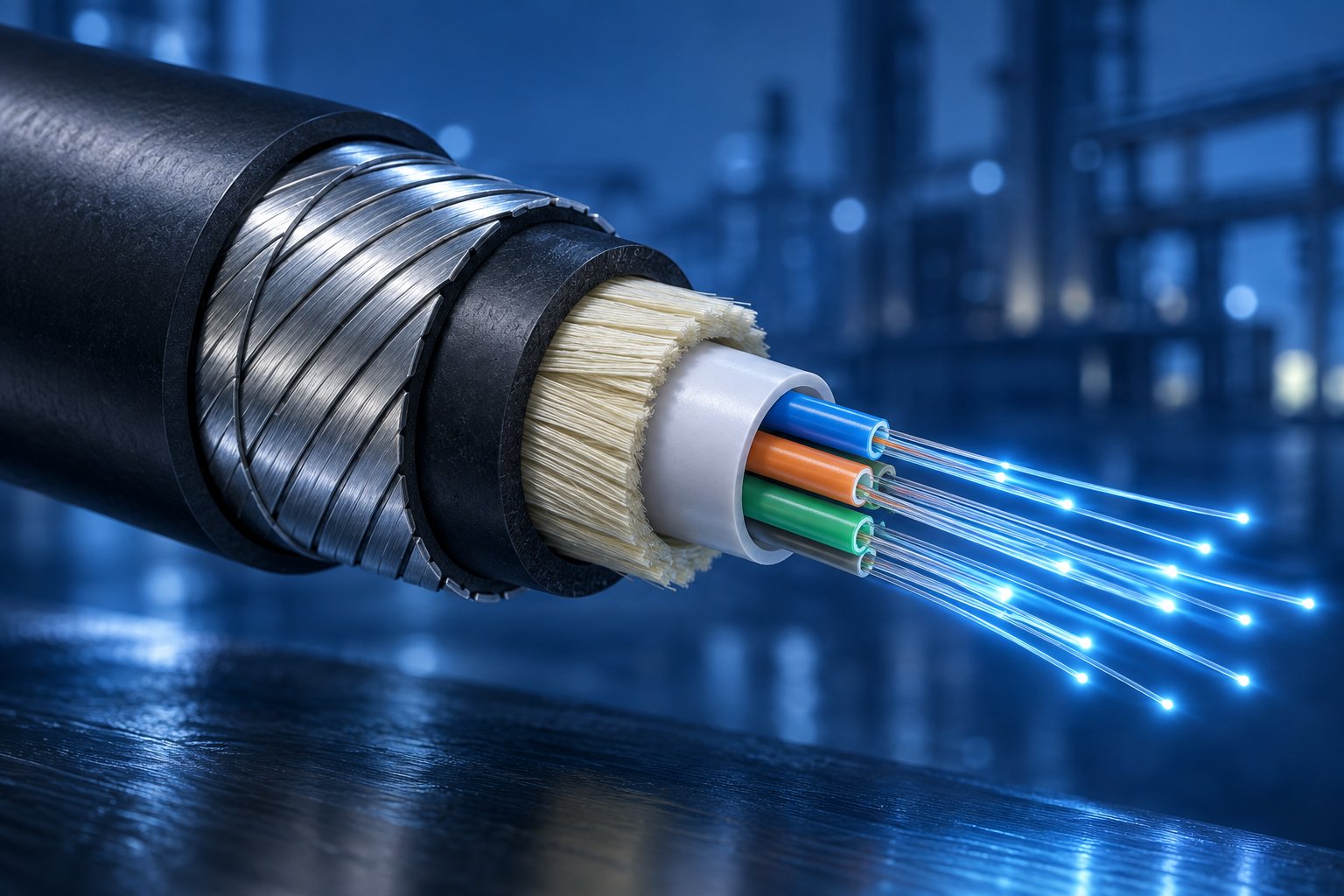
A practical B2B buyer's guide to armored fiber optic cable: when armor is the right choice, when standard cable is enough, how to specify construction correctly, and what to verify before ordering.
Armored fiber optic cable is one of the most common topics buyers raise when they plan outdoor, industrial, or direct-buried network projects. The question sounds simple — do I need armor or not? — but the answer affects your material cost, installation method, long-term maintenance budget, and even the warranty conversations you will have with your own customers. As a manufacturer that produces both armored and non-armored fiber optic cable, patch cords, and adapters for global B2B buyers, we get this question every week from distributors, telecom contractors, and FTTH project owners. This guide explains, in practical procurement terms, when armored fiber optic cable is the right choice, when standard loose tube or indoor cable is enough, and how to specify armor correctly so you do not overpay or under-protect your network.
Throughout this article we use typical industry values for reference only. Exact attenuation, tensile strength, crush resistance, temperature range, and bend radius always depend on the specific cable construction and should be confirmed against the datasheet of the product you actually order. Where we mention warranty terms, our standard is 12 months from shipment date, and we recommend you confirm warranty conditions with any supplier before placing an order.
What Is Armored Fiber Optic Cable?
Armored fiber optic cable is a fiber cable that includes a protective metallic or non-metallic armor layer between the inner cable core and the outer sheath. The armor layer is usually corrugated steel tape, aluminum tape, or aramid-based non-metallic armor. Its job is specific: to resist crushing, rodent attack, accidental impact, and tensile stress during installation — threats that a standard plastic-sheathed cable is not designed to withstand on its own.
A typical armored outdoor cable is built in layers. From the inside out, you generally find the optical fibers in a loose tube or tight-buffered structure, water-blocking material, a strength member, the armor layer, and a final polyethylene (PE) outer jacket. Indoor armored cables, often called armored patch cords or indoor security cables, use a smaller stainless steel or spiral steel tube around the tight-buffered fiber so the cable can be routed through buildings, trays, and equipment rooms where physical damage is more likely.
The key point for buyers is this: armor is not about optical performance. The fiber inside an armored cable and a standard cable can be identical — same G.652.D or G.657A2 fiber, same attenuation class. Armor changes the mechanical and environmental protection envelope. That is why the decision is driven by the installation environment, not by bandwidth or transmission distance requirements.
Armored vs Non-Armored Fiber Optic Cable: The Core Differences
Buyers often compare the two types side by side before deciding. The table below summarizes the practical differences that matter in procurement decisions. Values shown are typical industry reference values; always confirm the exact figures on the datasheet of the cable you are buying.
| Aspect | Armored Fiber Optic Cable | Non-Armored Fiber Optic Cable |
|---|---|---|
| Crush resistance | Typically 1000–3000 N/100mm depending on construction | Typically 300–1000 N/100mm |
| Tensile strength | Typically 1000–4000 N short-term for outdoor armored types | Typically 300–1000 N short-term |
| Rodent protection | Effective against rats and squirrels with steel tape or steel wire armor | Not protected; relies on conduit or duct |
| Direct burial | Suitable without conduit in most soil conditions | Generally requires HDPE conduit or duct |
| Bend radius | Larger, typically 15–20× cable diameter dynamic | Smaller, easier to route in tight spaces |
| Weight and diameter | Heavier and thicker | Lighter and thinner |
| Unit cost | Higher, typically 20–50% above equivalent non-armored type | Lower |
| Grounding consideration | Metallic armor may require grounding at termination points | Not applicable |
Two of these rows deserve extra attention. First, bend radius: armored cables are stiffer, so if your route includes many tight corners, small trays, or dense equipment racks, the extra stiffness can slow installation and increase labor cost even though the cable itself is more protected. Second, grounding: steel-tape armored cables installed outdoors should be grounded at splice closures and building entrances according to local electrical codes. Non-metallic (all-dielectric) armored cable avoids this requirement and is the standard choice near high-voltage equipment or where grounding is impractical.
When You Should Choose Armored Fiber Optic Cable
1. Direct Burial Without Conduit
If your route crosses open ground and you plan to bury the cable directly, armored cable is usually the correct default. Steel-tape armored loose tube cables are designed to withstand soil pressure, small rocks, and occasional digging activity near the cable path. A common specification for direct-buried projects is a corrugated steel tape (CST) armored, double-jacket cable with GYTA53-style construction, which adds an inner and outer PE sheath around the armor for moisture protection.
That said, direct burial is not automatically the cheapest option. In some markets, pulling non-armored cable through HDPE conduit costs less overall because the conduit protects the cable and makes future replacement easier without re-trenching. The decision depends on your soil conditions, trenching cost, expected route lifetime, and whether future upgrades are likely. If you expect to pull additional cables through the same trench later, conduit plus non-armored cable is often the smarter long-term layout.
2. Rodent-Prone Environments
Rodent damage is one of the leading causes of outdoor fiber cable failure in rural, agricultural, and suburban networks. Rats and squirrels chew through standard PE jackets easily, and the resulting fiber breaks are expensive to locate and repair. Steel tape or steel wire armor effectively stops rodent attack. If your route passes through farmland, orchards, forest edges, or areas with known rodent activity, armor is not optional — it is the difference between a network that runs for years and one that generates repeated emergency repair calls.
For aerial routes in rodent-prone regions, buyers often choose figure-8 self-supporting cables with integrated steel strength members, which provide both tensile support and a degree of rodent resistance. For underground routes, GYTA53 or GYTY53 double-armored constructions are the common answers.
3. Industrial Plants and Factory Floors
Inside factories, warehouses, and processing plants, cables face forklift traffic, moving machinery, vibration, oil mist, and occasional impact from maintenance work. Standard indoor cable in a tray at floor level will not survive long in these conditions. Armored indoor cable, or armored outdoor-type cable routed through the plant, protects the fiber against mechanical damage that plastic jackets cannot resist.
In heavy industrial environments, buyers should also consider the cable jacket material. Standard PE works for most cases; for areas with oil exposure or higher temperature, ask your supplier about special jacket compounds. Non-metallic armor is preferred in plants with high-voltage equipment or strict grounding policies.
4. Aerial Installations in Harsh Conditions
Aerial fiber is exposed to wind, ice loading, UV radiation, and falling branches. Self-supporting armored cables — including figure-8 designs with a steel messenger wire and all-dielectric self-supporting (ADSS) cables for high-voltage corridors — combine tensile performance with mechanical protection. If your aerial route crosses long spans, heavily wooded areas, or regions with severe weather, the armored or self-supporting construction decision should be made during the design phase, not after the first storm season.
5. Data Centers and Equipment Rooms With High Traffic
Not all armor decisions are outdoor. In data centers, armored patch cords and indoor security cables are used in under-floor routes, overhead trays above active equipment, and any path where cables can be stepped on, pinched by cabinet doors, or snagged during maintenance. A stainless steel armored patch cord looks similar to a standard patch cord but resists crushing and rodent damage inside the facility. For buyers managing colocation spaces or edge data centers with limited staff, armored patch cords reduce the risk of accidental service interruption.
6. Campus and Metropolitan Networks Crossing Public Areas
When fiber routes cross roads, parking lots, construction zones, or public spaces where third-party excavation is possible, armor buys you protection against the most common failure mode: someone else digging in the wrong place. No cable survives a backhoe, but armored cable survives hand digging, shallow excavation near the route, and the general wear of a shared right-of-way.
When Standard Non-Armored Cable Is the Better Choice
Armor is protection, and protection has a price in cost, weight, stiffness, and installation time. In the following situations, standard cable is usually the better engineering and economic decision.
Indoor Horizontal Cabling in Protected Pathways
For office buildings and enterprise LANs where cable runs through conduit, ceiling spaces, and raised floors with controlled access, standard indoor tight-buffered cable is sufficient and much easier to route. The pathway itself provides the mechanical protection. Adding armor here increases cost and bend radius without adding real value.
Duct and Conduit Installations
When cable is pulled through HDPE conduit or micro-ducts underground, the conduit carries the mechanical protection role. Non-armored loose tube cable is standard for duct installation because it is lighter, pulls more easily over long distances, and costs less. The exception is duct routes with known rodent intrusion or sections where the duct is damaged or shallow — there, armor or conduit repair should be evaluated.
Short Patch Cords Inside Protected Racks
Standard patch cords inside closed cabinets and protected racks do not need armor. Armored patch cords make sense at rack exits, under-floor routes, and cross-connect areas — not for every jumper in the facility.
Budget-Constrained Projects With Conduit Available
If your project budget is tight and conduit is already installed or inexpensive locally, spending on conduit plus standard cable often delivers better total value than armored cable without conduit, especially for routes that may need future capacity upgrades.
How to Specify Armored Fiber Optic Cable Correctly
Once you have decided that armor is needed, the next step is specifying the right construction. Buyers who specify clearly get accurate quotations faster and avoid the most common mismatch: receiving a cable that is armored but not armored the way the project requires. Here are the specification points that matter.
Cable Type and Standard
Outdoor armored cables follow widely recognized type codes. GYTA is a loose tube cable with aluminum tape armor for duct and aerial use. GYTS uses steel tape armor for stronger mechanical protection. GYTA53 adds a second PE sheath around steel tape armor for direct burial. GYXTW is a central tube design with steel tape armor and parallel steel wires, popular for access networks because of its compact diameter. Knowing these codes — or asking your supplier to recommend one for your environment — prevents most specification errors. All these type codes describe mechanical construction; the optical performance still depends on the fiber class inside, typically G.652.D for standard single-mode and G.657A1/A2 for bend-insensitive applications such as FTTH drop sections.
Fiber Count and Fiber Class
Count the fibers you need today and add realistic spare capacity. A common planning rule is 20–50% spare fibers for backbone routes, because adding fibers later means a new cable pull. For the fiber class, G.652.D remains the standard choice for most outdoor single-mode routes, while G.657A2 is preferred where tight bends are unavoidable, such as building entrances and indoor FTTH routing. Multimode OM3/OM4 remains common inside data centers for short-reach links. Confirm the attenuation specification on the datasheet — typical single-mode values are around 0.36 dB/km at 1310 nm and 0.22 dB/km at 1550 nm, but exact values vary by product and should be treated as typical reference figures, not guarantees.
Armor Type: Steel Tape, Steel Wire, or Non-Metallic
Corrugated steel tape (CST) armor is the most common and cost-effective choice for direct burial and general outdoor protection. Steel wire armor (SWA) provides higher tensile strength for vertical runs and underwater or river-crossing sections. Non-metallic armor, usually glass roving or aramid-based, is required where electrical isolation matters: near power lines, inside plants with grounding restrictions, or along routes with lightning exposure. Choosing metallic armor when your project cannot support grounding creates a long-term safety and corrosion issue, so this choice deserves a deliberate decision, not a default.
Jacket Material and Environmental Ratings
Standard HDPE jackets cover most outdoor applications. Where the cable is exposed to oil, chemicals, or extreme temperatures, ask about special jacket compounds. Temperature range is typically quoted as -40°C to +70°C for outdoor cables, but confirm the exact range on the datasheet. For UV exposure, standard PE is generally suitable, but verify with the supplier for your climate zone.
Installation Method and Accessories
Your specification should match your installation plan. Direct burial needs cable with sufficient crush resistance and, ideally, a cable warning tape and depth plan. Duct installation needs good pulling performance and compatible cable grips. Aerial installation needs self-supporting construction or a separate messenger wire, plus hardware such as suspension clamps and tension clamps. Ordering cable without planning the accessories is one of the most common causes of project delay — the cable arrives, but the closures, clamps, and splice protection sleeves do not.
Common Buyer Questions About Armored Fiber Optic Cable
These are the questions we hear most often from distributors and project buyers, answered in practical terms.
Does armor affect optical performance?
No, not in any meaningful way. The armor layer sits outside the fiber core structure and does not change attenuation or bandwidth. What armor changes is mechanical protection, cable diameter, weight, stiffness, and cost. If a supplier tells you armored cable has better optical performance than non-armored cable of the same fiber class, be skeptical — the fiber class determines optical performance, not the armor.
Can armored cable be buried directly everywhere?
Steel-tape armored cables with double sheaths (such as GYTA53-style construction) are designed for direct burial in most soil conditions. However, rocky terrain may still require a sand bed or conduit to prevent point-loading damage, and routes through areas with heavy future construction activity may justify deeper burial or conduit regardless of armor. Local installation practice and soil conditions should guide the final decision.
Is armored patch cord worth the extra cost?
For patch cords inside protected racks, usually not. For under-floor routes, overhead trays above active equipment, cross-connect areas, and any location with rodent risk or physical contact, armored patch cords pay for themselves by preventing a single service interruption. Many data center operators use armored patch cords selectively at vulnerable points rather than everywhere.
How does armored cable affect installation time?
Armored cable is stiffer and heavier, so pulling it through conduit takes more force and more care, and routing through tight trays is slower. For direct burial, installation is comparable to non-armored cable. Plan for slightly higher labor time in duct installations, and make sure your pulling equipment and cable grips are rated for the cable's weight and diameter.
What about grounding for steel tape armor?
Metallic armor should be grounded at splice closures, building entrances, and termination points according to local electrical codes. This is a standard practice but requires planning: grounding kits, bonding conductors, and accessible grounding points. If grounding is impractical on your route, choose non-metallic armored cable instead.
What is the typical MOQ and lead time for armored cable?
For standard constructions and common fiber counts, manufacturers typically work with MOQs in the range of 1–5 km per type, and lead times of 2–4 weeks depending on order volume and production schedule. Custom constructions, special jacket colors, or unusual fiber counts extend lead time. These are typical industry reference ranges — confirm the actual MOQ and lead time with your supplier for your specific requirement, and note that warranty terms are commonly 12 months from shipment date, which is our standard.
Cost Considerations: Total Cost of Ownership, Not Unit Price
Armored cable costs more per meter. Focusing only on unit price leads to bad decisions in both directions. A more useful frame is total cost of ownership over the route's lifetime.
On the cost side, armored cable adds typically 20–50% to the cable unit cost compared with an equivalent non-armored type, plus slightly higher shipping weight and possibly higher installation labor. On the benefit side, armor prevents the two most expensive failure modes in outdoor networks: rodent damage and third-party excavation damage. A single fiber break in a buried route can cost far more than the armor premium for the entire route once you add fault location, re-trenching, splicing, and service downtime. For routes in rodent-prone or excavation-prone areas, the armor premium is usually recovered the first time it prevents a failure.
Conversely, specifying armor for indoor office cabling in protected pathways adds cost with no realistic failure to prevent. The right question is not "is armor better?" but "what threats does this specific route face, and what is the cheapest construction that handles them?"
Quality Checks Before You Place an Order
Before committing to a supplier, use this practical checklist. It reflects what experienced buyers verify regardless of supplier.
- Fiber class and attenuation specification: Confirm the exact fiber class (G.652.D, G.657A2, OM3/OM4) and the attenuation values on the datasheet, not in a marketing summary.
- Armor construction: Confirm armor type (CST, SWA, non-metallic), single or double jacket, and that the construction matches your installation method.
- Mechanical ratings: Check crush resistance and tensile strength values against your installation conditions; treat datasheet values as the binding specification.
- Temperature range: Confirm the operating temperature range suits your climate, especially for aerial routes in hot or cold regions.
- Length marking: Reel lengths should be marked on the cable jacket at regular intervals; verify the marking method with the supplier.
- Test reports: Ask for factory test reports on the delivered reels, including OTDR traces or insertion loss data where applicable.
- Packaging: Confirm reel size, drum packing, and protection for sea or air freight to your market.
- Warranty terms: Confirm the warranty period and conditions in writing. Our standard is 12 months from shipment date.
How We Support Armored Cable Projects
As a manufacturer of fiber optic cable, patch cords, and adapters for global B2B buyers, we produce both armored and non-armored constructions and support OEM/ODM requirements including custom fiber counts, jacket colors, printing, and reel lengths. For project buyers, the most useful starting point is a short description of your route: indoor or outdoor, duct or direct burial or aerial, route length, fiber count, and any environmental constraints such as rodent activity, high-voltage proximity, or extreme temperatures. With that information, a supplier can recommend a specific construction, confirm the datasheet values, and quote accurately — usually faster than negotiating around a generic specification.
If you are planning an outdoor, industrial, or FTTH project and are unsure whether armored fiber optic cable is the right choice for your route, share your route details with our team. We will recommend the appropriate construction, provide the full datasheet for your review, and confirm MOQ, lead time, and warranty terms — 12 months from shipment date — before you commit.
Armored Fiber Optic Cable in FTTH and Access Networks
Fiber to the home projects deserve a separate discussion because the armor decision works differently there than in backbone networks. In FTTH, the drop cable — the section from the distribution point to the subscriber's home — faces a unique combination of threats: tight bends at the building entrance, exposure on exterior walls, occasional contact with garden tools, and in many markets, rodent activity along eaves and rooflines.
Standard FTTH drop cable uses a flat or round tight-buffered design with G.657A2 bend-insensitive fiber, strength members, and a LSZH or PE jacket. This construction handles normal drop installations well and keeps cost per subscriber low — a critical factor when a project involves thousands of subscribers. However, in regions with heavy rodent pressure or where the drop route passes through vegetation, armored drop cable with a thin steel tape or steel wire layer is a common upgrade. The armor adds a small amount to the per-subscriber cost but significantly reduces repeat truck rolls for fiber breaks.
Inside the subscriber premises, the decision reverses again. Indoor drop cable after the entrance point is typically non-armored because it routes along walls and skirting boards where stiffness would make installation difficult. Some operators use thin armored indoor cable for the section between the entrance and the optical network unit (ONU) when the route crosses garages or shared corridors with higher damage risk.
For distribution and feeder sections of FTTH networks — from the central office or cabinet to the distribution points — the same logic as backbone networks applies: duct installation favors non-armored loose tube cable, direct burial favors steel-tape armored double-sheath cable, and aerial routes favor self-supporting constructions. The fiber class throughout is typically G.657A1 or A2 for the drop and G.652.D for feeder sections, though many operators standardize on G.657A2 across the network to simplify splicing and inventory.
Comparing Armor With Alternative Protection Strategies
Armor is one of several ways to protect fiber. Understanding the alternatives helps you decide when armor is the most economical answer and when another strategy fits better.
HDPE Conduit and Micro-Ducts
Conduit protects cable mechanically and allows future cable replacement without re-trenching. For urban routes with expected upgrades, conduit plus non-armored cable is often the best long-term investment. Conduit also enables air-blown fiber installation in micro-ducts, which some operators prefer for metro networks. The trade-offs are higher upfront civil works cost and the fact that conduit does nothing against rodent intrusion if the duct is breached.
Deeper Burial and Warning Systems
Burying cable deeper — commonly 1.0 to 1.2 meters versus a shallower 0.6 to 0.8 meters — reduces damage from shallow excavation and agricultural activity. Combined with warning tape, marker posts, and accurate route documentation, deeper burial is a low-cost protection measure that complements or partially substitutes for armor on low-risk routes. Route documentation deserves emphasis: a significant share of third-party damage happens because the excavator did not know the cable was there.
Steel Wire Armor for Special Conditions
For river crossings, vertical shafts, and long aerial spans, steel wire armor provides tensile strength that steel tape cannot match. These are specialized applications where the cable construction should be engineered with the supplier rather than selected from a catalog. If your project includes a water crossing, share the span length, depth, and soil conditions with your supplier so the correct construction and installation method can be specified.
Route Design as Protection
The cheapest protection is a well-designed route. Avoiding shared trenches with power cables, routing away from future construction zones, using existing duct infrastructure where available, and choosing aerial versus buried based on terrain all reduce the threats that armor is meant to handle. Armor should be the answer to residual risk after good route design, not a substitute for it.
Installation Best Practices for Armored Fiber Optic Cable
Even the best cable fails if installed poorly. These practices address the most common installation issues we hear about from contractors working with armored cable.
Plan the Pull Before You Start
Armored cable is heavier and stiffer than standard cable. Calculate the pulling tension for your route — cable suppliers can provide typical maximum pulling tension values for the specific construction — and position pulling equipment and lubrication accordingly. For long duct runs, intermediate pulling points or figure-eight coiling reduce tension below safe limits. Exceeding the maximum pulling tension stretches the cable, which can deform the loose tube and increase attenuation permanently; this damage is invisible at installation and appears later as marginal links.
Respect the Minimum Bend Radius
Armored constructions typically specify a dynamic bend radius of 15 to 20 times the cable diameter during installation and a smaller static radius once secured. Because armored cable has a larger diameter than standard cable, the absolute bend radius is noticeably bigger. Route planning should account for this: corners in trays, duct bends, and entrance points need enough space. Kinking an armored cable during pulling can damage the armor layer and the fiber beneath it.
Handle the Armor at Termination
At splice closures and termination points, the armor layer must be properly bonded, grounded where required, and clamped so that the cable's tensile load transfers to the closure rather than the fiber. Use closure kits designed for armored cable — standard closures may lack the grounding terminals and armor clamping features. A poorly terminated armor layer is a common source of long-term problems: corrosion ingress, loose grounding, and mechanical stress on the splice tray.
Document the Route
Record the actual buried depth, route coordinates, and marker locations during installation. This documentation costs almost nothing at installation time and saves hours during any future fault location. For direct-buried routes, as-built drawings and GPS waypoints are the difference between a two-hour repair and a two-day excavation.
Test Every Section
Perform OTDR testing on every fiber in every section after installation, and archive the traces. Baseline OTDR data makes future fault location dramatically faster and provides the reference needed for warranty claims. Bidirectional OTDR testing at 1310 nm and 1550 nm is standard practice for backbone sections; for FTTH drop sections, insertion loss testing with a light source and power meter is usually sufficient.
Maintenance and Fault Management for Armored Routes
Armored cable reduces failure frequency but does not eliminate maintenance. A practical maintenance plan for armored routes includes periodic visual inspection of aerial sections, checking splice closure seals after severe weather, monitoring optical power on critical links to catch gradual degradation, and keeping spare cable and splice materials on hand matched to the installed construction.
When a fault does occur, armored cable presents one specific challenge: locating and accessing the break. The armor that protected the cable for years now resists your repair crew's access. OTDR baseline data, accurate route documentation, and a cable fault locator for buried routes shorten the repair time significantly. Repair splices on armored cable require closures with armor clamping and grounding provisions, so keep the correct closure models in your spares inventory.
For networks in rodent-prone areas, even armored routes benefit from monitoring. A fiber that survives a first chewing attempt may have degraded armor at that point, making a second attack more likely. Optical power monitoring with alarm thresholds catches these degradations before they become outages.
Regional and Market Considerations for Global Buyers
Buyers in different regions face different conditions, and the armor decision often has a regional pattern worth knowing.
In tropical and subtropical markets, rodent pressure and high humidity dominate. Steel-tape armored double-sheath cables are the standard for buried routes, and jacket material selection should account for sustained high temperatures and UV intensity. In markets with termite activity, ask about termite-resistant jacket options or non-metallic armor with appropriate additives.
In cold climates, the temperature range of the cable and its behavior during installation in freezing conditions matter. Standard outdoor cables are typically rated for -40°C operation, but installation below freezing requires care with jacket brittleness and lubricant performance. Aerial routes in ice-prone regions need self-supporting constructions with adequate ice-load ratings.
In dense urban markets, duct infrastructure is usually available, so non-armored cable in conduit dominates, with armor reserved for building entrance sections and areas with known duct damage. In rural and remote markets, direct burial with armored cable is the norm because conduit installation cost per kilometer is prohibitive over long distances.
Import regulations and logistics also affect the decision. Cable is heavy and voluminous; armored cable's extra weight increases freight cost per kilometer. For overseas buyers, discussing reel lengths, drum packing, and container utilization with the supplier before ordering avoids unpleasant freight surprises. Standard export packing on wooden drums with moisture protection is the norm; confirm the packing specification in writing.
Working With a Manufacturer: What Good Suppliers Provide
The difference between a smooth armored cable procurement and a problematic one usually comes down to supplier behavior. Based on what buyers tell us, these are the markers of a supplier worth working with.
A good supplier asks about your installation environment before quoting. If a supplier quotes a cable type within minutes without asking whether the route is duct, buried, or aerial, the quote is a guess. The environment determines the construction, and the construction determines the price — a quote without environment context will change later.
A good supplier provides complete datasheets with mechanical ratings, not just optical summaries. Crush resistance, tensile strength, temperature range, minimum bend radius, and cable diameter should all appear with test-method references. If these values are missing, the supplier either does not test them or does not want to commit to them.
A good supplier offers factory test reports with delivery. OTDR traces or attenuation test data for the delivered reels let you verify the product before installation and provide the baseline for future fault location. Suppliers who resist providing test data are telling you something.
A good supplier supports customization within reason. Fiber counts, jacket colors, cable printing, reel lengths, and armor variations are standard OEM/ODM capabilities among established manufacturers. If your project needs a non-standard construction, a capable manufacturer will confirm feasibility and lead time rather than forcing you toward a catalog product that does not fit.
A good supplier states warranty terms clearly. Our standard is 12 months from shipment date, and we recommend buyers confirm equivalent clarity from any supplier. Vague warranty language is a risk signal.
A Practical Decision Framework
To close the loop, here is a compact decision framework you can apply to any route. Answer the questions in order and the construction choice usually becomes obvious.
- Is the route indoors in protected pathways (conduit, ceiling, raised floor with controlled access)? Standard indoor cable. No armor needed.
- Is the route indoors but exposed (under-floor, above equipment, cross-connects, shared corridors)? Armored indoor cable or armored patch cords at vulnerable points.
- Is the route in duct or micro-duct underground? Non-armored loose tube cable, unless rodent intrusion or duct damage is known.
- Is the route direct-buried? Steel-tape armored double-sheath cable (GYTA53-style). Consider conduit instead if future upgrades are planned and trenching cost favors it.
- Is the route aerial? Self-supporting construction (figure-8 with steel messenger, or ADSS near power lines). Add armor consideration for rodent-prone or heavily wooded areas.
- Is the route near high-voltage equipment or where grounding is impractical? Non-metallic armor regardless of the installation method.
- Are there river crossings, vertical shafts, or long spans? Engineer the construction with the supplier; steel wire armor is likely.
This framework covers the large majority of routes. For the exceptions, the right move is a conversation with your supplier's engineering support, armed with the route details listed earlier in this article.
Frequently Asked Questions, Continued
Can I splice armored cable with standard equipment?
Yes. The splicing process for the fiber itself is identical to any loose tube cable — strip, clean, cleave, and fusion splice. The difference is at the closure: you need closures rated for armored cable with armor clamping and grounding features, and the preparation takes slightly longer because of the armor layer. Standard fusion splicers and splice protection sleeves work normally.
What is the difference between GYTA and GYTS?
Both are loose tube outdoor cables, but GYTA uses aluminum tape armor while GYTS uses steel tape armor. Steel tape provides higher crush resistance, making GYTS more common for direct burial and harsher environments, while GYTA's aluminum tape suits duct and aerial applications where moisture blocking matters more than crush resistance. GYTA53, with its additional outer sheath, is the standard direct-burial choice among the three.
Does armored cable need special connectors?
No. The connectors used at termination — SC, LC, FC, ST in UPC or APC polish — depend on your equipment and patch panel, not on the cable's armor. The armor terminates at the closure or patch panel with grounding and clamping; from there, standard pigtails and patch cords complete the connection.
How long does armored fiber optic cable last?
Well-installed outdoor fiber cables, armored or not, are designed for service lives commonly quoted in the 25-year range. Actual longevity depends far more on installation quality, route conditions, and damage events than on the armor layer itself. Armor's contribution is reducing the frequency of damage events, not extending the cable's intrinsic design life.
Is non-metallic armor as strong as steel armor?
Non-metallic armor provides good crush and rodent resistance for many applications but generally does not match steel tape or steel wire in ultimate mechanical strength. Its role is to provide protection where electrical isolation is required. If your route has no grounding constraints, steel tape armor usually delivers more mechanical protection per unit cost.
Can armored cable be used for indoor-to-outdoor transitions?
Yes, and this is one of its practical strengths. Certain constructions are designed for both indoor and outdoor use, letting a single cable run from an outdoor entrance through an equipment room without a transition splice. This simplifies building entrance design and removes one splice point from the link budget. Confirm the construction is rated for both environments before ordering.
Summary: The Short Answer to a Long Question
When should you use armored fiber optic cable? Use it when the route faces mechanical threats that standard cable and its pathway cannot handle: direct burial without conduit, rodent-prone areas, industrial environments, exposed aerial sections, high-traffic equipment rooms, and public rights-of-way. Skip it when the pathway itself provides protection: indoor cabling in conduit and controlled spaces, duct installations, and protected rack environments. In between, weigh the armor premium of typically 20–50% against the cost of a single preventable failure on your specific route.
Specify the construction deliberately — cable type code, fiber class and count, armor type, jacket material, and installation method — and verify the datasheet values rather than marketing summaries. Plan grounding for metallic armor, order the accessories with the cable, and archive OTDR baselines at installation. And confirm warranty terms in writing; our standard is 12 months from shipment date.
If you are evaluating armored fiber optic cable for an upcoming project, our team can review your route conditions and recommend the appropriate construction with full datasheets, typical MOQ and lead time ranges, and OEM/ODM options for custom requirements. Contact us with your project details, and we will respond with a specific recommendation rather than a generic catalog.