
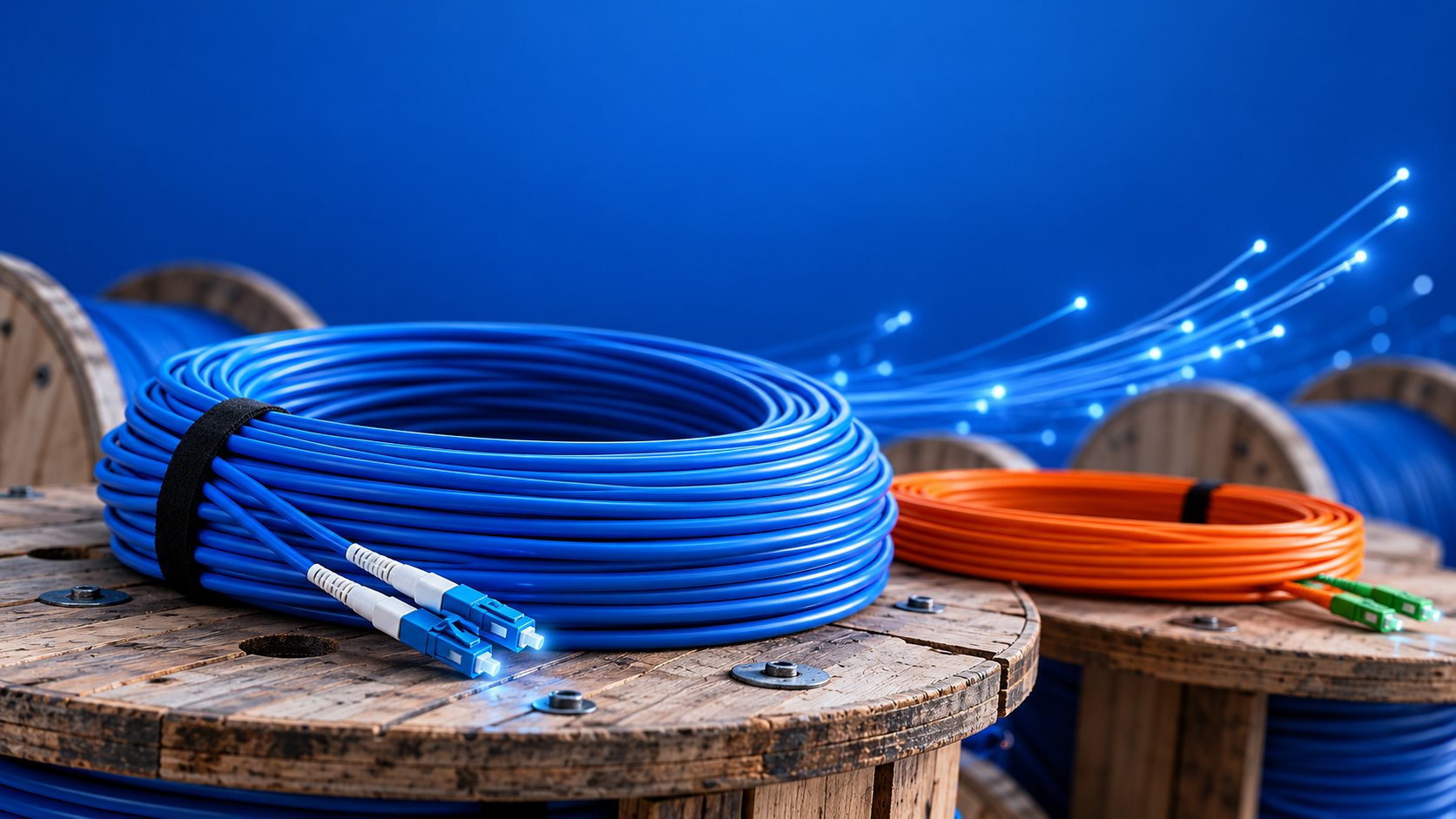
A buyer's guide to choosing between G.652D and G.657 fiber optic cable: bend radius, attenuation, splice compatibility, project-section routing and a procurement checklist before you order.
Procurement teams ordering fiber optic cable for the first time — or the first time at scale — almost always hit the same fork in the road: the supplier quotation asks whether the fiber should be G.652D or G.657, and the two options can differ in price, availability and lead time. Choosing wrong is expensive in either direction. Order G.652D for a dense FTTH drop network and installers will complain about losses in tight bends; order G.657 everywhere by default and you may pay a premium for a property your backbone route never uses, or wait longer for a fiber type your supplier stocks in smaller volumes.
This guide answers the question directly, then walks through the evidence a buyer needs: what each ITU-T standard actually defines, how the two fiber types differ in bend performance, attenuation and splice compatibility, where each one belongs in a real network, and a practical checklist you can send back to your supplier with the RFQ. Everything here is written from the perspective of a manufacturer that produces both fiber types in cable form and ships them to operators, distributors and contractors worldwide, so the emphasis is on the decision you make at the purchase order stage — not on lab theory.
The Short Answer Before the Detail
If your route is a backbone, metro, campus duct or aerial run with generous bend radii and professional installation crews, order G.652D. It is the global default for outdoor single mode cable, it is the most widely stocked fiber type in the industry, and every major transceiver and splice platform is built around it. If your project involves FTTH drop cables, indoor tight-buffered cable routed through buildings, patch cords and pigtails terminated in crowded cabinets, or any installation where fiber will be bent at radii below roughly 30 mm on a routine basis, order G.657 — typically G.657.A1, or G.657.A2 where bends will be tighter still.
For most complete projects the honest answer is that you will order both: G.652D in the outdoor loose-tube cable that runs between sites, and G.657 in the drop cables, indoor cable and connectorized assemblies that terminate the link inside homes, buildings and racks. The remainder of this article explains why that split works, how to verify it with your own supplier, and what to check before you sign the order.
What the G.652D and G.657 Designations Actually Mean
Both designations come from the International Telecommunication Union (ITU-T), whose G-series recommendations define the transmission characteristics of single mode optical fiber and cable. Understanding what each recommendation covers removes most of the confusion, because the two standards are not competitors in the sense of old versus new technology — they describe different fiber behaviors for different deployment environments.
G.652: The Standard Single Mode Fiber Family
ITU-T G.652 describes dispersion-unshifted single mode fiber optimized for operation around 1310 nm, and usable across the 1310 nm, 1550 nm and higher wavelength windows used by modern transceivers. Within the family, the G.652D subcategory is the low water peak variant: the hydroxyl ion absorption peak near 1383 nm has been suppressed, so the fiber can carry traffic across the extended wavelength band from roughly 1260 nm through 1625 nm. This is the fiber type installed in the overwhelming majority of the world's outdoor cables — long-haul routes, metro rings, campus backbones and access feeder networks.
On paper and in practice, G.652D fiber is characterized by a 125 µm cladding diameter, a mode field diameter around 9 µm at 1310 nm, and attenuation in the region of ≤0.36 dB/km at 1310 nm and ≤0.22 dB/km at 1550 nm for a well-made cable. Those are the values we state on our own outdoor G.652D cable specification, measured against the IEC 60793 test methods referenced by the ITU-T recommendation; the exact guaranteed figures for any order are always confirmed on the specification sheet issued with that order, which is the document that governs acceptance.
What G.652D does not guarantee is immunity to tight bending. The standard defines macrobend loss limits at radii that a well-run outdoor route can always respect — think of the minimum bend radius of the cable itself, which for a typical loose-tube outdoor design is around 20 times the cable diameter during installation and 10 times the cable diameter once installed. A 10 mm outside-diameter cable therefore wants a 200 mm radius while crews are pulling it. Inside buildings and at termination points, that kind of space is rarely available.
G.657: The Bend-Insensitive Family Built for the Last 100 Meters
ITU-T G.657, most recently revised in August 2024, defines bending-loss insensitive single mode fiber. It was developed for exactly the environments where G.652D struggles: FTTH drop installations routed around corners and through wall penetrations, indoor cable stuffed into shallow wall boxes and micro-ducts, patch cords terminated in high-density racks, and the increasingly compact hardware — ONTs, mini ODFs, optical distribution frames in apartment risers — where fiber must turn at radii that would visibly bend a traditional jumper.
The recommendation splits into categories. Category A fibers are designed to be fully compatible with G.652D in terms of mode field diameter and splice behavior, which matters enormously for anyone maintaining a mixed network. Within Category A, G.657.A1 permits a minimum bend radius of 10 mm, and G.657.A2 permits 7.5 mm, with the standard defining maximum macrobend losses at 1550 nm and 1625 nm for a defined number of turns at those radii. Category B fibers push bend performance further but trade off some compatibility parameters, which is why Category A dominates practical procurement: it gives installers the bend tolerance they need without creating a different fiber species inside the same network.
In day-to-day language: a G.657.A1 fiber inside a drop cable can be laced around a window frame, stapled along a skirting board and looped inside an ONT wall mount, and the optical loss added by those bends stays within the limits the standard sets. The same routing applied to a bare G.652D fiber would typically show measurable excess attenuation at 1550 nm and become a service ticket generator.
One More Designation You Will See: The Cable Does Not Have to Match the Fiber
A common procurement confusion deserves its own paragraph: the ITU-T designations describe the fiber, not the cable construction. A G.652D fiber can be placed in a loose-tube outdoor cable, an armored direct-burial cable, an ADSS aerial cable or an indoor tight-buffered cable. Likewise, a G.657.A2 fiber can be manufactured into a flat FTTH drop cable or a 2 mm duplex indoor jumper. When you specify an order, the cable construction and the fiber standard are two separate lines that both need to be right: construction is chosen by environment and installation method, fiber standard is chosen by how tightly the fiber will be bent in service. Our earlier guides on choosing fiber optic cable by project type and on armored versus standard construction cover the construction side of that decision in depth.
How the Two Standards Differ in Numbers That Matter to a Buyer
Specifications documents can bury the practical differences in tables of test parameters. The following comparison condenses the difference into the properties that change real purchasing and installation outcomes. Where a value is typical rather than guaranteed, it is marked as such — your order-specific specification sheet always takes precedence.
| Property | G.652D | G.657.A1 | G.657.A2 | Why It Matters When Ordering |
|---|---|---|---|---|
| Governing standard | ITU-T G.652 (low water peak subcategory D) | ITU-T G.657, Category A1 | ITU-T G.657, Category A2 | Defines what acceptance testing must reference |
| Minimum bend radius (fiber) | Not specified for tight bends; practical limits governed by cable design | 10 mm | 7.5 mm | The core reason the standard exists; drives indoor routing freedom |
| Mode field diameter at 1310 nm | Approx. 9 µm (9.2 ± 0.4 µm on our outdoor cable spec) | Approx. 9 µm, matched to G.652D | Approx. 9 µm, matched to G.652D | Low splice loss with the existing plant |
| Cladding diameter | 125 ± 1 µm typical | 125 µm | 125 µm | Same connector and splicing hardware |
| Attenuation in cable, typical | ≤0.36 dB/km at 1310 nm, ≤0.22 dB/km at 1550 nm (per our spec, IEC 60793 methods) | Comparable in cable form; check datasheet | Comparable in cable form; check datasheet | Optical budgeting across the route |
| Splice compatibility with installed G.652D plant | Baseline | Designed for compatibility (Category A) | Designed for compatibility (Category A) | Mixed networks and emergency repairs behave predictably |
| Typical deployment | Backbone, metro, campus, outdoor feeder | FTTH drop, indoor distribution, patch cords | Very tight indoor routing, micro-duct, high-density panels | Match the fiber to the tightest bend it will see in service |
Three of those rows deserve expansion, because they are where most procurement mistakes start.
Bend Radius Is the Whole Point of G.657
The macrobend loss of a single mode fiber does not degrade gently as the radius shrinks — it rises steeply once the radius crosses a threshold. A G.652D fiber looped at 15 mm can add several tenths of a dB at 1550 nm, and the loss is wavelength-selective, so it can pass a quick 1310 nm continuity check and still fail a 1550 nm or PON-level acceptance test. G.657.A1 holds the loss within standard limits at 10 mm, and G.657.A2 at 7.5 mm. For a buyer, translate this into a question for the installation team: what is the tightest radius the fiber will be asked to hold in this project, permanently? If the answer is under about 30 mm, G.657 is not a luxury.
Compatibility Is Why Category A Won the Market
Early bend-insensitive designs achieved their performance by changing the mode field diameter, which caused measurable splice loss when bent fiber was spliced to standard fiber — a real problem for operators maintaining mixed plant. Category A fibers were engineered to match G.652D's mode field diameter, so a G.657.A1 fiber spliced to an existing G.652D plant behaves like a normal joint, and a fusion splicer's standard recipes apply. For procurement, the practical consequence is that ordering G.657.A1 for the last segment does not create a second optical ecosystem: one set of splicing consumables, one set of test procedures, one set of connector styles. Category B exists but is rarely the right default for a buyer maintaining conventional plant, and if a supplier proposes it, ask specifically why Category A does not meet the route.
Attenuation Differences Are Smaller Than the Marketing Suggests
Bend-insensitive fiber is sometimes pitched as if it were lower-loss fiber. In cable form, the straight-line attenuation of G.657.A1 and G.652D is in the same range — the difference that matters shows up only under bending. Do not pay a premium expecting better long-haul attenuation from G.657; the reason to order it is mechanical, not optical budget. Conversely, do not fear that G.657 sacrifices straight-line performance: Category A fibers are specified to keep attenuation comparable. As always, compare the actual datasheet values of the cables being quoted rather than the standard's name.
Where G.652D Is the Right Order
G.652D remains the correct, and usually the most economical, choice for the overwhelming majority of outdoor and long-distance kilometerage. Ordering it deliberately — rather than by habit — is easier when you recognize the conditions that make it the right call.
- Backbone and metro routes. Long spans between splice points, professional civil works, duct or direct-burial installation with controlled pulling tension. Bends are governed by the cable's minimum bend radius, not by cramped hardware, so the fiber never approaches the tight-radius regime where G.657 earns its price.
- Aerial spans, including self-supporting designs. Whether the route uses figure-8 self-supporting cable on a messenger or all-dielectric self-supporting cable on power poles, the fiber is under tension management and lives at sag radii far looser than 30 mm. The selection driver here is the cable's tensile and environmental design, covered in our aerial and armored cable guides, not fiber bend class.
- High fiber-count distribution cable. A 144-core or 288-core distribution cable feeding several splice closures is priced per kilometer; the fiber count dominates cost. Since such routes are installed by crews with duct access and closure space, G.652D is the industry-default fill.
- Long-term stock and supply-chain simplicity. G.652D is the most produced fiber type in the world. For distributors and wholesalers holding inventory across many core counts and constructions, standardizing the outdoor range on G.652D simplifies stock rotation and keeps every drum interchangeable.
- Migration of legacy networks. When you are extending or repairing a plant that is already G.652D, staying with the same fiber type in new builds keeps splice planning and test baselines uniform, even though Category A fiber would splice acceptably.
One nuance worth noting from our manufacturing side: because G.652D is the volume leader, its lead time for standard core counts is usually the shortest in the range — for our own outdoor cable, standard configurations are typically dispatched within 15–20 working days after order confirmation, and custom core counts or sheath options are scheduled individually. When a tender timeline is tight, that availability difference between fiber types is a legitimate factor, not a marketing point.
Where G.657 Pays for Itself
The case for G.657 is not made on the backbone; it is made wherever the fiber's last stretch is handled by hand, bent around hardware, or hidden inside a building where nobody will ever re-pull it gracefully.
- FTTH drop cables. The drop cable runs from the distribution point to the subscriber, around eaves, through a wall penetration, into an ONT. Route geometry on site is dictated by the building, not by the installer's preferences. A G.657.A2 bend-insensitive fiber inside the drop is what makes the final 50 meters behave like the rest of the link instead of becoming the link's weakest section. Our FTTH drop cable guide walks through the construction choices that pair with this fiber decision.
- Indoor tight-buffered distribution inside buildings. Riser and plenum runs, patch-panel approaches in floor cabinets, and routing through cable trays shared with power and other services all involve frequent direction changes. Bend-insensitive fiber adds tolerance exactly where installation shortcuts are most likely.
- Patch cords and pigtails in high-density racks. A patch cord is bent every time someone works in the rack. Terminations in crowded ODFs and switch panels routinely produce radii below 30 mm. Bend-insensitive fiber in jumper assemblies reduces intermittent degradation that is nearly impossible to diagnose remotely. If you are reading cord specifications in detail, our guide to insertion loss, return loss and polish types pairs with this section.
- MDU and apartment deployments. In-building wiring in existing multi-dwelling buildings uses existing conduits, skirting routes and doorframes. Rework after installation is disproportionately expensive — access to a subscriber's wall is a customer-service event, not a maintenance window. The fiber that cannot tolerate the route gets reinstalled at full labor cost.
- Micro-duct and compact hardware environments. Air-blown micro-duct systems, mini ODFs and wall-box ONT mounts compress geometry further. This is the natural habitat of G.657.A2, and of Category B fiber in the most extreme cases.
- Data center high-density interconnect. Modern high-density panels concentrate hundreds of ports per rack unit. Bend-insensitive fiber inside the jumpers prevents port-to-port performance variation caused simply by adjacent cords crowding each other.
Notice the pattern: G.657 is ordered where the installation environment, not the transmission distance, sets the constraints. That is the single most useful heuristic for a buyer deciding fiber class per project section.
What We See When the Wrong Standard Was Ordered
Across the OEM/ODM projects we run and the technical inquiries that reach our engineering desk before an order, certain failure patterns recur with almost monotonous regularity. They are worth describing here because each one maps to a procurement decision that could have gone differently — and none of them shows up at the acceptance test of the outdoor section.
The FTTH ticket storm. A drop network built with standard fiber inside the drop cable often passes commissioning with acceptable OTDR readings, because during commissioning every drop is routed carefully with time available. Weeks later, subscriber moves, furniture changes and weather-induced cable slack gradually push bend radii down. The symptom is wavelength-selective: the 1490 nm downstream PON signal degrades before the 1310 nm upstream path shows obvious trouble, so the fault reads as an intermittent ONT problem rather than a bend-loss problem. By the time the pattern is recognized, dozens of drops need re-routing. The purchase-order fix costs a modest premium per drop cable; the field fix costs a truck roll per subscriber.
The crowded rack that flunked its own acceptance test. A data hall or campus head-end is built with standard-fiber jumpers because the Bill of Materials was consolidated to a single fiber type. During final acceptance at 1550 nm, a handful of links exceed their loss budget. Every one of them traces to a jumper routed through the tightest corner of the cabinet. Replacing the affected cords with bend-insensitive assemblies resolves it — but the delay lands on the project's critical path, and the retest consumes the schedule margin that was budgeted for something else.
The inverse mistake: paying bend premiums on the backbone. Less damaging but still real: a tender specifies G.657.A2 throughout, including 96-core backbone sections installed in duct with no tight-bend geometry anywhere. The fiber is not wrong — Category A splices fine — but unit price and, in some regions, availability are worse, and the premium buys nothing on those kilometers. On a large metro build, that inefficiency compounds across every reel.
None of these patterns argues for one fiber type everywhere. They argue for deciding fiber class per project section, and for writing that decision explicitly into the RFQ so that the supplier quotes the correct fiber in each cable construction — not a single consolidated line item chosen for convenience.
Running Both Standards in One Project Without Creating Problems
Most real deployments mix the two fiber types, and mixing is safe when three conditions are respected.
First, splice points between the fiber types are treated as normal joints. Category A fiber matches G.652D's mode field characteristics, so a fusion splice between G.657.A1 and G.652D reads like an ordinary splice on the splicer and on the OTDR. Train crews simply to aim for their usual splice-loss target — typically well under 0.1 dB per joint — rather than treating cross-standard joints as special cases.
Second, test at the wavelengths that will carry traffic. Bend loss is more visible at 1550 nm and beyond than at 1310 nm. If the acceptance test plan only exercises 1310 nm, it will under-detect tight-bend problems on any fiber. Including a 1550 nm pass in acceptance testing, and on PON links testing at the actual operating wavelengths, is cheap insurance regardless of which fiber class is inside the cable.
Third, label and document fiber class per section. Five years from now, a maintenance crew adding a splice closure should know whether the fiber on each side is G.652D or G.657.A1 — not because they must be treated differently, but because knowing the plant removes guesswork from future repairs and extensions. Drum labels, test reports and as-built documentation should carry the fiber designation, which is something to require from your supplier at the order stage rather than reconstructing later.
A Procurement Checklist to Send With Your RFQ
Everything above condenses into a short checklist that makes the fiber-standard decision explicit on paper. We use the same structure when confirming OEM/ODM configurations, and buyers who send this information with an RFQ typically receive tighter quotations in return because fewer assumptions need to be made on the supplier side.
- Route sections and environments. Split the project into outdoor backbone/feeder, outdoor distribution, drop and indoor sections. State the deployment method per section: duct, direct burial, aerial, indoor tray, in-wall.
- Fiber standard per section. Default G.652D for backbone and feeder; G.657.A1 for indoor distribution, patch cords and pigtails; G.657.A2 for drop cable and the tightest in-building routes. Adjust upward where site surveys show unusually tight routing.
- Core counts and growth margin. State required fibers at the far end plus spare capacity for future splits or tenancy changes. Cable cost scales far more gently with core count than a second pull-out does with labor.
- Cable construction per environment. Loose-tube PE jacket for duct and burial; armored construction where mechanical risk or rodent exposure exists; ADSS or figure-8 for aerial spans; tight-buffered LSZH or PVC for indoor riser and plenum.
- Drum lengths and pulling plan. Standard 2, 4 or 6 km drums cover most routes, but the optimal drum length depends on splice locations and duct chamber spacing. Confirming drum length with the quotation avoids on-site joins that the route design never intended.
- Test and documentation requirements. Ask for per-drum attenuation test reports and confirm acceptance wavelengths. Require the fiber standard to appear on drum labels and as-built documentation.
- Standards references in the PO. Write "ITU-T G.652D" or "ITU-T G.657.A1/A2" explicitly rather than "single mode" — the latter is not a fiber class, and quotations based on it can vary.
- Warranty and after-shipment support. Confirm the warranty term in writing — our cables carry a 12-month warranty from shipment date covering manufacturing defects, with claims raised by reel number, test report and fault description — and confirm how test reports and replacement logistics work before the order, not after a fault.
The Cost Perspective: Premium Versus Risk
Fiber-standard decisions ultimately land on a budget comparison, and the honest version of that comparison rarely favors a single standard across a whole project.
The price difference between G.652D and G.657.A1 fiber inside a cable is a small percentage of the cable's overall cost — far smaller than the difference between constructions, and small next to labor. On backbone kilometerage it is still real money, which is why defaulting to G.657 there is hard to justify: the bend property is simply never exercised. On drop cables, indoor cable and jumper assemblies, the picture reverses. The absolute cost of the fiber inside a 1 km drop or a 2 m patch cord is trivial; the cost of the failures G.657 prevents is measured in truck rolls, subscriber complaints and retest cycles. Where bends are routine, the premium buys down the most expensive risk category in the project — field labor on customer premises.
Availability is the third leg. G.652D's volume production means standard configurations ship from stock-led schedules; specialized G.657.A2 constructions in unusual core counts can carry longer scheduling. For tenders with fixed completion dates, ask the supplier to quote both standards for the borderline sections and compare the combined effect on price and delivery, rather than deciding the whole bill of materials on fiber class alone.
How We Support G.652D and G.657 Orders
Nexora Communications manufactures both fiber classes in cable form from its facility in Shenzhen: 16,000+ m² of manufacturing space, 12 production lines, 180+ employees and an annual capacity of 2.8M+ units, with 3,500+ product configurations across the fiber optic range and 500+ completed OEM/ODM projects delivered to customers in 50+ countries. In practice this means the two decisions in this article — cable construction and fiber standard — are configured together per order rather than forced into a fixed catalog.
On the G.652D side, our outdoor loose-tube cable is available in 2–288 core counts for backbone, metro and access routes, with gel-filled tubes, steel or FRP strength members and a black PE jacket, tested per IEC 60793 and IEC 60794 reference methods. Standard configurations are typically dispatched within 15–20 working days, supplied on wooden drums in 2, 4 or 6 km standard lengths, with jacket printing and custom drum lengths available for OEM/ODM orders.
On the G.657 side, bend-insensitive fiber is specified into FTTH drop cables, indoor tight-buffered distribution cable and connectorized assemblies — patch cords and pigtails in the SC, LC and FC families, UPC or APC polished — so that the drop and termination sections of a project order match the backbone rather than arriving from a different supplier with a different documentation standard.
Quality control runs through the whole process at 30+ QC stations, from incoming material through component, in-process, functional, visual, final and packaging inspection, and every cable reel is tested for attenuation and continuity before dispatch, with test reports available with the shipment. All Nexora fiber optic cables carry a 12-month warranty from shipment date covering manufacturing defects; claims are raised with the reel number, test report and fault description, and confirmed manufacturing defects are replaced or credited, with a response within 5 working days and replacement stock typically dispatched within 15 working days of claim confirmation.
If you are planning a project and want the fiber-standard decision confirmed against your route profile, share the section split, core counts and deployment methods with our team and we will return a configuration proposal with the matching specification sheets — for both the backbone sections and the last 100 meters.
How Acceptance Testing Should Differ Between the Two Fiber Types
Buyers often inherit a single generic acceptance test plan and apply it to every cable section in the project. That habit hides the differences between the two fiber standards at exactly the moment they are cheapest to catch. A test plan tuned to the fiber class in each section turns the specification from a promise into a measured, documented fact before the supplier's warranty window starts running.
For G.652D backbone and feeder sections, the priority is long-range characterization. An OTDR trace at 1310 nm and 1550 nm per fiber, taken from both ends where access allows, establishes the attenuation baseline and flags splice joints above the agreed threshold. Because the route is long and the bends are gentle, macrobend testing is not the focus; what matters is documenting the per-drum factory attenuation reports alongside the field OTDR traces so that any future degradation can be traced to a drum, a span or a closure. Water-peak verification at 1383 nm is rarely necessary for modern G.652D fiber, but if the route is intended to carry CWDM traffic, it is worth confirming the low water peak claim from the manufacturer's report rather than assuming it.
For G.657 sections — drop cables, indoor distribution and jumper assemblies — the emphasis inverts. Link lengths are short, so OTDR becomes less informative per meter, while bend behavior becomes the dominant variable. Insertion-loss testing at 1550 nm or at the actual PON operating wavelengths, with the cable routed as it will actually sit in service rather than carefully laid out on a table, is the test that predicts field behavior. Installers should be instructed to dress the fiber normally during testing; a test that straightens every bend certifies the fiber, not the installation, and will systematically under-report what subscribers will experience. For patch cords and pigtails, requiring end-face inspection results alongside insertion loss and return loss values completes the picture, since a bend-tolerant fiber behind a contaminated connector still fails the link.
Document the fiber standard per section in the test records themselves. When every trace and loss result carries the fiber designation, a future maintenance team can distinguish a genuine fault from a design-era routing decision within minutes, and your acceptance documentation becomes part of the network's long-term asset value rather than a file that is never opened again.
Frequently Asked Questions
Can I splice G.657 fiber directly to my existing G.652D network?
Yes, when the G.657 fiber is Category A (A1 or A2). Category A fibers are designed to match G.652D's mode field diameter, so fusion splices between the two behave like ordinary joints and standard splicer recipes apply. This is precisely why Category A dominates procurement: you can upgrade the bend-critical sections of a network without creating a compatibility project. Category B fibers are a different story — splice loss with standard plant can be higher, so they require a specific justification before ordering.
Is G.657 cable more expensive than G.652D cable?
Per kilometer of finished cable, G.657 fiber usually carries a modest premium over G.652D, though the exact difference depends on core count, construction and volume. The more useful comparison is per section: on backbone routes the premium buys nothing, while on drop and indoor sections it buys protection against the most expensive failure mode in the project. Ask your supplier to quote both fiber classes for the borderline sections so the decision is made on real numbers rather than on assumptions.
Does using G.657 fiber mean my cable can be bent at 7.5 mm freely?
No — the 10 mm (A1) and 7.5 mm (A2) figures are fiber-level bend radii with defined macrobend loss limits. The cable still has its own minimum bend radius, which for a loose-tube outdoor design is typically around 20 times the cable diameter during installation and 10 times in service. G.657 saves the fiber inside the cable; it does not change how the cable jacket, strength members and tubes should be handled. Cable-level handling limits remain on the specification sheet and should be respected by installation crews.
Which G.657 subcategory should I order for FTTH drop cable?
G.657.A2 is the common choice for drop cable because in-building routing can approach the 7.5 mm regime — wall boxes, ONT mounts and tight corner routing. G.657.A1 is sufficient where routing stays above roughly 10 mm. If the drop design is already fixed and site surveys show generous radii, A1 is the more economical specification; if routing freedom is the selling point of the construction, A2 removes the argument. Your installation partner's route methodology is the deciding input, so it is worth asking them before the order rather than after the first re-route.
Do patch cords and pigtails also need to be G.657?
For anything that lives in a rack, cabinet or wall box — which is to say nearly every patch cord and pigtail — bend-insensitive fiber is a sensible default. Cords are bent every time someone works in the rack, and the resulting losses are invisible to remote monitoring but real on the optical budget. Standard-fiber cords remain acceptable for short, well-managed runs, but as high-density panels compress spacing, G.657 fiber inside jumpers has become the industry norm rather than an upgrade.
How do I verify which fiber is actually inside the cable I receive?
Require the fiber standard on the drum label and in the per-drum test report, and make it a line item on the purchase order. Fiber class is printed into the manufacturing record and is not reliably identifiable by visual inspection once cabled — which is why documentation discipline at the order stage is the buyer's real verification tool. Reputable manufacturers supply attenuation test reports per drum and will state the ITU-T designation without hesitation; hesitation is itself a signal.
What warranty applies to fiber optic cable orders?
All Nexora fiber optic cables carry a 12-month warranty from shipment date covering manufacturing defects. A claim is raised by sending the reel number, test report and fault description; confirmed manufacturing defects are replaced or credited, with a response within 5 working days and replacement stock typically dispatched within 15 working days of claim confirmation. Damage caused during installation or by third-party civil work falls outside the warranty scope, which is another reason the installation-side bend discipline discussed in this article matters.
We are extending a 10-year-old network. Should new sections match the old fiber?
Not necessarily at the fiber level. Category A G.657 fiber splices cleanly to aging G.652D plant, so you can modernize the bend-critical sections without mismatch. What matters more for consistency is matching the cable construction and documentation conventions of the existing plant — core count logic, closure types, labeling and test baselines. Write both the fiber standard and the construction into the new RFQ explicitly, and the extension will integrate with the old plant rather than fight it.
The Bottom Line for Your Next Order
The G.652D versus G.657 question is not a technology fashion choice; it is a routing-geometry decision made per project section. Outdoor routes with professional installation and generous radii belong to G.652D — the world's default backbone fiber, with the widest stock, the shortest standard lead times and every splice and test platform built around it. Drop cables, indoor distribution and rack interconnects belong to G.657, because that is where the fiber actually gets bent, and where the cost of getting it wrong is paid in field labor rather than in cable price.
Make the decision explicit per section in the RFQ, verify it in the drum documentation, test at the wavelengths that carry traffic, and keep Category A fiber as the default wherever mixed plant exists. Do that, and the fiber standard becomes one of the least risky lines on your next fiber optic cable order — which is exactly where a specification decision should sit.