
A buyer's guide to choosing indoor fiber optic cable by building zone: riser (OFNR), plenum (OFNP) and horizontal runs, covering fire ratings, jacket materials, fiber type, count and mechanical limits.
Inside a building, the fiber optic cable decision is rarely about one cable. A single multi-floor project usually crosses three different environments: a vertical riser shaft between floors, an air-handling plenum space above corridors or below raised floors, and horizontal runs through ceiling voids and cable trays to the work areas. Each of these zones is governed by different fire and smoke requirements, and a jacket that passes one zone can fail inspection in another. This is why experienced buyers treat indoor fiber optic cable selection as a zoning decision first, and a fiber decision second.
The cost asymmetry is what makes the zoning decision matter. If you order the wrong fiber count, you pay for extra cores you did not need. If you order the wrong fire rating, the cable may have to be pulled out of the ceiling after it has already been terminated, re-pulled, and re-terminated at both ends. The cable is the cheapest line item in that scenario; the labour, the schedule slip and the inspection delay are not. In many projects the re-work cost of a wrong jacket rating is several times the value of the cable itself.
This guide walks through the decisions in the order a buyer actually meets them: what the cable has to do inside the building, how riser, plenum and horizontal requirements differ, how to choose between tight-buffered and loose-tube construction, how to select fiber type and count, which jacket material fits which zone, and what to write on the specification sheet so the delivered cable matches the inspection your building will face. Throughout, the specification values used as examples come from the Indoor Tight-Buffered Fiber Optic Cable and the Distribution Fiber Optic Cable families supplied by Nexora, with typical values noted as such: final figures for your order should always be confirmed on the datasheet issued with the quotation.
What an Indoor Fiber Optic Cable Has to Do Inside a Building
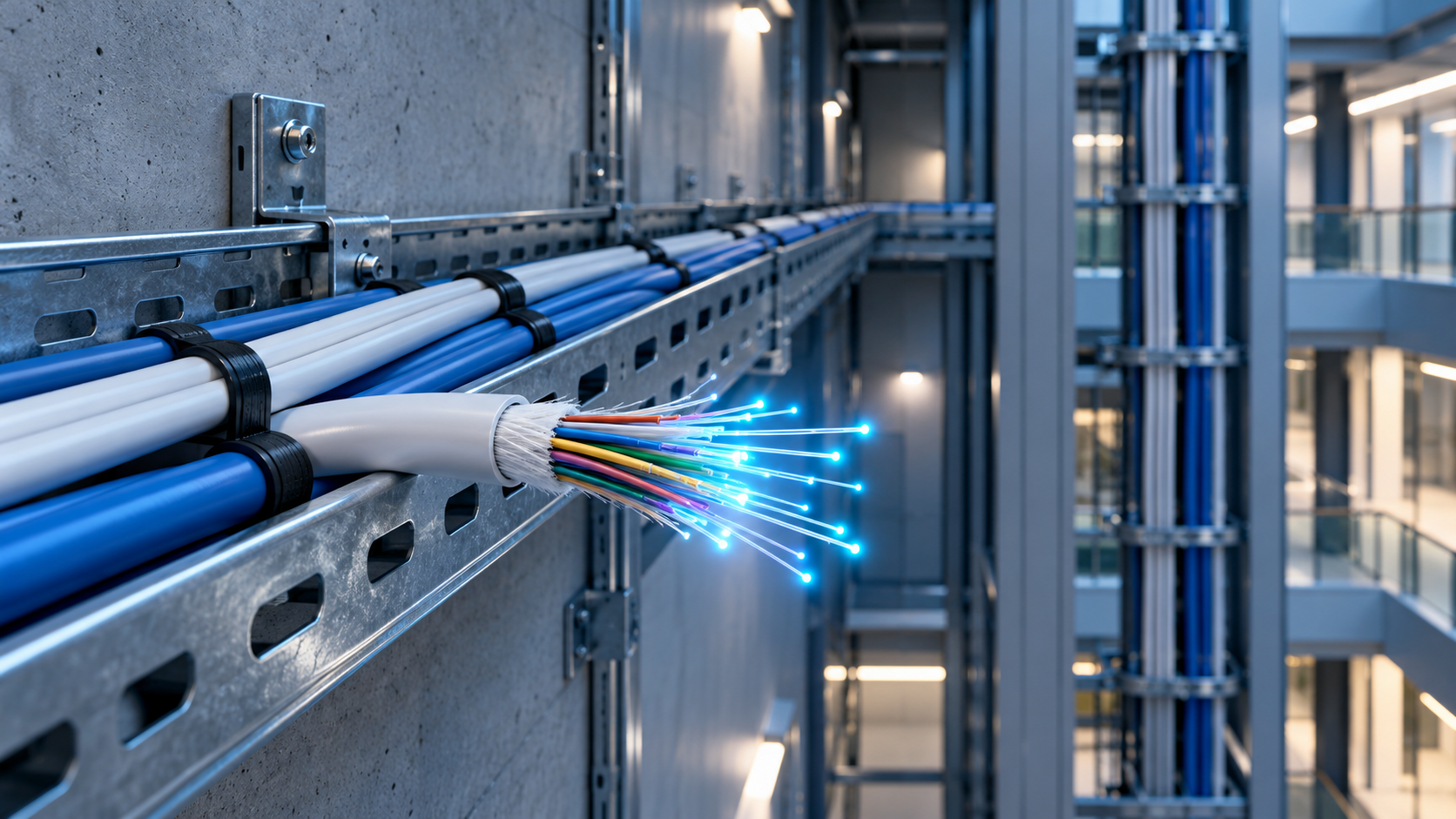
Indoor cable has a different job from outdoor cable. An outdoor cable is engineered to survive water, temperature cycling, rodents and civil work over long spans. An indoor cable is engineered for the last hundred meters of the network: frequent bends around trays and conduits, compact routing in riser shafts and ceiling voids, and termination at patch panels, wall outlets and optical distribution frames (ODF) where each fiber is handled individually.
Three capabilities follow from that job. First, the cable must be easy to terminate. Inside a building, most fibers end at a connector rather than at a splice, so the construction should let an installer strip the buffer and terminate directly without gel-cleaning steps. A 900 µm tight buffer, in which the buffer sits directly on the 250 µm coated fiber, is the standard answer: it protects the fiber during handling and can be stripped cleanly at the panel. Second, the cable must be flexible enough for crowded routing. Trays above an office ceiling are shared with power, copper data and HVAC lines, and the fiber route has to make bends the tray layout dictates. Bend-radius limits therefore decide whether a route is realistic. Third, and most distinctively, the cable must carry the fire rating of the zone it runs through. This is the requirement outdoor cable never faces, and it is the one that most often causes expensive mistakes.
It helps to map the zones before looking at any datasheet. A vertical run between floors lives in a riser shaft. A run through a space that also carries environmental air — the return-air plenum above an office corridor, the underfloor plenum of a data hall — lives in a plenum space, which has the strictest smoke and flame requirements in the building. Everything else, from ceiling trays to conduit under the raised floor of a non-plenum zone, is a general horizontal route. Each zone maps to a cable designation, and the designations are printed on the jacket so an inspector can verify them on site.
The Fire-Rating Question: OFNR, OFNP, and Where LSZH Fits
Most buyers meet indoor fiber fire ratings through the North American marking system, which has become the de facto reference on international projects. Under the United States National Electrical Code (NEC, NFPA 70) Article 770, optical fiber cables carry designations that indicate the flame and smoke performance of their jacket: OFNP (optical fiber, plenum) for the highest rating, OFNR (optical fiber, riser) for vertical shafts, and OFN/OFNG for general-purpose use. A plenum-rated cable can be substituted anywhere a riser-rated or general-purpose cable is allowed, but not the other way around. The hierarchy matters commercially as well as technically: OFNP jackets cost more than OFNR, so ordering plenum cable for the whole building "to be safe" spends budget where it does not buy anything, while ordering riser cable for a plenum route buys a failed inspection.
Two clarifications keep this system straight. First, the rating describes the cable jacket's flame and smoke performance in the listed test, not the optical performance of the fiber. A riser-rated and a plenum-rated cable can carry identical OS2 single mode fiber with identical attenuation; what differs is the jacket compound and its behaviour in fire. Second, the marking system is a North American code framework. Many projects in Europe, the Middle East and Asia reference it in tenders because it is widely understood, but the locally applicable rule is always the building code and fire authority of the project's jurisdiction. Where a project specifies European practice, the reference points are the Euroclass fire reaction classes under the Construction Products Regulation for the cable's country of use. The practical rule for an international buyer is the same in either system: identify the zone, ask which rating the local inspector requires for that zone, and order the cable whose marking matches it. When in doubt, request written confirmation of the required rating before production starts — it is a one-line email that prevents the most expensive class of indoor cable rework.
Alongside the OFN designations, buyers frequently ask how LSZH (low smoke zero halogen) jackets relate to the rating. The two dimensions answer different questions and are often ordered together. The OFN marking addresses flame spread and smoke in the listed fire test; LSZH addresses the composition of the smoke itself, limiting halogen acid gas emission when the jacket burns, which matters in enclosed occupied spaces such as control rooms, tunnels, ships and public buildings. An LSZH cable can be riser-rated, and a PVC-jacketed cable can be riser-rated too; the jacket material and the fire rating are specified as a pair. This is exactly how the Nexora indoor tight-buffered family is ordered: jacket material LSZH or PVC, fire rating riser (OFNR) or plenum (OFNP), each selectable so the cable matches both the zone and the material requirement of the project. For a deeper treatment of when LSZH is worth specifying, see the dedicated guide What Is LSZH Fiber Optic Cable and When Should You Specify It?
Riser Runs: Specifying the Vertical Backbone
The riser is the vertical highway of the building network: fiber runs from the main equipment room or basement MDF up (or down) to each floor's patch position. A riser-rated cable marked OFNR is designed to resist flame spread in a vertical shaft, where fire and hot gases travel upward and a cable that carries flame becomes a chimney. In practice the riser decision is mostly about three things: the rating itself, the construction of the vertical run, and how the cable is supported.
On rating, the rule is to confirm rather than assume. Some buildings route the vertical backbone through a dedicated, rated shaft that allows general-purpose cable; others require riser rating for any inter-floor penetration. The AHJ (authority having jurisdiction) or the fire consultant on the project settles the question, and the buyer should get the answer in writing before the order is confirmed. Since the same cable family is usually available in both ratings — the Nexora indoor tight-buffered family, for example, covers OFNR and OFNP in 2 to 144 cores with LSZH or PVC jackets — the cost of specifying the right rating is zero, and the cost of guessing wrong is a re-pull.
On construction, a long vertical run rewards tight-buffered designs. Riser distances between floors are short compared with outdoor spans, and the run terminates at patch positions on each floor, so the fibers are stripped and terminated repeatedly along the route. Tight-buffered fiber handles this direct-termination work well, and the compact outer diameter of a tight-buffered distribution design keeps the shaft uncluttered. Where the vertical run also has to break out to equipment on intermediate floors, a multi-core distribution cable — such as the 2-to-48-core Distribution Fiber Optic Cable — lets the installer pull one backbone and branch at each floor's ODF instead of pulling individual cords per link.
On support, riser cable should be clamped at intervals that hold its own weight, or fitted with a dedicated strength element when the shaft is tall. Vertical runs concentrate the cable's weight on its lowest meter, so the pulling and anchoring plan matters even though the span is short. Keep the bend radius at every transition — shaft to tray, tray to cabinet — at or above the cable's installation limit, which for the tight-buffered family is typically 20 × cable outer diameter during installation and 10 × once fixed. For the wider mechanics of pulling fiber without damaging it, the contractor's guide to cable pulling tension and bend limits covers the winch, dynamometer and lubrication practices that apply just as much indoors as outdoors.
Plenum Spaces: When OFNP Is the Requirement
A plenum is any space used to move environmental air: the return-air ceiling void above an office corridor, the supply plenum below a raised floor in a data hall, the ducted cavity feeding room air. Because smoke in these spaces spreads through the HVAC system before anyone sees a fire, codes treat plenum spaces with the strictest cable requirements in the building. Cable marked OFNP passes the plenum test for flame spread and smoke developed, and only this rating may be installed in the plenum space itself.
The recurring design question is where the plenum boundary actually falls. A ceiling void can be plenum in one wing of the building and non-plenum in another, depending on how the HVAC return is engineered; a raised floor can be a supply-air plenum in the data hall and ordinary space in the office block. The HVAC drawing, not habit, defines the boundary, and the cable schedule should be zone-mapped floor by floor before ordering. A practical mapping looks like this:
| Building zone | Typical required marking | Jacket options |
|---|---|---|
| Vertical shaft between floors | OFNR (riser) | LSZH or PVC |
| Air-handling plenum (return-air ceiling, underfloor supply air) | OFNP (plenum) | Plenum-rated compound |
| General horizontal routing (non-plenum ceiling, conduit, tray) | OFN / riser substitute | LSZH or PVC |
Two cost behaviours follow. First, OFNP carries a price premium over OFNR for the same fiber, so the zone map directly controls the budget; a project that discovers mid-installation that a corridor ceiling is a return-air plenum pays both the jacket premium and the re-pull. Second, because plenum-rated constructions are a separate build, they are usually planned rather than pulled from stock: include them in the RFQ with the total length per zone so the production plan covers both ratings in one delivery. The Nexora tight-buffered indoor family supplies OFNP as an ordered option alongside OFNR, which keeps the fiber type and termination method identical across zones even when the jacket changes.
One more plenum habit is worth adopting: label the cable schedule with the zone, not just the rating. When an inspector walks the route, the fastest way to pass is a schedule that says "Floor 3 corridor — return-air plenum — OFNP" next to the jacket printing. Ambiguity between riser and plenum zones is a paperwork failure that becomes a physical failure only after the cable is in the ceiling.
Horizontal Runs and the Work Area
Horizontal routing — from the floor distributor to the outlets and equipment positions — is where indoor fiber cable is bought in the largest lengths and where small design choices repeat hundreds of times. The horizontal decision set is narrower than the riser and plenum questions, but it has its own economics.
First, decide between individual cords and a multi-core distribution cable. Pulling a bundle of simplex or duplex cords per link multiplies every cost that scales with cable count: pulls, labels, tray congestion, bend-radius violations and future maintenance confusion. A 24- or 48-core distribution cable pulled once to the floor and broken out at the panel replaces dozens of separate pulls with one, and the tight-buffered construction lets each fiber be terminated directly at the patch position. The break-even is not subtle: the labour to pull and dress 48 individual cords through a tray is several times the labour to pull one 48-core assembly, and every extra cord adds another bend the tray has to accommodate. The Distribution Fiber Optic Cable page shows the arithmetic in detail with a worked 48-port floor panel example.
Second, size the fiber count with growth in mind, not just current ports. Re-pulling a backbone later costs far more than ordering spare cores now, so the count that covers today's ports plus a realistic growth margin is usually the economical choice. Third, respect the mechanical limits that repeat across every run: keep installed bends at 10 × cable diameter or wider, installation bends at 20 × or wider, and leave service loops at each end so re-termination never strains a fiber. Where the horizontal route is in a congested office ceiling with limited slack space, a cable with a compact OD and a forgiving bend radius is worth its unit-price difference several times over the life of the network.
Tight-Buffered or Loose-Tube Indoors? A Short Version
The construction question deserves its own article — and there is one on this site — but the zoning decision needs the short version. Tight-buffered cable carries each fiber in its own 900 µm buffer that can be stripped and connectorized directly; it suits indoor runs that terminate at panels, outlets and ODFs. Loose-tube cable houses fibers in gel-filled tubes; it suits long spans and spliced routes, which is why it dominates outdoor designs. The common hybrid pattern is to run loose-tube outdoor cable to the building entry, splice it there to a tight-buffered indoor cable, and let the tight-buffered fibers fan out to the panels — keeping each construction in the job it was built for. For the full comparison, see How Do You Choose Between Tight-Buffered and Loose-Tube Fiber Optic Cable for Indoor Networks?
Fiber Type Indoors: OS2, OM3 and OM4
Once the jacket and rating are settled, the fiber decision follows the links the cable will carry. Indoor backbones mostly choose between single mode OS2 and multimode OM3/OM4, and the trade-off is reach versus transceiver economics.
OS2 single mode is the carrier-grade choice: long reach, one fiber type across the whole backbone, and no distance anxiety on any in-building link. Inside a building, distances are short enough that OS2 attenuation is almost never the limiting factor — on a 300 m run at 1310 nm, fiber attenuation at the typical ≤ 0.36 dB/km figure contributes roughly 0.11 dB, leaving nearly the entire link budget for connectors and margin. Single mode also future-proofs the backbone: transceiver speeds on single mode keep advancing without changing the fiber.
OM3 and OM4 multimode suit short, high-speed runs inside a floor or between nearby racks, where multimode transceivers are typically more cost-effective than their single mode equivalents. OM3 supports, as a working rule, 10G reaches up to about 300 m; OM4 extends that margin and underpins the same equipment at longer reaches or higher speeds. The practical indoor rule of thumb: choose OM3/OM4 for equipment-to-equipment runs inside a data room or between floors of a campus building where distances are short and transceiver count is high; choose OS2 for the building backbone, campus interconnects and anything that must not care about distance.
| Fiber type | Typical attenuation | Typical indoor use |
|---|---|---|
| OS2 single mode (G.652D) | ≤ 0.36 dB/km @ 1310 nm; ≤ 0.22 dB/km @ 1550 nm | Building backbone, campus links, carrier equipment |
| OM3 multimode | ≤ 3.5 dB/km @ 850 nm; bandwidth ≥ 1500 MHz·km | Short 10G runs, in-floor and in-row cabling |
| OM4 multimode | ≤ 3.5 dB/km @ 850 nm; bandwidth ≥ 3500 MHz·km | Short high-speed runs with longer 10G/40G/100G margins |
Values shown are the typical figures for the Nexora indoor cable families. Confirm the exact limits for your ordered construction on the datasheet before finalising a link budget.
Both the tight-buffered indoor family (OS2, OM3 or OM4) and the distribution family (G.652D single mode or OM3/OM4 option) carry all three fiber types, so the zoning decisions do not constrain the fiber decision — you can hold one construction across the building while mixing fiber types zone by zone where the equipment plan requires it.
Fiber Count Planning: Buy the Margin Once
Indoor fiber count is a planning decision more than a technical one. The ports you need today are visible in the design; the ports you will need in three years are not, and they are the ones that cost money when missed. The economical pattern is to size the backbone for current demand plus a growth margin, then break out at each distribution point.
Three planning inputs sharpen the estimate. First, count the active ports at each floor's patch position, then add the growth the tenant or IT plan actually states — a floor that will double its workstations has a different margin than one that is already full. Second, count the shared services that ride the same backbone: Wi-Fi access points, security cameras, building-automation segments and any second network the tenant operates. These are the loads that grow quietly between equipment refreshes. Third, keep a spare-core convention consistent across the project, for example 25–30% spare on each vertical run, so the spare is distributed where future break-outs will actually happen rather than concentrated in one shaft. A 48-core backbone feeding six floors with a port plan of 30 per floor is already close to its ceiling; the same backbone with a deliberate margin serves the next plan without a re-pull. The cost of a few extra cores at order time is a small fraction of the cost of a second pull through an occupied building.
Jacket Material: PVC or LSZH, Paired With the Rating
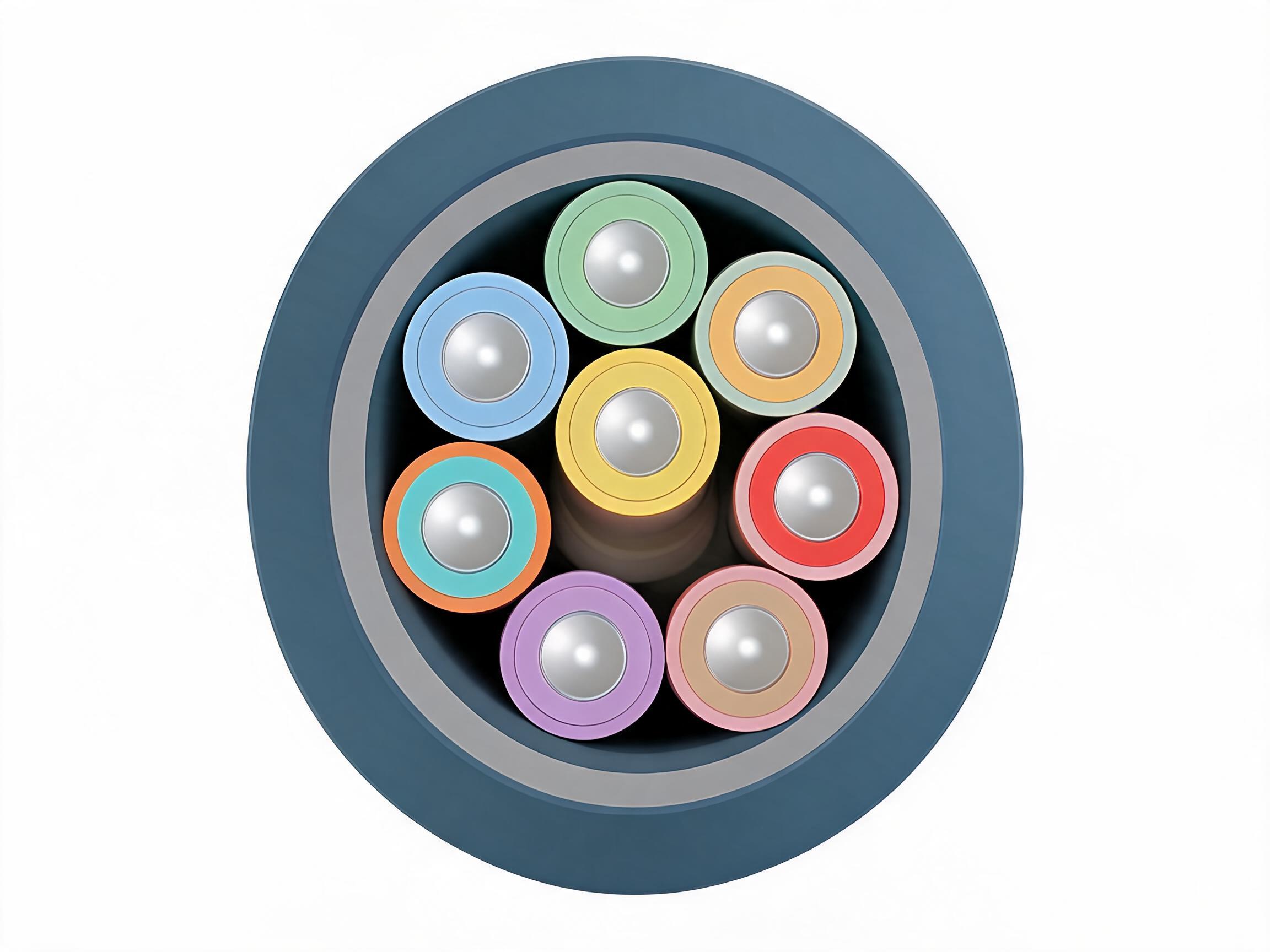
Jacket material is the last variable in the zoning decision, and it is specified as a pair with the fire rating. PVC is the traditional indoor compound: economical, easy to process, and available in both riser and general-purpose ratings. LSZH burns with limited smoke and emits little or no halogen acid gas, which protects people and electronics in enclosed occupied spaces — control rooms, hospitals, tunnels, airports, public buildings and any space where evacuation visibility and equipment corrosion are concerns.
The buyer rule is straightforward. Where the code or the tender calls for LSZH, specify LSZH with the required rating; where the space is enclosed and occupied but the tender is silent, LSZH is usually the prudent default for the occupied floors, with PVC acceptable in plant rooms and risers where smoke composition is less critical. Because the Nexora indoor family offers LSZH or PVC in both OFNR and OFNP, the material choice is independent of the rating choice — you can hold the fire rating constant across the building and vary the material by zone, or the reverse, without changing supplier or construction. For the full LSZH decision, the dedicated guide covers the trade-offs and typical applications in depth.
Mechanical Limits: Bend Radius and Tensile, the Numbers That Decide the Route
Indoor cable failures are rarely optical; they are mechanical. A fiber kinked below its rated bend radius shows up weeks later as a marginal link that fails acceptance or, worse, passes acceptance and degrades in service. The two numbers to keep in view are the bend radius and the tensile limit.
For the Nexora tight-buffered indoor family, the static bend radius is 10 × cable outer diameter and the installation limit is 20 ×. On a 6 mm jacket that is 60 mm installed and 120 mm under pull load — a dimension that must exist in the tray, not just on the drawing. Congested trays are the usual offender: a bundle of individual cords with hard corners at every turn accumulates micro-bends that attenuate and eventually break. The distribution cable family publishes the same convention (10 × installed, 20 × under pull load) with a short-term tensile limit of up to 10 × cable weight, which is ample for horizontal pulls but should still be respected in long vertical runs where the cable's own weight accumulates. The typical operating temperature range for the indoor families is −20 °C to +70 °C, which covers normal conditioned buildings; unconditioned spaces and outdoor runs belong to the outdoor cable families. All of these are typical values — confirm the exact limits on the datasheet for your ordered construction before the route is finalised.
Two installation habits protect these numbers. Use a pulling grip on the jacket rather than pulling on the fibers, and leave service loops at each termination point so future re-termination never stresses the routed cable. Both cost nothing and prevent the most common mechanical failures reported on indoor jobs.
Where Indoor Ends: The Outdoor-to-Indoor Transition
The indoor cable decision is incomplete until the building entry is planned, because this is the joint where the two cable worlds meet. An outdoor loose-tube cable — gel-filled, PE-jacketed, built for water and weather — should not simply run indoors: the gel is messy indoors, and the jacket does not carry the indoor fire ratings. The standard pattern is a transition point as close to the entry as practicable: outdoor cable lands in an entry splice enclosure or cabinet, and tight-buffered indoor cable continues to the ODF and panels.
Three transition details deserve attention in the order book. First, the splice plan: fusion splicing at the entry adds attenuation and labour per fiber, so count the transition cost into the link budget rather than discovering it at acceptance. Second, the routing between the entry point and the first indoor zone: this segment is indoors and must carry the rating its zone requires, which is usually riser or plenum, not general purpose. Third, where the entry route is exposed — a basement conduit shared with other services, a wall crossing — specify mechanical protection rather than hoping the route stays benign; where rodents or impact are real risks, an armored fiber optic cable covers the exposed segment. And where the outdoor leg itself needs specification, the Outdoor G.652D Single Mode Fiber Optic Cable family covers direct burial, duct and aerial deployment in 2 to 288 cores.
Buyers who document the transition in the cable schedule — outdoor cable type and length, entry point, splice plan, indoor cable type and rating from the entry onward — hand the installer a route that can be checked in one pass, and hand the inspector a schedule that matches what is in the ceiling.
Six Mistakes That Fail Inspections or Waste Budget
Across indoor fiber projects, the same handful of errors keeps recurring. None of them is exotic; all of them are cheaper to prevent at the order stage than to fix after installation.
- Ordering one rating for the whole building. The most common and most expensive mistake. Zones differ; a riser-rated cable in a return-air plenum fails inspection after it is already terminated. Map the zones first, then order per zone.
- Guessing the plenum boundary from habit. Ceiling voids and raised floors are plenum only where the HVAC design says so. The HVAC drawing defines the boundary; a five-minute check of that drawing beats a re-pull.
- Buying individual cords where one distribution cable belongs. Pulling and dressing dozens of simplex cords multiplies labour, tray congestion and bend violations. A 2-to-48-core distribution assembly pulled once and broken out at the panel is usually cheaper in total even when the cord bundle looks cheaper per unit.
- Sizing the fiber count to today's ports only. Spare cores are cheap at order time and expensive later as a second pull through an occupied building. Size with the stated growth margin, not just the current port plan.
- Ignoring bend radius in the tray layout. The 10 × / 20 × rules exist because tight-buffered fiber accumulates micro-bend loss at hard corners. Check the tray corners and the cabinet entry before the pull, not after a failing acceptance test.
- Specifying jacket material without the rating, or the rating without the material. They are ordered as a pair. "LSZH" alone does not say riser or plenum; "OFNP" alone does not say whether the buyer needs low-smoke halogen-free composition or is happy with a plenum PVC compound. Write both, every time.
Each of these is a specification habit rather than a technical discovery, which is good news: they can all be closed out in the RFQ.
The Specification Sheet: What to Write in the RFQ
An indoor fiber cable RFQ that answers the zoning questions up front gets accurate quotations on the first round and removes most of the back-and-forth. The minimum field set is short:
| Field | What to state | Example |
|---|---|---|
| Fiber type | OS2 / OM3 / OM4 (or the mix per zone) | OS2 backbone, OM4 in-row |
| Fiber count | Cores per run, including the growth margin | 48 cores per riser |
| Buffer construction | Tight-buffered (direct termination) or loose-tube | Tight-buffered, 900 µm |
| Fire rating per zone | OFNR / OFNP per the zone map, confirmed with local code | Riser: OFNR; Floor 3 corridor: OFNP |
| Jacket material | LSZH or PVC, paired with the rating | LSZH, OFNR |
| Lengths and reels | Total length per zone and preferred reel length | 1,800 m riser + 2,400 m horizontal |
| Marking | Jacket print format if OEM branding is required | Buyer logo + zone code |
The RFQ article on this site expands this list with the commercial fields (delivery terms, inspection documentation, warranty scope) that belong in a complete enquiry: What Information Should You Include in a Fiber Optic Cable RFQ?
How Nexora Supports Indoor Cable Orders
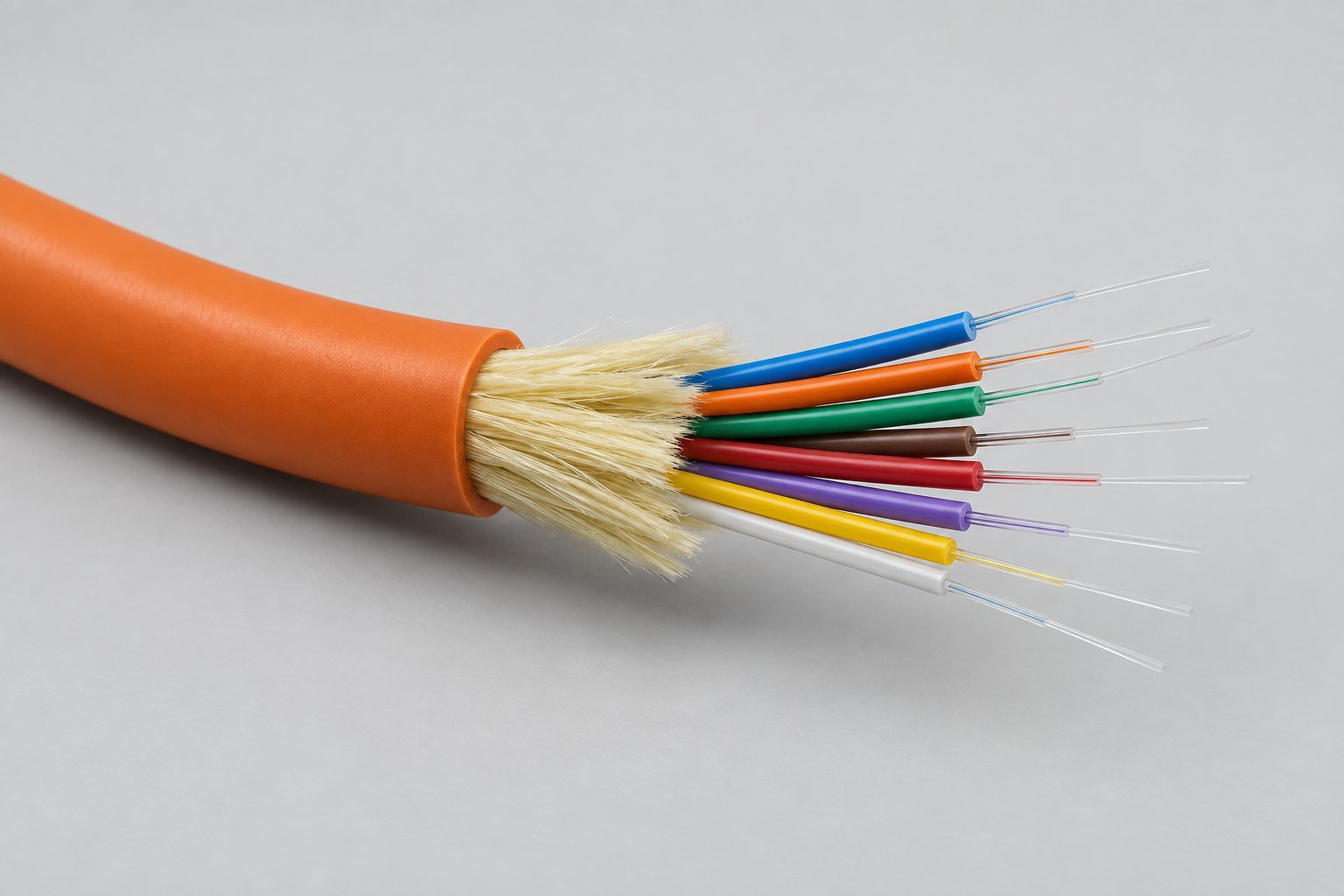
Nexora Communications is a Shenzhen-based B2B fiber optic network equipment manufacturer whose indoor cable families are built for exactly this zoning decision. The Indoor Tight-Buffered Fiber Optic Cable covers 2 to 144 cores in OS2, OM3 or OM4, with LSZH or PVC jackets in riser (OFNR) or plenum (OFNP) ratings, a 900 µm tight buffer for direct termination, and static/installation bend radii of 10 × and 20 × cable diameter. The Distribution Fiber Optic Cable covers 2 to 48 cores in tight-buffered or loose-tube construction with an LSZH jacket for building distribution, patch panels and ODF break-outs.
On the commercial side, manufacturing runs through a 16,000+ m² Shenzhen facility with 12 production lines and more than 30 QC stations covering incoming material, in-process and final inspection; attenuation and geometry are checked on the finished assembly before packing, and each reel is labelled with its fiber count, fiber type and length. The company has delivered more than 500 OEM/ODM projects across 50+ countries and supports custom jacket printing and custom lengths — useful when the cable schedule needs zone codes printed on the jacket. Typical production lead time for standard indoor constructions is in the range of 7 to 25 working days depending on the family, fiber count and jacket rating, with custom builds scheduled individually; MOQ is set per configuration, with small trial quantities possible for a first order. All figures here are typical references — confirm the schedule and MOQ for your specific configuration with the quotation.
Warranty across the Nexora cable range is 12 months from shipment date, covering manufacturing defects reported within that period, with claims handled against the reel label and delivery documents. The scope and the claims process are described in detail in the dedicated guide What Does a 12-Month Warranty Really Cover for Fiber Optic Buyers? For packing and shipping logistics — reel sizes, drum weights and delivery inspection — see How Is Fiber Optic Cable Packed and Shipped for Export? And once the cable is on site before installation, the warehouse storage guide explains how to protect reels from damage and waste: How Should You Store Fiber Optic Cable in Your Warehouse to Prevent Damage and Waste?
Frequently Asked Questions
Is OFNP required everywhere inside a data center?
No. The requirement follows the zone, not the facility type. In many data centers only the underfloor supply-air plenum and certain return-air ceiling voids are plenum spaces; equipment rooms, corridors with no air movement and dedicated riser shafts follow their own zone requirements. Map the spaces against the HVAC drawing and order per zone.
Can I use one fiber count and rating for the whole building to simplify purchasing?
You can order it that way, but you will usually pay for it twice: once in the OFNP premium on routes that did not need it, and once in the re-work if a riser-rated length ended up in a plenum. Zone-mapped ordering costs one planning pass and usually reduces the total cable spend.
Does the fire rating affect the optical performance of the fiber?
No. The rating describes the jacket's flame and smoke performance. The same OS2 or OM4 fiber with the same attenuation is available in each rating, so the link budget does not change with the jacket choice.
Can tight-buffered cable be used in the riser?
Yes — tight-buffered designs are a common riser choice because riser distances are short and the fibers terminate at panels on each floor. Confirm the riser rating (typically OFNR) and the vertical support plan for the shaft height involved.
How much spare capacity should I plan in an indoor backbone?
A consistent convention across the project, such as 25–30% spare cores per vertical run, is a common planning reference. The right margin depends on the tenant's stated growth and the services sharing the backbone; the key is to distribute the spare where future break-outs will happen.
What is the difference between LSZH and OFNP?
They answer different questions. OFNP is a flame-and-smoke rating for plenum spaces; LSZH is a jacket material that limits halogen acid gas in the smoke. An LSZH cable can be riser- or plenum-rated, and the two are specified together as a pair.
Do I need plenum cable between the building entry and the first patch panel?
The segment is indoors, so it must carry the rating of the zone it passes through — which may be riser or plenum depending on the route. Plan the entry-to-first-zone routing in the cable schedule rather than treating it as leftover outdoor cable.
What bend radius should I design into the tray layout?
Use the datasheet values for your construction. For the tight-buffered indoor families referenced in this guide, the typical figures are 10 × cable outer diameter installed and 20 × under pull load — confirm the exact values on the datasheet before finalising the route.
Can jacket printing show zone codes for the installer?
Yes. Custom jacket printing is supported for OEM and ODM orders, and many buyers print zone or floor codes alongside the standard marking so the installer and the inspector can verify the rating zone by zone.
What warranty applies to the indoor cable families?
Nexora fiber optic cables carry a 12-month warranty from shipment date covering manufacturing defects reported within that period. Claims are handled against the reel label and delivery documents; keep both with the shipment.
Key Takeaways
- Treat indoor fiber as a zoning decision. Riser, plenum and horizontal zones carry different fire requirements, and the cable must match the zone it runs through — not the average of the building.
- Confirm the plenum boundary from the HVAC drawing, and get the required rating confirmed in writing before production. This is the single cheapest prevention against the most expensive class of indoor re-work.
- Order the rating and jacket material as a pair (OFNR/OFNP × LSZH/PVC) so both the fire requirement and the smoke-composition requirement are covered.
- Use tight-buffered construction where fibers terminate and consider one multi-core distribution cable per route instead of bundles of individual cords — the labour saving usually dwarfs the unit-price difference.
- Size the fiber count with the stated growth margin, respect the 10 × / 20 × bend-radius limits in the tray layout, and plan the outdoor-to-indoor transition with a splice point at the entry.
If you are planning an indoor fiber order and want the zoning decisions checked against your cable schedule, send us the zone map, fiber counts and required ratings — the team will confirm availability, ratings and lead time for each zone in one quotation. For the surrounding decisions — cable selection overall, termination at the ODF, bend-insensitive fiber for tight indoor routes, and the full patching picture — the related guides below cover each step.