
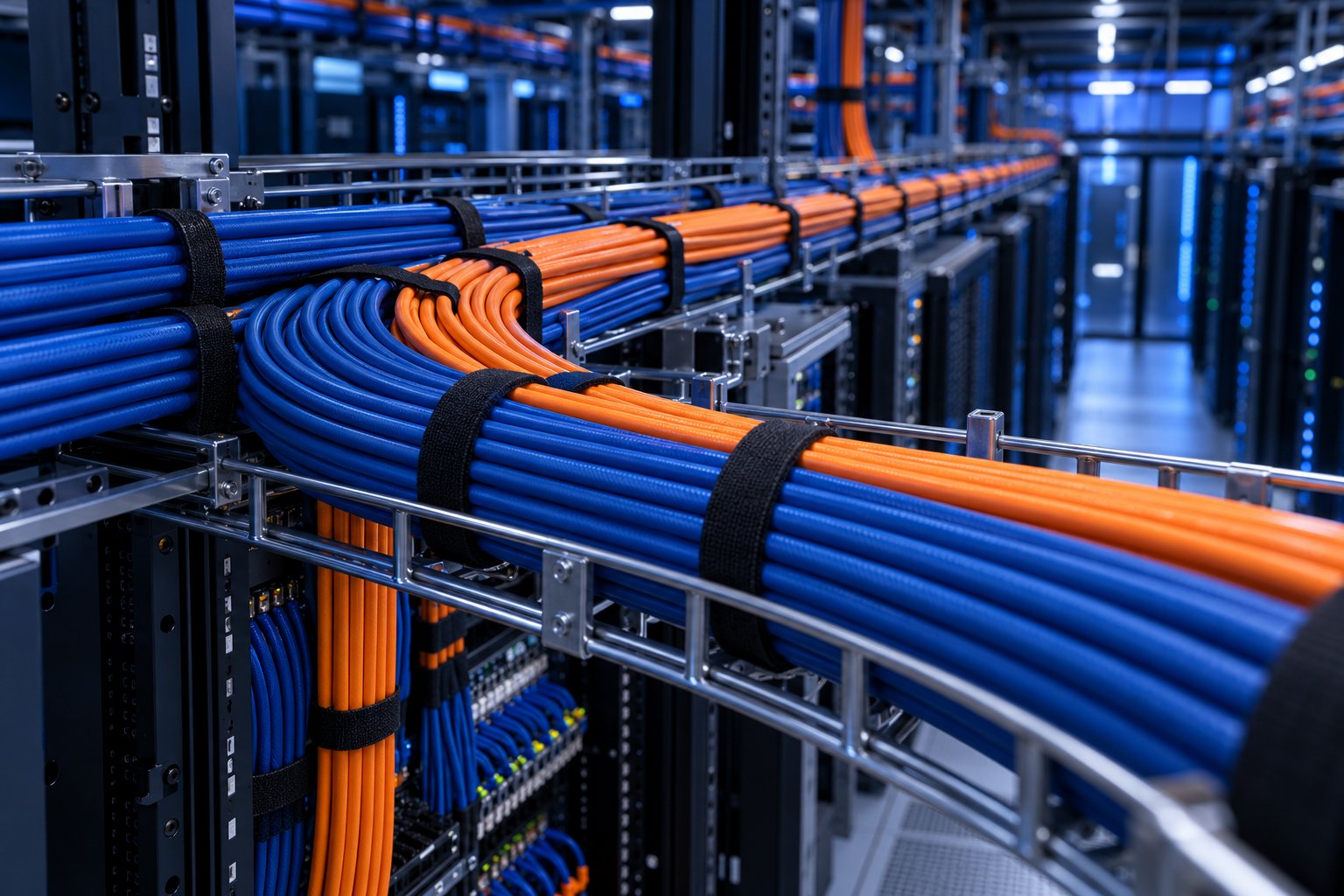
This guide explains what LSZH (low smoke zero halogen) fiber optic cable is, how it compares with PVC and PE jackets, where fire-safety codes require it, which IEC and EN 50575 tests define its performance, and how B2B buyers should specify and verify it — with Nexora's LSZH-capable indoor cable, FTTH drop, patch cord, and pigtail product line linked throughout.
When a fiber optic cable burns inside a building, a data center, or a tunnel, the jacket material around the glass determines how much smoke is produced, how toxic that smoke is, and how quickly people can evacuate. That is why low smoke zero halogen (LSZH) jackets have become a default requirement in a growing number of tenders and indoor installations. Yet many buyers still order indoor fiber cable on price alone and discover the mismatch only when a consultant, fire marshal, or end customer rejects the installation.
This guide answers the questions overseas B2B buyers ask us most often: what exactly is LSZH fiber optic cable, how does it compare with PVC and PE jacket materials, where is it required or strongly recommended, which standards define its performance, and which design parameters you should confirm with your supplier before placing an order. All figures given as typical industry values should be verified against the datasheet of the specific cable you purchase; nothing in this article should be read as a guaranteed performance commitment for any particular shipment.
What Exactly Is LSZH Fiber Optic Cable?
LSZH stands for low smoke zero halogen, sometimes written as LSOH, LS0H, or LSHF (low smoke halogen free). An LSZH fiber optic cable is a fiber cable whose outer jacket is made from a halogen-free compound — typically a polyolefin base (such as polyethylene or EVA copolymer) loaded with inorganic flame retardants like aluminum hydroxide (ATH) or magnesium hydroxide (MDH) — formulated so that, when exposed to fire, it produces very little smoke and releases no halogen acid gases.
The word "zero halogen" refers to elements such as chlorine and fluorine. Conventional PVC (polyvinyl chloride) jackets contain chlorine by design. When PVC burns or is heated to decomposition, it releases hydrogen chloride (HCl), which combines with moisture in the air to form hydrochloric acid. That acid corrodes electronic equipment, cable trays, switchgear, and structural steel — often causing more long-term damage than the fire itself. Dense smoke from burning PVC also obscures exit routes and blocks the light of emergency signage, which is one of the most dangerous factors in enclosed-space evacuations.
LSZH compounds take a different route to flame retardancy. Instead of relying on chlorinated chemistry, they use metal hydroxide flame retardants that absorb heat and release water vapor when heated — an endothermic reaction that cools the burning surface and suppresses flame spread without generating halogen acid gas. The trade-off is technical: achieving the same flame-retardant class with halogen-free chemistry usually requires a high loading of inorganic filler, which makes the compound stiffer and typically a little more expensive than general-purpose PVC. Modern formulations have narrowed the flexibility gap considerably, and for most indoor routing the difference is minor, but it is a real design consideration for very small bend radii and cold-weather installations.
It is worth separating three related properties that buyers sometimes conflate:
- Flame retardant: the cable resists flame spread under defined test conditions (for example IEC 60332 series). A PVC cable can be flame retardant without being LSZH.
- Low smoke: the cable emits reduced smoke density under defined test conditions (for example IEC 61034).
- Zero halogen: the compound releases negligible halogen acid gas under defined test conditions (for example IEC 60754).
A cable described only as "flame retardant indoor cable" may meet none of the LSZH requirements. Always check which tests the specific jacket has passed, and ask the manufacturer for the corresponding test report rather than relying on a generic datasheet claim.
How Does LSZH Compare with PVC and PE Jacket Materials?
Buyers choosing between jacket materials are really choosing between fire behavior, mechanical behavior, and cost. Here is how the three most common jacket families compare for indoor fiber optic cable. All entries are typical industry characteristics for guidance; the exact values for a specific cable depend on its design and compound grade, and the manufacturer's datasheet governs.
| Property | LSZH | PVC | PE (outdoor) |
|---|---|---|---|
| HCI acid gas emission | None (halogen-free) | Significant when burning | None (but burns readily) |
| Smoke density in fire | Low | High, dense black smoke | Moderate to high |
| Flame spread | Self-extinguishing grades available (IEC 60332) | Flame-retardant grades available | Poor unless modified |
| Corrosion of nearby equipment | Minimal | High risk from acid gases | Low, but sustained fuel load |
| Flexibility at room temperature | Good; slightly stiffer than premium PVC | Very flexible | Moderate |
| Low-temperature behavior | Typical installation range roughly -10 °C to +70 °C (grade dependent) | Typically similar to slightly narrower | Good, commonly to -40 °C for outdoor grades |
| Moisture resistance | Good | Good | Excellent |
| Relative cost | Highest of the three | Lowest | Low to moderate |
| Typical best use | Indoor, enclosed, occupied or high-value spaces | General indoor, cost-driven, areas where smoke/acid risk is accepted | Outdoor buried, aerial, duct |
Two practical conclusions follow from this table. First, LSZH and PVC are not interchangeable in projects where people evacuate through the same spaces that carry cable: metros, tunnels, high-rise risers, hospitals, airports, and public buildings. Second, PE is an outdoor material, not an indoor one; using an outdoor PE-jacketed cable inside a building without a proper transition — or without a firestopping and riser-rated design — fails most indoor code frameworks regardless of the fire scenario.
Cost is the area where buyers most often over- or under-specify. In bulk manufacturing, the jacket compound is only one part of the cable's bill of materials, so the premium for LSZH over PVC on a finished patch cord or indoor cable is usually a modest percentage rather than a doubling of price. Conversely, on very large distribution-cable volumes the difference does add up, which is exactly why the material choice should be driven by the installation environment and the applicable code, not by habit.
Where Should You Specify LSZH Fiber Optic Cable?
The common principle behind every LSZH application is the same: cable routes pass through enclosed spaces that people occupy or that contain high-value equipment. When fire risk is combined with evacuation routes or with equipment whose downtime cost dwarfs the cable cost, LSZH earns its premium. The following scenarios account for most LSZH demand we see in export orders.
Data centers and central offices
Modern data centers concentrate enormous equipment value along dense cable trays. A fire that produces acid gas can corrode server connectors and switch contacts well beyond the room where it started, turning a localized incident into a fleet-wide reliability problem. For that reason, many operators and colocation providers specify LSZH or plenum-class cabling inside the white space and in interconnect rooms. High-density zones that use MPO/MTP assemblies and OM4 multimode links frequently ask for LSZH jackets on both trunk and patch cabling, and several of our data-center patch cord orders in recent years have specified LSZH specifically for this reason.
High-rise buildings, risers, and horizontal distribution
In commercial towers, indoor distribution cable and tight-buffered cable run through riser shafts and ceiling voids shared with HVAC and electrical systems. Fire codes in many markets — expressed through local adaptations of IEC or UL frameworks — restrict what may be installed in plenum and riser air paths. LSZH tight-buffered and distribution cables are the standard answer where the specification calls for halogen-free behavior in these vertical and horizontal runs, particularly in jurisdictions where low-smoke requirements are explicitly written into building regulations.
Tunnels, metros, and rail infrastructure
Rail tunnels, metro stations, and road tunnels are the textbook LSZH environment: long enclosed routes, large numbers of evacuating people, and smoke extraction systems that cannot cope with dense combustion products. Rolling stock and trackside cabling specifications almost universally demand halogen-free jackets, and the same logic extends to the fiber backbone that carries signaling, CCTV, and communications along the line.
Ships, offshore platforms, and marine applications
Marine class societies treat halogen-free cabling as a core safety requirement, since smoke and toxic gas inside a vessel's hull are more dangerous than the fire itself in many scenarios. Fiber backbone links on ships, offshore wind platforms, and FPSO vessels routinely call for LSZH or marine-approved equivalents, with additional mechanical requirements such as resistance to salt mist and oil.
Airports, hospitals, schools, and public venues
Anywhere large crowds gather, the fire-safety engineering of smoke and toxic gas dominates the cable specification. Hospitals add a second dimension: critical care areas cannot be evacuated quickly, so smoke toxicity in ceiling voids and shafts is a first-order design constraint. Public tenders in the Middle East, Europe, and increasingly in Southeast Asia name LSZH explicitly for these building types.
Telecom rooms, campus backbones, and FTTH indoor segments
Even in smaller installations, the indoor segment of an FTTH drop cable — from the building entry to the subscriber's optical network terminal — often runs through occupied corridors and stairwells. Specifying an LSZH jacket option on the drop cable and on indoor patch cords is a low-cost way to align the whole indoor link with the building's fire-safety strategy. The same applies to enterprise telecom rooms, where racks of patch cords sit inside occupied floors.
Which Standards and Test Methods Define LSZH Performance?
LSZH is not a single pass/fail certificate; it is a family of test methods, each measuring one fire parameter. Understanding which test applies to which property lets you read a datasheet critically instead of accepting a blanket "LSZH compliant" claim. The tests below are the ones buyers encounter most frequently in international tenders. Performance descriptions are typical interpretations for guidance; the governing documents are the standards themselves and the test reports issued for the specific cable design.
Flame spread: IEC 60332 series
IEC 60332-1 (parts 1-2) covers flame spread on a single vertical insulated wire or cable — the basic self-extinguishing test. IEC 60332-3 (categories A, B, C, D) covers flame spread on bunched cables installed vertically in ladder or tray configurations, which is far more representative of how cables actually behave in a building riser. Category C is the level most commonly specified for general indoor data cabling, while categories A and B appear in tunnels and high-density installations. When a tender says "IEC 60332-3 Cat.C," it is talking about bunched-cable flame spread, not the single-cable test, and the two results are not interchangeable.
Halogen acid gas emission: IEC 60754
IEC 60754-1 measures the amount of hydrogen halide acid gas evolved during combustion of the cable material; the traditional pass criterion is below 0.5% HCl equivalent. IEC 60754-2 measures gas acidity by pH and conductivity, with commonly cited criteria of pH ≥ 4.3 and conductivity below specified limits. A genuinely halogen-free compound passes both comfortably; a "low-halogen" compound may pass one but not the other, so buyers should ask which parts were tested.
Smoke density: IEC 61034
IEC 61034 measures the transmission of light through smoke generated in a specified chamber — in practice, the criterion most tenders cite is that minimum transmittance over the test exceeds 60%. Low smoke is what keeps exit signage visible and ventilation manageable during evacuation, and it is the property most directly tied to life safety in enclosed spaces.
Riser and plenum classifications: UL 1666 and NFPA frameworks
In North American practice, cables are classified for vertical riser (OFNR / riser) and forced-air plenum (OFNP / plenum) environments by different test regimes. A plenum-rated cable must pass a stricter flame and smoke test than a riser cable. LSZH and plenum are related but distinct concepts: a cable can be plenum-rated without being halogen-free, and vice versa. Projects that reference both requirements need cables that satisfy both test families, and buyers should ask the manufacturer to confirm each rating separately.
Construction Products Regulation (EN 50575) for the European market
For cables supplied into the EU, EN 50575 defines fire performance classes (B2ca, Cca, Dca, Eca, and so on) with declared performance for flame spread, smoke production (s1, s2, s3), acid gas emission, and flaming droplets. A cable marketed in Europe should carry a Declaration of Performance with a class such as Cca-s1a,d1,a1. If your EU-bound project specifies LSZH behavior, asking for the DoP and its class is far more reliable than asking whether the cable "is LSZH," because the class bundles all the fire parameters into one audited declaration.
Reading test reports critically
Three habits protect buyers here. First, match the report to the exact cable construction — jacket compound, fiber count, and overall diameter all affect test results, so a report for a 12-core design does not automatically cover a 48-core one. Second, check the testing body: reports from accredited third-party laboratories (for example national accreditation members of ILAC) carry more weight than self-declared in-house results, although in-house data is still useful for incoming-material control. Third, check the standard's edition year; fire test methods are revised periodically, and a very old edition may no longer be accepted by the end customer's consultant.
What Design Parameters Should Buyers Confirm Beyond the Jacket?
A jacket material alone does not make a cable. Two cables with identical LSZH claims can behave very differently in service if the underlying construction differs. Before ordering, confirm the following parameters in writing with your supplier. Where values below are described as typical, treat them as industry reference points and verify against the specific datasheet.
- Fiber type: single mode G.652D for standard outside-plant-compatible links, G.657A bend-insensitive fiber for tight indoor routing and FTTH drops, OM3/OM4 laser-optimized multimode for premises and data-center links. Match the fiber class to the transmission plan of the equipment at both ends.
- Fiber count: indoor distribution cables commonly run from 2 to 48 cores (tight-buffered designs can reach 144 cores); leave realistic spare capacity for future moves, adds, and changes instead of sizing for today only.
- Buffer type: 900 µm tight buffer for easy stripping and connectorization indoors; loose tube with gel or dry water-blocking for moisture-tolerant designs. Tight buffer terminates faster; loose tube handles longer runs and temperature swings better.
- Strength members and armor: aramid yarn for flexible patch cords; FRP (fiberglass reinforced plastic) central members for metal-free indoor requirements; steel wire or corrugated steel tape where rodent protection or higher crush resistance is needed — noting that metallic elements reintroduce design questions in electrical-bonding-sensitive environments.
- Attenuation: typical values for G.652D single mode are around 0.36 dB/km at 1310 nm and 0.22 dB/km at 1550 nm; for OM4 multimode around 3.0 dB/km at 850 nm and 1.0 dB/km at 1300 nm. These are typical industry figures, not guarantees; the reel-specific test data printed on the drum and the datasheet govern acceptance.
- Temperature range: typical indoor LSZH installation ranges around -10 °C to +70 °C vary by compound grade; cold-weather projects should confirm the installation temperature limit explicitly, because LSZH compounds are generally less tolerant of very cold installation than outdoor PE.
- Bend radius and crush resistance: typical minimum bend radii of 10 to 20 times the cable outer diameter during installation, relaxing after installation, are common design references; G.657A fiber inside allows tighter routing than standard G.652D.
- Print marking and traceability: jacket printing with the manufacturer's name, cable type, fiber count, standard references, and meter marks supports both site QA and later fault diagnosis. OEM buyers should confirm the marking format and logo authorization in the order.
One more parameter matters more than buyers expect: consistency across the order. A cable that passes LSZH tests in one production batch but is re-made with a substitute compound in a later batch has silently lost its fire performance. Batch-level material traceability — which compound lot went into which cable drum — is what protects you over multi-year framework supply, and it is a question well worth asking any prospective supplier.
What Are the Most Common Buyer Mistakes with LSZH Fiber Optic Cable?
Across hundreds of OEM and project inquiries, a handful of mistakes recur. Avoiding them costs nothing at specification time and saves expensive rework later.
Assuming every indoor cable is LSZH
Indoor cable is not synonymous with LSZH cable. Plenty of indoor products ship with standard PVC jackets because they are cheaper and perfectly adequate for cost-driven projects. The jacket material must be written into the purchase order, not assumed from the word "indoor."
Specifying "flame retardant" when LSZH is meant
"Flame retardant" describes flame spread behavior only. A PVC cable can be flame retardant and still produce dense, acidic smoke. If the project's fire-safety rationale is smoke and toxicity in evacuation routes, the specification must name the halogen-free and smoke tests explicitly — or the CPR class for EU supply — rather than a generic flame-retardant phrase.
Ignoring the destination market's regulatory framework
A cable sold with IEC test reports may still need a CPR Declaration of Performance to enter the EU construction market, and a plenum classification for certain North American air paths. Mapping the destination market's framework before quoting avoids the classic situation where technically acceptable cable cannot clear the consultant's document review.
Mixing jacket specifications across related SKUs
A project that orders LSZH distribution cable but ordinary PVC patch cords has left a weak link in the fire strategy — literally, since patch cords are often the most exposed cables on the rack. Align the jacket specification across cables, pigtails, and patch cords on the same link, and state it in the RFQ so the supplier quotes a consistent set.
Treating LSZH as a guaranteed life-safety system by itself
LSZH improves fire behavior; it does not make a cable fireproof, and it does not replace compartmentation, detection, or suppression systems. Consultants sometimes reject specifications that lean on jacket material alone to satisfy a fire strategy. Use LSZH as one layer in the design, documented by test reports, rather than a headline claim.
Ignoring storage and installation temperature
Halogen-free compounds vary in low-temperature flexibility. Cable stored in unheated containers or installed in winter conditions can crack if bent below its rated installation temperature. Confirm the storage and installation temperature window for the specific compound, especially for projects in cold regions or with long outdoor site storage.
Which Nexora Products Are Available with LSZH Jackets?
Nexora Communications manufactures and exports a full fiber optic product line from Shenzhen, and LSZH jacket options run across the indoor cable and connectivity range that international buyers most often combine in one order. The products below all offer LSZH jacket options per their published configurations; final jacket availability for a specific fiber count or length should be confirmed in the quotation.
- Indoor distribution cable: the Distribution Fiber Optic Cable is a flexible multi-core indoor design (2-48 fibers, G.652D or OM3/OM4 options) with an LSZH jacket for building and data-center routing where easy branching matters.
- Tight-buffered indoor cable: the Indoor Tight-Buffered Fiber Optic Cable offers a 900 µm tight buffer, 2-144 fiber counts, and LSZH or PVC jacket options for riser and plenum runs, patch panels, and short-haul indoor distribution.
- FTTH drop cable: the FTTH Drop Cable is a bow-type flat design with G.657A bend-insensitive fiber, 1-4 fibers, steel or FRP strength members, and LSZH or PE sheathing — the LSZH option covering the indoor subscriber segment.
- Single mode patch cords: the LC-LC Duplex Single Mode Patch Cord and the SC-SC Single Mode G.652D Patch Cord are standard workhorses for equipment-to-panel links, with jacket options specified per order.
- Multimode data-center patch cords: the LC-LC Duplex Multimode OM4 Patch Cord is built for 40G/100G data-center links with LSZH or PVC jacket options, insertion loss ≤0.3 dB max per cord (≤0.2 dB typical), and return loss ≥20 dB, in custom lengths from 0.5 m to 30 m.
- Pigtails and splicing consumables: the Fiber Optic Pigtail range (SC/LC/FC, single mode or multimode) supports ODF termination with matching jacket options for indoor frames.
- Complementary outdoor and protected designs: for links that transition outdoors, the Armored Fiber Optic Cable covers protected routing, and its indoor termination typically uses the LSZH indoor products above.
Combining these in one purchase order keeps the jacket specification consistent end to end. As a manufacturer with a 16,000+ m² facility, 12 production lines, and 30+ QC stations covering incoming material, in-process, functional, and final inspection, Nexora also supports OEM/ODM jacket marking, custom fiber counts, custom lengths, and bulk supply — more than 500 OEM/ODM projects have been delivered to customers in 50+ countries since our founding in 2014. Warranty on supplied fiber optic products is 12 months from shipment date.
How Should You Evaluate an LSZH Fiber Optic Cable Supplier?
Because LSZH is fundamentally a fire-safety material claim, supplier selection deserves more scrutiny than a simple price comparison. A practical evaluation checklist:
- Ask for construction-specific test reports, not just marketing datasheets — flame spread, halogen gas, and smoke tests performed on the fiber count and construction you are buying.
- Verify material traceability — can the supplier state which compound lot was used for your batch? Framework buyers should treat this as a hard requirement.
- Check incoming-material QC — jacket compound should be verified at goods-in, not assumed from the purchase invoice. Ask how many QC stations and checks the factory runs and at which stages.
- Confirm capacity against your schedule — a plant running 12 production lines with an annual capacity in the millions of units absorbs large framework orders without emergency compound substitution.
- Review OEM/ODM depth — custom jacket printing, custom fiber counts, hybrid constructions, and private-label packaging should be standard capability, with completed project references you can verify.
- Request samples and do a simple jacket check — burn behavior cannot be judged by eye, but sample review does confirm build quality, print legibility, diameter consistency, and packaging before bulk production.
Suppliers who answer these questions with documents rather than adjectives are the ones who will still be consistent in year three of a supply agreement.
How Are LSZH Jackets Manufactured and Quality-Controlled?
Understanding how an LSZH jacket is actually made helps buyers judge which supplier claims are plausible. The process starts at the compound stage: a halogen-free compound is either purchased from a specialized compounder or formulated in-house, blending a polyolefin base resin with ATH or MDH flame-retardant powder, stabilizers, processing aids, and pigments. Compound quality is the single largest determinant of LSZH performance — filler dispersion, moisture content, and lot-to-lot consistency all show up later in the fire test results, which is why serious manufacturers verify incoming compound against certificates of analysis rather than trusting the delivery note.
Extrusion is the next critical step. Compared with PVC, halogen-free compounds are generally more sensitive to processing temperature and shear: overheating can cause pre-degradation of the metal hydroxides and surface defects, while insufficient melt homogeneity leaves filler agglomerates that weaken the jacket and distort test performance. Line speed, screw configuration, and cooling practice are tuned per compound grade, and jacket thickness is measured continuously or by frequent sampling against the construction drawing.
Quality control then runs through several layers. At incoming inspection, compound lots are checked for moisture, density, and MFR consistency. During production, in-process checks cover jacket diameter, concentricity, surface finish, and printing legibility. On finished cable, functional and visual inspections verify attenuation against the reel test data, jacket integrity, drum winding, and packaging. For fire performance, periodic type testing at accredited laboratories — or at minimum retention of valid reports for the exact construction — keeps the documented evidence aligned with what the line is producing. Buyers evaluating a factory can simply ask: which of these checkpoints exist, how many QC stations run them, and can I see records for my batch?
Batch traceability closes the loop. A drum label that references the production order, compound lot, and reel test data turns a fire-performance claim into an auditable chain. For framework buyers who reorder the same construction over years, this chain is what prevents a quiet substitution of a cheaper compound somewhere in the middle of the relationship — a failure mode that only becomes visible after an incident or a consultant audit, when it is far too late.
What Installation Practices Protect LSZH Cable Performance?
The fire performance of an installed cable depends on the cable as delivered, but its service life depends heavily on installation practice. Four areas deserve attention on site.
Respect the bend radius during pulling, not just at rest. LSZH compounds are typically a little stiffer than PVC at room temperature, and pulling tension around corners concentrates stress at the sheath. Use appropriate sheaves and pull boxes, observe the manufacturer's minimum bend radius during installation — commonly quoted at 10 to 20 times the cable outer diameter depending on construction — and never pull a cold cable straight from a winter container without letting it acclimatize.
Control pulling tension and lubrication. Excessive tension deforms the jacket and can disturb the fiber inside long before any visible damage appears. Rated pulling tension values are construction-specific; the installation supervisor should have them on the method statement, along with approved cable lubricants that are compatible with the jacket compound.
Keep fire stopping and segregation intact. An LSZH cable passing through a fire-rated wall still needs a properly rated penetration seal; the jacket does not restore compartmentation. Similarly, maintaining separation from power cables according to the project's segregation matrix preserves both electrical safety and the assumptions behind the fire design.
Document as-built details. Recording drum numbers, reel test data, and route drawings during installation gives the operator a traceable record that supports later maintenance and any future audit of the fire-safety documentation. On large projects this costs minutes per drum and saves days during handover.
What Does LSZH Really Cost, and How Should Buyers Frame the Premium?
Pricing questions dominate RFQ discussions, so it helps to decompose where the LSZH premium actually comes from. The compound itself typically costs more per kilogram than general-purpose PVC, and its higher filler loading means slightly more material for the same jacket diameter in some constructions. Processing can be a little slower due to tighter temperature control, adding modestly to conversion cost. Testing adds real money as well: accredited third-party fire tests are charged per construction, and a manufacturer who maintains current reports across a product range is recovering that cost across its order book.
Against these costs, buyers should weigh the avoided ones. Rejected installations, re-delivery of non-compliant cable, consultant review delays, and — in the worst case — corrosion damage to adjacent equipment after a fire all cost far more than the jacket premium. On a typical indoor project, the LSZH uplift on the cable and connectivity portion is a small fraction of total project value, while the compliance risk it removes is disproportionate. That asymmetry is exactly why public tenders and data-center specifications keep widening their LSZH requirements rather than narrowing them.
Negotiation with manufacturers also works differently for LSZH than for commodity cable. Because the compound and its traceability matter, an unusually low quote deserves the same scrutiny as an unusually low price on any fire-related product: which compound, whose test reports, and what traceability documentation will accompany the shipment? A supplier who answers those questions with documents is competing on the right dimension.
Frequently Asked Questions
Is LSZH cable worth the higher price for ordinary office projects?
Where cable routes share spaces with occupants and evacuation routes — typical office ceilings and risers — the premium is small relative to total project cost, and many local codes or consultants already require it. In light industrial or equipment-only spaces with short routes, standard PVC may be a legitimate engineering choice. The decision should follow the fire-safety design and applicable code, not price habit in either direction.
Can LSZH cable be used outdoors?
Standard LSZH compounds are designed for indoor environments; they are generally less moisture- and UV-resistant than outdoor PE sheathing and typically less tolerant of very cold installation temperatures. Some designs pair an outdoor PE outer sheath with an LSZH inner jacket, or offer a specialized outdoor-grade halogen-free compound. For buried, aerial, or duct runs, confirm the sheath design with the manufacturer rather than assuming a single jacket can serve both environments.
Is LSZH the same as plenum-rated cable?
No. Plenum rating is a North American classification for cables installed in forced-air spaces, tested for flame spread and smoke under a specific regime. LSZH describes halogen-free, low-smoke compound chemistry tested under IEC methods. A cable can carry one, both, or neither classification. Projects referencing both frameworks need both verified separately.
What fire performance classes apply in the European Union?
Cables permanently installed in EU construction works fall under EN 50575 and the Construction Products Regulation, with classes such as B2ca, Cca, and Dca plus supplementary smoke (s1-s3), acid gas, and droplet classifications. Ask your supplier for the Declaration of Performance matching the class named in your specification.
Does the LSZH jacket affect optical performance?
The jacket is outside the optical path, so attenuation and bandwidth are set by the fiber and cable design, not the compound. The practical interactions are mechanical: a stiffer compound can demand slightly larger bend radii, and compound density slightly affects cable diameter and weight. Well-designed LSZH cables handle routine indoor routing without difficulty, especially when built on bend-insensitive fiber.
What information should an LSZH cable RFQ include?
Fiber type and count, buffer and cable construction, jacket requirement with the specific standards or CPR class to be met, environment (indoor only or indoor-outdoor transition), required lengths and drum lengths, print marking format, destination market, and any certification documents the end customer will review. A complete RFQ lets the manufacturer quote the right construction on the first pass and avoids re-quotation delays.
How should we store LSZH cable on site?
Store drums in a dry, shaded area away from sharp objects, keep them in their original packaging until pulling, and avoid stacking heights that deform the lower drums. In hot climates avoid prolonged direct sunlight on the jacket, and in cold climates allow the cable to reach a workable temperature before bending or pulling. Follow the drum handling and rolling guidance printed by the manufacturer rather than dragging drums across rough ground.
Can we order LSZH patch cords and pigtails in custom lengths?
Yes, custom lengths are a standard OEM/ODM capability at specialized manufacturers. When ordering, state the jacket requirement alongside fiber type, connector types and polish, length tolerance, labeling format, and packaging preference, so the quotation covers a consistent specification. This is particularly relevant for data-center projects that pre-stage cabling to exact rack dimensions before installation.
What is the typical lead time for LSZH cable orders?
Standard constructions with available jacket stock are usually produced within the manufacturer's normal lead time for indoor cable, while large custom counts or new constructions may need compound procurement and sample confirmation first. As a reference point, Nexora quotes order-specific lead times against the confirmed construction and quantity; buyers should confirm the schedule in the quotation and allow time for document review when the end customer requires test reports with the shipment.
Conclusion: Specify by Environment, Verify by Report
LSZH fiber optic cable exists for one reason: when cable burns where people work, travel, or gather, the smoke should be light and the gas non-corrosive. The material costs slightly more, is slightly stiffer, and rewards buyers who specify it precisely — by test standard, by construction, and by destination-market framework — with installations that clear consultant review and age safely over their full service life. Check the jacket requirement against each space the cable passes through, keep the specification consistent from distribution cable down to the last patch cord, and hold suppliers to construction-specific test reports.
If you are preparing a tender, a data-center fit-out, or an FTTH rollout and need LSZH options quoted across cables, patch cords, and pigtails in one consistent order, the Nexora export team can review your routing plan and jacket requirements, then return a construction-matched quotation with the supporting test documentation your end customer expects.