
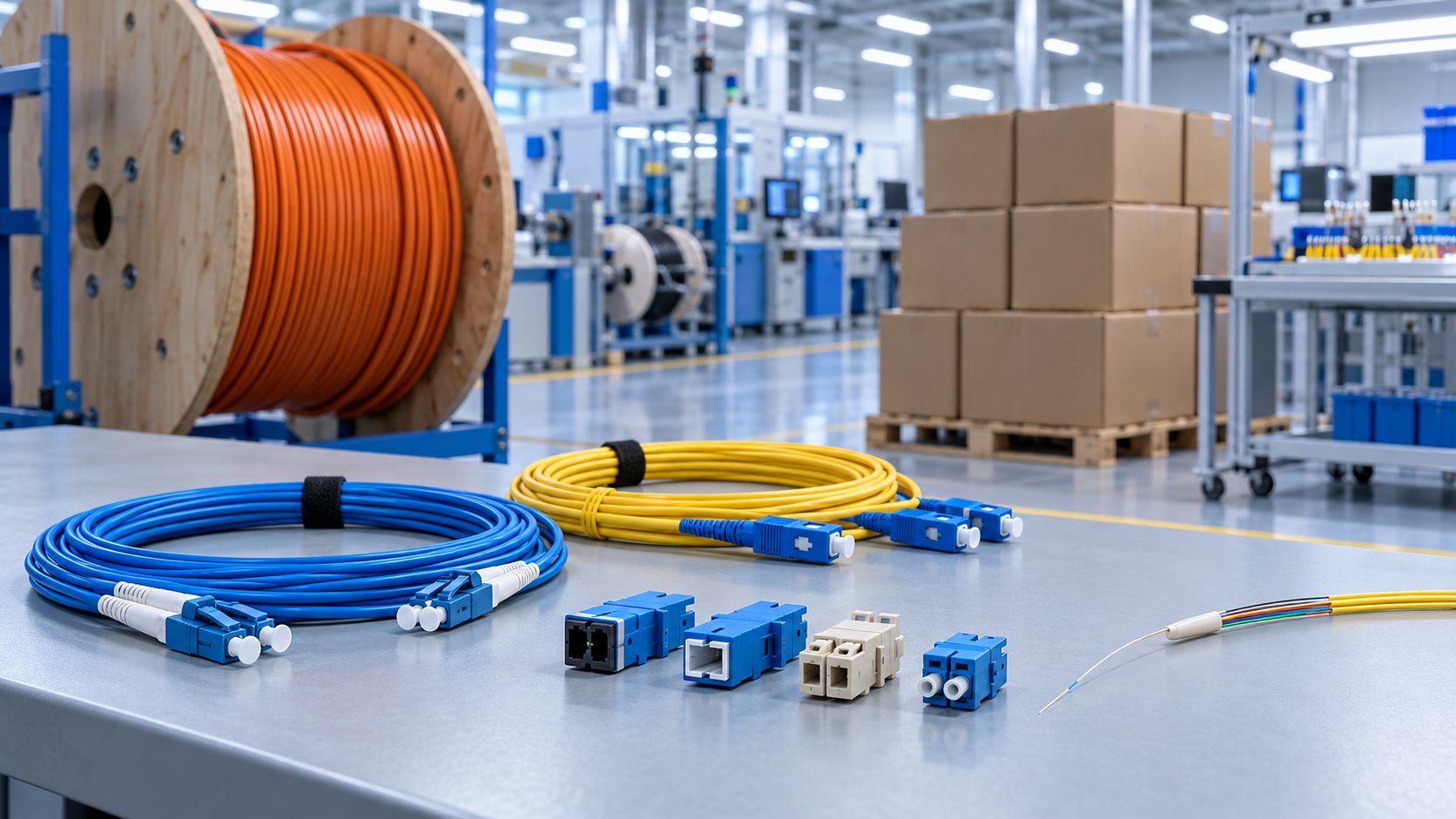
Узнайте, как работают минимальный объём заказа (MOQ) и срок производства при заказе оптоволоконного кабеля, патч-кордов и адаптеров, что определяет каждый показатель и как спланировать первый заказ.
Almost every overseas buyer who contacts a fiber optic manufacturer for the first time asks the same two questions before anything else: what is your MOQ, and how long is your lead time? The answers decide whether a supplier is even worth a second email, because they determine how much capital you tie up in stock, how quickly you can respond to your own customers, and how much risk you carry on a first order. This guide explains how MOQ and lead time actually work when you order fiber optic cable, patch cords, pigtails and adapters from a manufacturer, what drives each number up or down, how sampling fits into the process, and how to structure a first order so that neither side is exposed.
What does MOQ mean when you buy fiber optic products?
MOQ stands for minimum order quantity. It is the smallest quantity a manufacturer is willing to produce and ship in a single order, and it exists because every production run carries fixed costs that do not shrink when the quantity shrinks. Setting up an extrusion line, changing a connector type on an assembly bench, printing a custom jacket, cutting a specific length, or preparing private-label packaging all take time and labour that are largely independent of how many units come out at the end.
For fiber optic products, MOQ is rarely a single number for the whole catalogue. It is normally expressed per product family, and sometimes per configuration. A standard single mode patch cord in a common connector combination may have a low MOQ because it can be produced alongside other similar orders. A custom-length armored cable with a specific jacket colour and printed marking may have a much higher MOQ, because the setup cost has to be recovered from that one run.
It also helps to understand what MOQ is not. It is not a statement about the smallest quantity the factory is physically capable of making. A factory can usually make one piece of almost anything. MOQ is a commercial threshold: below it, the unit price would have to rise so much that neither side benefits, so the manufacturer sets a floor instead.
What drives the MOQ of fiber optic cable, patch cords and adapters?
Buyers are often surprised that two suppliers quote very different MOQs for what looks like the same product. The difference usually comes from a small number of concrete factors, and once you know them you can often negotiate the number down by changing the specification rather than by arguing about the price.
Whether the product is standard or custom
Standard products that are already in production and held in the catalogue generally carry the lowest MOQ, because they can be scheduled into an existing run. Custom configurations carry a higher MOQ because the line has to be set up specifically for that order. The further a specification moves from the standard range, the higher the MOQ tends to be.
Connector type, polish and fiber type
For patch cords and pigtails, the connector combination is one of the strongest drivers. A common combination such as LC to LC or SC to SC in a widely used polish is easy to schedule. A hybrid cord that puts two different connector families on the same assembly, or a less common polish, requires separate components and separate handling, which raises the minimum. Fiber type matters too: a standard single mode fiber is available in bulk, while a specific multimode grade or a specialty fiber may only be purchased in larger reels, which pushes the minimum order up.
Cable construction and length
For cable, the construction determines how the product is made and therefore what the minimum run looks like. A simple indoor tight-buffered cable is produced in a continuous extrusion process where the economical run length is set by the line, not by the buyer. An outdoor cable with strength members, water-blocking elements and a heavy jacket involves more materials and more process steps, so the minimum run is usually longer. Custom lengths add a cutting and testing step, and unusual lengths can create more waste per run.
Jacket colour, printing and private label
Any change that requires a dedicated setup raises the MOQ. A non-standard jacket colour means a colour change on the extrusion line. Custom printing on the jacket means a printing setup. Private-label packaging means printed cartons, labels and sometimes printed bags, all of which have their own minimum print runs from the packaging supplier. This is why a buyer who wants their own brand on the product should expect a higher minimum than a buyer who accepts the standard presentation.
Packaging format
Packaging is easy to overlook, but it changes the economics of a small order. Cable supplied on a drum, cable supplied in coils, patch cords packed individually in bags, and patch cords packed in bulk all require different handling. A packaging format that needs custom printed material will carry a minimum set by the printer, which can be higher than the minimum set by the cable factory itself.
What is lead time, and what does it actually include?
Lead time is the time between placing a confirmed order and the goods being ready to ship. It is one of the most misunderstood numbers in B2B sourcing, because different suppliers count it from different starting points. Before you compare two lead times, make sure you are comparing the same thing.
A complete lead time normally includes several stages:
- Order confirmation and specification freeze — the point at which the drawing, connector combination, length, packaging and quantity are agreed and locked. Nothing should start before this, because a change after production begins is expensive.
- Material preparation — fiber, cable, connector components, adapters and packaging material have to be available. If a component is not in stock, this stage can dominate the whole lead time.
- Production — cutting, stripping, cleaving, assembly, polishing, jacketing or extrusion, depending on the product.
- Testing and inspection — insertion loss, return loss, end-face inspection, attenuation and continuity checks, plus the visual and packaging inspection stages.
- Packing and documentation — coiling, bagging, cartoning, drum preparation, labelling and the preparation of test records and packing lists.
Two suppliers can quote the same number of days and mean completely different things. One may be quoting production time only, assuming material is already in stock. Another may be quoting the full period from order confirmation to goods ready for dispatch. When you compare quotations, ask each supplier to state explicitly what the quoted lead time includes and what it excludes.
What factors change fiber optic lead time?
Lead time is not a fixed property of a supplier. It moves with the order, the season and the supply chain. The factors below are the ones that most often explain why a quoted lead time turns out to be optimistic or conservative.
Order quantity and production scheduling
Larger orders take longer to produce, but not proportionally. A factory running several lines can often absorb a moderate increase in quantity with a small increase in time, while a very large order may need to be scheduled across multiple runs. The position of your order in the production queue also matters: an order placed just before a peak period waits longer than the same order placed in a quiet month.
Standard versus custom configuration
Standard products that are already in production can often be scheduled quickly. Custom configurations need the line to be set up, and if the specification is still being finalised, the clock has not really started. This is one of the most common causes of a lead time that slips: the buyer believes the order was placed, while the supplier is still waiting for a confirmed drawing.
Component availability
Fiber optic assemblies depend on many small components: ferrules, alignment sleeves, housings, boots, dust caps and adapters. If one of these is not in stock, the whole order waits for it. Component availability is also the factor most exposed to external disruption, which is why a supplier that holds buffer stock of common components can usually quote a shorter and more reliable lead time than one that buys everything to order.
Testing requirements
Testing is not free in time. An order that requires per-reel attenuation records, per-unit insertion loss and return loss data, and end-face inspection results takes longer to release than an order that only needs a standard final check. If your project needs detailed test documentation, build that time into your plan rather than discovering it at the end.
Seasonality and shipping schedules
Demand for fiber optic products is not evenly spread through the year. Periods when telecom and FTTH projects are being commissioned tend to be busier, and public holidays in the manufacturing region reduce effective working days. Ocean freight schedules add a further variable: even when the goods are ready, the sailing schedule determines when they actually arrive. A realistic delivery plan separates production lead time from transit time, because they are controlled by different things.
Documentation and compliance requirements
If your order needs specific documentation — test records, material traceability, packing lists in a particular format, or certificates for the destination market — preparing that documentation takes time and should be requested early. Asking for it after production is finished is a common cause of delay at the packing stage.
How do MOQ and lead time interact?
MOQ and lead time are usually discussed separately, but they are connected. A small order below the standard minimum may still be accepted, but it is often scheduled around larger runs, which can extend the lead time. Conversely, a large order that comfortably exceeds the minimum can sometimes be scheduled more efficiently, because the setup cost is spread over more units.
This interaction is why the cheapest unit price and the shortest lead time rarely come from the same order size. A buyer optimising for unit price will order in large batches and accept longer production windows and more inventory. A buyer optimising for responsiveness will order smaller quantities more often and accept a higher unit price. Neither approach is wrong; the right choice depends on how predictable your own demand is and how much working capital you want to hold in stock.
| Order profile | Typical effect on unit price | Typical effect on lead time | Best suited to |
|---|---|---|---|
| Small trial order, standard product | Higher, because setup is spread over fewer units | Often scheduled around larger runs | First order, market testing, sample approval |
| Standard order at or above MOQ | Moderate | Predictable, based on the production queue | Regular replenishment of established products |
| Large bulk order | Lowest | Longer, and may be split across runs | Projects with known volumes and a fixed schedule |
| Custom configuration | Higher, plus setup | Longer, and depends on specification freeze | Private label and OEM/ODM programmes |
How does sampling fit into the ordering process?
Sampling is the bridge between a specification and a production order, and it is the stage where most first-order risk is removed. A sample lets you confirm the product, the workmanship, the connector end faces, the marking and the packaging before committing to a bulk quantity. For custom and OEM/ODM projects, the approved sample also becomes the reference against which production is inspected.
A typical sampling sequence looks like this:
- Requirement confirmation — you share the product type, connector combination, fiber type, length, quantity range, packaging preference and any branding requirement.
- Feasibility and configuration proposal — the supplier confirms what can be produced, which options are standard and which require a custom setup, and what the MOQ would be for each option.
- Sample development — the sample is produced to the agreed configuration.
- Sample review — you check the physical product, the optical performance data and the packaging, and either approve or request adjustments.
- Specification freeze — the approved sample and drawing become the reference for the production order.
- Bulk production — production and inspection follow the frozen specification.
Two habits make sampling work better. First, review the sample against a written checklist rather than a general impression, so that the approval is based on the same criteria the factory will use in production. Second, treat the sample approval as the moment the specification is frozen. Changes requested after that point are possible, but they reset part of the process and can affect both the lead time and the cost.
It is also worth asking how the sample relates to the production order. A sample that is hand-built by an engineer and a production unit that comes off a line are not always identical, so ask whether the sample is representative of the production process and what tolerances apply.
How should a buyer plan a first order with a new fiber optic supplier?
A first order is a test of the working relationship as much as of the product. Structuring it well reduces risk on both sides and makes the second order much easier.
Start with a clear specification
The single most useful thing you can do is to describe the product precisely. Product type, connector type and polish, fiber type, cable construction, length, jacket material and colour, marking, packaging format and target quantity. A precise specification shortens the quotation stage, reduces the chance of a misunderstanding, and makes the MOQ and lead time answers meaningful rather than generic.
Ask for MOQ and lead time per product, not for the company
Because MOQ and lead time vary by product and configuration, a single company-level answer is not useful. Ask for the numbers against the specific items you intend to order, and ask what would change them.
Separate production time from transit time
When you build your own delivery commitment, keep production lead time and shipping transit time as two separate numbers. They are controlled by different parties, and combining them into one figure makes it impossible to tell where a delay actually occurred.
Confirm what is included in the price and the lead time
Ask whether the quoted lead time includes testing and documentation, whether the price includes packaging in the format you need, and whether any destination-specific documentation is included. These are the items that most often turn into unexpected cost or delay.
Agree the acceptance criteria in writing
For fiber optic products, the acceptance criteria should be stated as values with a test method — for example, insertion loss and return loss limits, and the inspection stages that will be recorded. Agreeing these before production means both sides read the same test record the same way.
Plan the second order before you need it
Once the first order is delivered and inspected, you have real data: actual lead time, actual quality, actual packaging. Use it to plan replenishment intervals rather than re-ordering only when stock runs out, because an emergency order is the most expensive way to buy.
What should a buyer ask a fiber optic manufacturer before ordering?
The questions below are the ones that most reliably separate a supplier who can support a long-term programme from one who can only fill a single order. They are also useful for comparing quotations that look similar on price.
- What is the MOQ for this specific configuration, and what drives it? A supplier who can explain the driver is usually also able to suggest a lower-minimum alternative.
- What exactly does your quoted lead time include? From order confirmation to goods ready, or production only?
- How is the order scheduled once the specification is frozen? This tells you whether the clock starts at order placement or at specification confirmation.
- What test data accompanies the shipment, and at what granularity? Per reel, per batch or a single summary.
- How are custom and OEM/ODM orders controlled? Which drawing or sample drives production and inspection?
- What packaging formats are available, and which ones require custom material? This is often where a hidden minimum or a hidden delay sits.
- What happens if a batch fails inspection? A defined non-conformance process is a better answer than a promise that failures do not happen.
- Can the finished product be traced back to its material batch? Traceability is what makes a targeted replacement possible instead of a full recall.
- How is the order documented for export? Packing list format, shipping marks and any destination-specific requirements.
- What is the warranty period, and what does it cover? Nexora products carry a 12-month warranty from shipment date; confirm the equivalent terms with any supplier you compare.
How does Nexora handle MOQ, lead time and first orders?
Nexora Communications is a Shenzhen-based B2B fiber optic network equipment manufacturer founded in 2014, supplying fiber optic cables, patch cords, pigtails, adapters, FTTH products and telecom infrastructure products to telecom operators, ISPs, distributors, wholesalers, system integrators, network contractors, data center companies and telecom brands worldwide.
Because MOQ and lead time depend on the product and the configuration, they are confirmed per order rather than published as a single company-wide figure. The information below describes the manufacturing and quality infrastructure that sits behind those numbers, so that you can judge whether the capacity exists to support your programme.
- Manufacturing footprint — a 16,000+ m² facility in Shenzhen with 12 production lines, supporting standard products, bulk orders and custom manufacturing.
- Capacity — an annual capacity of 2.8M+ units and a monthly capacity of 230K+ units, scheduled around customer orders, specifications and project needs.
- Product range — more than 3,500 product specifications and configurations, with 300+ new configurations developed every year.
- Quality control — 30+ QC stations covering incoming material, component, in-process, functional, visual, final and packaging inspection.
- OEM/ODM experience — more than 500 OEM/ODM projects delivered, with product supply covering 50+ countries and regions.
- Team — 180+ employees across production, quality control, R&D and international sales.
For a first order, the practical sequence is the same one described above: confirm the specification, agree the configuration and the MOQ for that configuration, develop and approve a sample where the project requires it, freeze the specification, then produce and inspect against it. Buyers can confirm the product, quality and packaging on a sample before placing a bulk order, which is the most effective way to reduce the risk of a mismatch between expectation and delivery.
Nexora also supports private label and wholesale supply. For private label, the buyer's logo, labels and packaging are applied to the product; for wholesale, standard products are supplied in bulk to distributors, wholesalers and contractors. Both models have their own minimum quantities, which are confirmed against the specific product and packaging format.
How do MOQ and lead time differ across fiber optic product types?
The table below summarises how the two numbers tend to behave across the main product families. It is a planning guide, not a quotation: the actual figures for your order depend on the configuration, the quantity and the current production schedule.
| Product family | What mainly drives MOQ | What mainly drives lead time | Buyer planning note |
|---|---|---|---|
| Fiber optic patch cords | Connector combination, polish, length, packaging | Component availability, assembly and testing volume | Standard combinations are the easiest to schedule; hybrid or uncommon combinations need more notice |
| Fiber optic pigtails | Connector type and fiber type | Splicing-ready preparation and end-face quality control | Often ordered alongside patch cords; confirm the connector type matches your panels |
| Fiber optic adapters | Connector standard, simplex or duplex, flange type | Component availability and assembly | Small and light, but still subject to a minimum per configuration |
| Indoor cable | Fiber count, jacket material and colour, marking | Extrusion scheduling and run length | Custom jacket colour or printing raises the minimum |
| Outdoor cable | Construction, fiber count, strength members, drum length | Material preparation, extrusion, attenuation testing | Drum length and packing format affect both cost and handling on site |
| FTTH drop cable | Fiber count, construction, connectorisation | Extrusion and, where applicable, pre-termination | Pre-terminated options add assembly and testing time |
What are the most common mistakes buyers make on a first fiber optic order?
Most first-order problems are not technical. They come from assumptions that were never checked, and they are usually avoidable with one extra question at the quotation stage.
- Assuming the MOQ applies to the whole order rather than per configuration. A mixed order of several products may have a minimum for each one, which changes the total quantity you need.
- Comparing lead times that are not measured the same way. One supplier quotes production time, another quotes the full period to dispatch. The numbers look comparable but are not.
- Leaving the specification open until after the order is placed. The lead time clock usually starts at specification freeze, not at the first email.
- Forgetting that packaging has its own minimum. Custom printed cartons or bags can carry a minimum set by the printer, independent of the product minimum.
- Requesting test documentation after production. Detailed test records take time to prepare and should be agreed before production starts.
- Confusing production lead time with delivery time. Ocean freight schedules are outside the factory's control and should be planned separately.
- Ordering only when stock runs out. Emergency orders are the most expensive way to buy and the least likely to be scheduled at a favourable time.
- Not confirming the acceptance criteria. Without agreed limits and a test method, a test record cannot be used to settle a quality question.
How can a buyer reduce MOQ and lead time without lowering quality?
There is no way to make a factory produce a custom product in a small quantity at a low price with a short lead time, but there are legitimate ways to improve the numbers without compromising the product.
- Move the specification towards standard options. Standard connector combinations, standard jacket colours and standard packaging are usually the fastest and cheapest to produce.
- Consolidate products into one order. Ordering several related items together can improve scheduling efficiency compared with several small separate orders.
- Plan ahead and place orders earlier. A predictable order placed in advance can be scheduled into a suitable production window, which is better for both sides than a rush order.
- Freeze the specification early. The fastest way to shorten a lead time is to remove the waiting time before production starts.
- Accept standard packaging where branding is not essential. Custom packaging is worth it where it supports your brand, but it is not always necessary on a trial order.
- Build a small buffer stock of your fastest-moving items. Holding a modest buffer on the products you sell most often removes the need for emergency orders on those items.
- Discuss the forecast, not just the order. Sharing an expected annual volume helps a supplier plan material and capacity, which can improve both the minimum and the lead time for the items you buy regularly.
How do MOQ and lead time connect to the products you order?
The general principles above apply across the fiber optic range, but the emphasis changes with the product. For outdoor G.652D single mode fiber optic cable and ADSS fiber optic cable, the minimum is usually set by the extrusion run and the drum length, and the lead time is dominated by material preparation and attenuation testing. For armored fiber optic cable and figure-8 self-supporting cable, the mechanical construction adds process steps that affect both numbers.
For patch cords and pigtails, the connector combination is the main lever. A LC-LC duplex single mode patch cord in a standard configuration is one of the easiest items to schedule, while a LC-SC hybrid patch cord that puts two different connector families on one assembly needs more notice because it draws on two component sets. Adapters such as the SC/UPC single mode fiber optic adapter are small and light, but each connector standard and configuration still carries its own minimum.
For FTTH projects, the FTTH drop cable is often ordered alongside fiber optic pigtails and adapters, and consolidating those items into a single order is one of the simplest ways to improve scheduling. Where a project needs pre-terminated assemblies, the assembly and testing steps add time that should be planned into the schedule from the start.
How should a buyer read a fiber optic quotation?
A quotation is more than a price. Two quotations for the same product can differ by a wide margin and still both be honest, because they may not include the same things. Reading a quotation properly means checking what is inside the number and what has been left outside it.
The items below are the ones that most often explain a price difference between suppliers, and they are the ones worth confirming in writing before you compare totals.
- Unit price basis — whether the price is per piece, per metre, per pair or per drum, and whether it is quoted at a specific quantity. A price quoted at 10,000 units is not the price you will pay for 1,000.
- What the price includes — connector assembly, polishing, testing, dust caps, individual bagging, cartoning and labelling. Some of these are standard inclusions and some are charged separately.
- Packaging format — whether the quoted price assumes standard packaging or the format you actually need. Custom printed cartons or bags are usually quoted separately.
- Test documentation — whether the price includes test records, and at what granularity. Per-reel or per-batch records take more time than a single summary.
- Tooling or setup charges — whether a custom configuration carries a one-time setup charge, and whether that charge is repeated on later orders.
- Sample cost and treatment — whether the sample is free, charged, or credited against the bulk order.
- Freight and Incoterms — which party arranges and pays for transport, and at which point the risk transfers. The Incoterm changes the total cost far more than most buyers expect.
- Payment terms — the deposit and balance split, and the point at which each payment falls due.
- Validity period — how long the quoted price holds, which matters when material costs are moving.
- Warranty terms — the period and what it covers, stated for the specific product rather than in general.
When you compare suppliers, it helps to normalise the quotations onto the same basis before looking at the totals. Convert everything to the same unit, the same quantity, the same packaging format and the same Incoterm, and add in any separately charged items. Only then is the comparison meaningful. A quotation that looks higher at first glance is sometimes the one that already includes the testing, the packaging and the documentation that the cheaper quotation leaves for you to add later.
How do payment terms and order documentation affect a first order?
Payment terms and documentation are not the most technical part of a fiber optic order, but they are the part that most often causes friction on a first transaction, because both sides are still establishing trust.
Payment terms for a first order are typically structured as a deposit with the balance due before shipment or against shipping documents. The exact split is a commercial matter between the two parties, and it is worth confirming it in writing at the quotation stage rather than at the point of production. Two details are worth clarifying early: the currency and the bank charges, since these affect the effective cost of the order, and the point at which each payment falls due, since a term that is described as "before shipment" can mean different things to different people.
On the documentation side, the items that matter most for a fiber optic order are the packing list, the shipping marks and the test records. The packing list should match the order line by line — quantities, lengths, model numbers and connector types — because it is the document your warehouse will use to receive the goods. Shipping marks should be agreed in advance if your warehouse or your customer has a labelling standard. Test records should be requested at the granularity you actually need, and the acceptance criteria they are measured against should be agreed before production.
For buyers who consolidate shipments from several suppliers, it is also worth confirming how the goods will be packed for consolidation. Whether cable is supplied on drums or in coils, and whether patch cords are packed individually or in bulk, affects how the goods are stored, how they are issued to installation crews, and how easily they can be combined with other shipments.
How do MOQ and lead time differ for distributors and project buyers?
The same manufacturer can serve two very different kinds of buyer, and the MOQ and lead time that suit one may not suit the other. Understanding which profile you are helps you ask for the right terms.
A distributor or wholesaler buys to hold stock and resell. Their demand is spread across many products and many customers, so they usually want a broad range of items available at a moderate minimum, with a lead time short enough to replenish before stock runs out. For this profile, the most useful conversation is about which items are held in production, what the minimum is per item, and how quickly a repeat order of an unchanged configuration can be scheduled.
A project buyer — a network contractor, system integrator or telecom operator — buys against a defined scope with a fixed installation window. Their demand is concentrated in a few configurations but in larger quantities, and the critical number is not the unit price but the date the goods must be on site. For this profile, the most useful conversation is about the production schedule against the installation date, the drum or coil lengths that suit the route, and the test documentation the project requires.
Both profiles benefit from the same discipline: freeze the specification early, agree the acceptance criteria before production, and keep production lead time separate from transit time in the delivery plan. The difference is in what they optimise. A distributor optimises for availability and replenishment speed; a project buyer optimises for schedule certainty and documentation. A supplier who understands which one you are can give you a more useful answer than a generic quotation.
How can a buyer verify that a quoted lead time is realistic?
A lead time is a promise, and like any promise it is worth testing before you depend on it. There are a few practical ways to judge whether a quoted figure is likely to hold.
- Ask what the lead time is measured from. A supplier who can state the starting point precisely is usually working from a real schedule rather than a rule of thumb.
- Ask what would change it. A supplier who can name the specific factors — component availability, testing volume, packaging material — understands their own process.
- Ask about the current production queue. Not for a confidential schedule, but for an indication of whether the quoted time assumes a quiet period or a busy one.
- Ask how the order is scheduled once the specification is frozen. This tells you whether the clock starts at order placement or at specification confirmation.
- Ask for the lead time on a repeat order of an unchanged configuration. A repeat order avoids a new setup, so the difference between a first-order and a repeat-order lead time is a useful indicator of how much of the time is setup.
- Test it on a small order first. A trial order is the most reliable way to learn how a supplier actually performs, and it is far cheaper than discovering a problem on a large project order.
It is also worth remembering that a lead time quoted in good faith can still slip for reasons outside the factory's control, such as component availability or shipping schedules. The useful question is not whether a supplier ever misses a date, but how they communicate when something changes and what they do about it. A supplier who flags a risk early gives you time to adjust; a supplier who stays silent until the date passes does not.
Frequently asked questions about MOQ and lead time
What is the minimum order quantity for fiber optic cable?
There is no single figure, because the minimum depends on the cable construction, the fiber count, the jacket material and colour, the marking and the drum length. A standard construction in a common configuration has a lower minimum than a custom construction with a non-standard jacket colour or custom printing. The most useful approach is to ask for the minimum against the specific configuration you intend to order, and to ask which element is driving it.
How long does it take to produce a fiber optic patch cord order?
Production time depends on the connector combination, the quantity, the testing requirements and the position of the order in the production queue. Standard combinations can usually be scheduled more quickly than hybrid or uncommon configurations. Because suppliers count lead time from different starting points, ask whether the quoted figure runs from order confirmation or from specification freeze, and whether testing and documentation are included.
Can I order a small quantity for a trial before committing to bulk?
Many manufacturers support a trial or sample order so that the buyer can confirm the product, quality and packaging before a bulk commitment. The trial quantity and its price depend on the configuration, because the setup cost is spread over fewer units. For custom and OEM/ODM projects, the sample stage is also where the specification is frozen and becomes the reference for production.
Does a custom logo or private label increase the MOQ?
Usually yes. Private label involves custom labels, printed packaging and sometimes printed bags, each of which has its own minimum from the packaging supplier. Custom jacket printing adds a printing setup on the production line. These minimums are separate from the product minimum, so it is worth confirming both when you plan a private-label order.
Why is the quoted lead time different from the delivery time?
Lead time normally covers the period from order confirmation to the goods being ready to ship. Delivery time also includes transit, which depends on the shipping method and the sailing or flight schedule. Because production and transit are controlled by different parties, keeping them as two separate numbers makes it possible to identify where a delay occurred.
What documentation should accompany a fiber optic order?
Depending on the product and the order, documentation can include insertion loss and return loss test records for patch cords, pigtails and adapters, attenuation and continuity records for cable reels or drums, end-face inspection results where required, material batch or traceability records, and a packing list with quantities, lengths, model numbers and shipping marks. Agree which records you need before production starts, and confirm the granularity — per reel or per batch is more useful than a single summary.
How can I shorten the lead time on a repeat order?
The most effective steps are to keep the specification unchanged, place the order earlier, and share a forecast so that material and capacity can be planned. Repeating the same configuration avoids a new setup, and a predictable order can be scheduled into a suitable production window rather than being treated as a rush job.
What warranty applies to fiber optic products?
Nexora products carry a 12-month warranty from shipment date. Warranty terms should be confirmed in writing for the specific product and order, and it is worth comparing the equivalent terms when you evaluate other suppliers.
Next step for your fiber optic order
If you are planning a fiber optic purchase and need to know what the minimum quantity and lead time would be for your specific configuration, share the product type, connector combination, fiber type, length, packaging preference and target quantity with our team. With those details, the configuration, the minimum and the production schedule can be confirmed against your project rather than answered in general terms.
Nexora supplies fiber optic cables, patch cords, pigtails, adapters and FTTH products to buyers in more than 50 countries and regions, and supports standard products, bulk supply and OEM/ODM manufacturing. Whether you are placing a first trial order or planning a long-term supply programme, the starting point is the same: a clear specification and an agreed set of acceptance criteria.
Request a quotation for your fiber optic order
Send us your product type, connector combination, fiber type, length, packaging preference and target quantity. Our team will confirm the configuration, the minimum order quantity and the production schedule for your project.