
Nexora
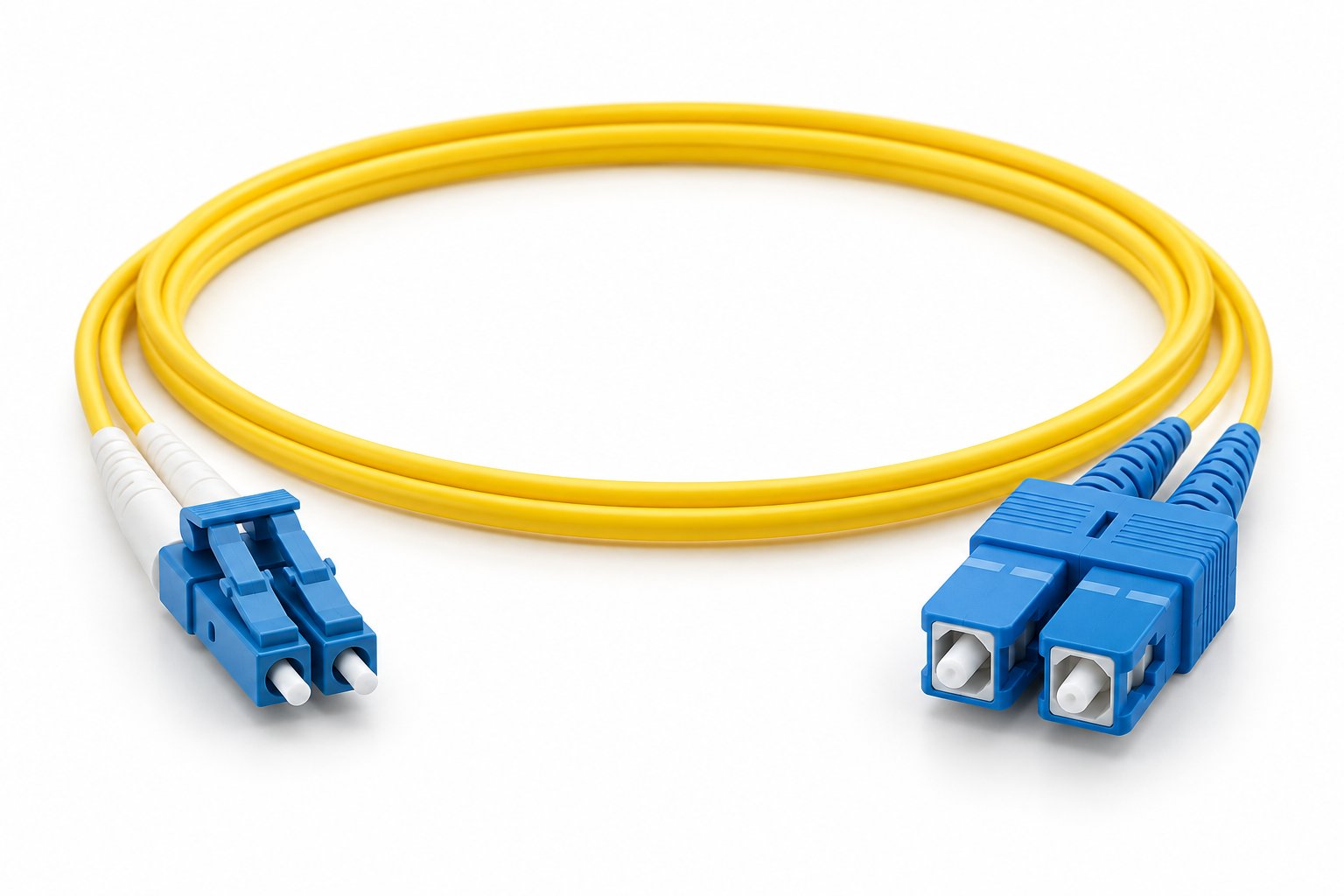
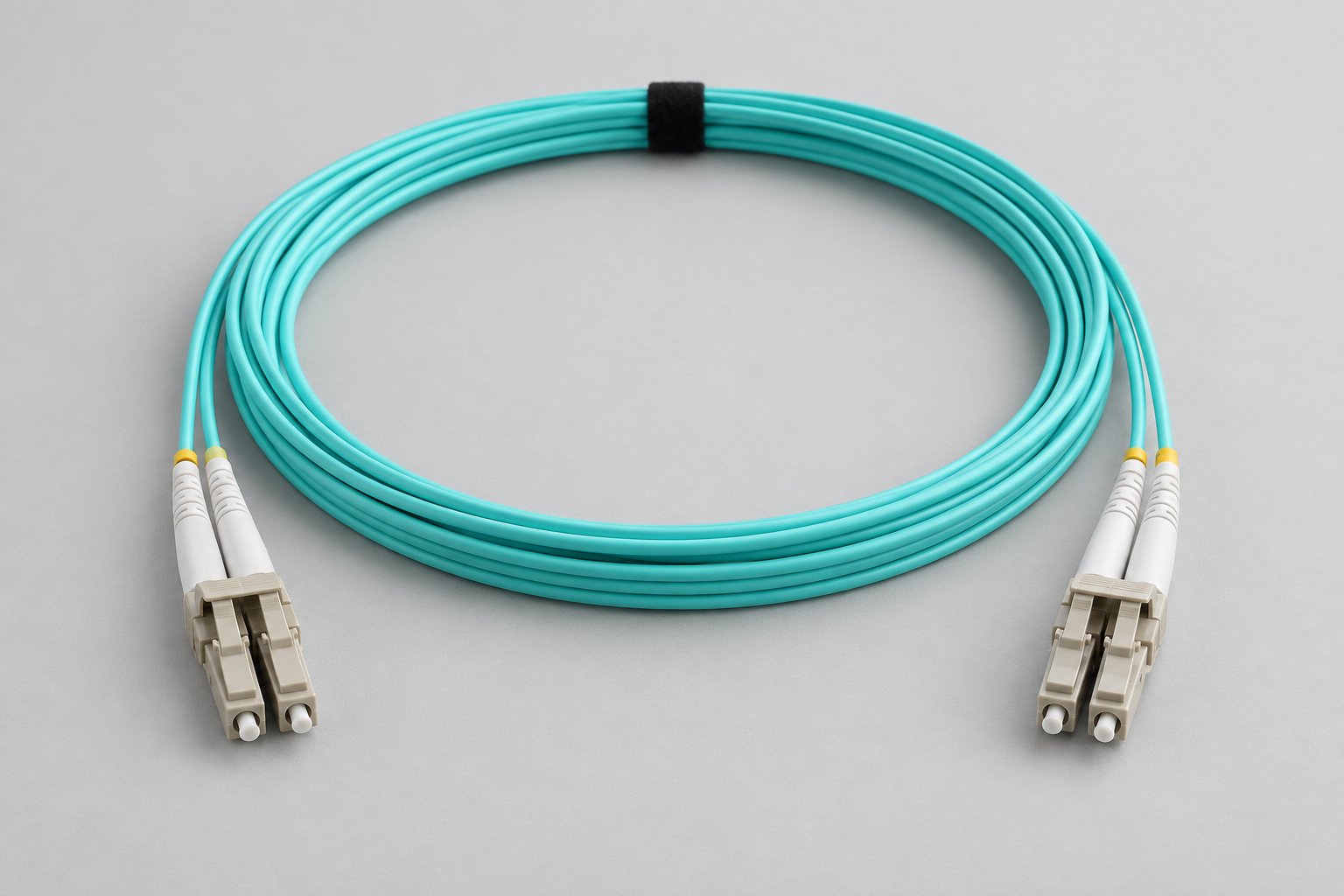
LC-SC Hybrid Patch Cord
LC to SC hybrid patch cord for connecting devices with different connector types, with low insertion loss and custom lengths.
Fiber type
Single mode G.652D
Connector type
LC-SC (hybrid)
Application
Single-mode cross-device links (LC to SC), patch panels, LAN/access; not for multimode links
Product Notes
- LC and SC connectors on one cord
- Cross-device connection without a coupler
- Single mode G.652D fiber
- Insertion loss ≤0.5 dB max per cord at 1310/1550 nm, ≤0.3 dB typical
- Return loss UPC ≥50 dB / APC ≥60 dB
Specifications
Fiber type, connector, test data, packaging proof and sample-kit notes are kept in the same quote sheet.
| Connector type | LC-SC (hybrid) |
|---|---|
| Fiber type | Single mode G.652D |
| Type | Simplex or duplex |
| Jacket | LSZH or PVC |
| Length | Custom, 0.5 m to 30 m |
| Application | Single-mode cross-device links (LC to SC), patch panels, LAN/access; not for multimode links |
| End face | UPC or APC |
| Insertion loss | ≤0.5 dB max per cord (release limit); ≤0.3 dB typical across production (statistical, not a per-piece guarantee) |
| Return loss | UPC ≥50 dB; APC ≥60 dB |
| MOQ | 100 pcs per configuration |
| Cable outer diameter | 2.0 mm or 3.0 mm |
| Packing | 100 pcs per inner bag; 1,000 pcs per carton |
| Lead time | 7 to 15 working days for standard configurations; 15 to 25 working days for mixed or high-volume orders, counted from order confirmation and deposit receipt |
| Warranty | 12 months from shipment date |
Application Notes
Why an LC-SC hybrid patch cord is the practical fix for mixed connector racks
Most network rooms end up with two connector standards in the same rack: LC on high-density switches and patch panels, SC on older routers, media converters and some access equipment. When a link has to cross from one to the other, the common workaround is to add a coupler or an adapter plate and then join two separate patch cords. Every extra connection point adds insertion loss, another surface that can collect dust, and one more part to stock and trace. An LC-SC hybrid patch cord removes that middle step by putting both connector types on a single cable, so the link runs from device to device with one continuous fiber path.
This page is written for network engineers, integrators and procurement teams who need to connect LC-terminated equipment to SC-terminated equipment without adding adapters, and who want to know how to choose the right hybrid patch cord, what to check before ordering, and what the supplier should confirm.
The problem: a coupler in the middle of the link doubles the failure points
When an LC port has to reach an SC port, the usual workaround is a coupler plus two patch cords. That turns one link into three mated pairs instead of two, and every mated pair is a place where loss can be added and where a fault can hide. The arithmetic is what makes this worth avoiding: with a per-connection release limit of 0.5 dB, a coupler-based link can consume up to 1.5 dB of the optical budget before the cable itself is counted, while a single hybrid cord consumes at most 1.0 dB across its two ends. On a link whose budget was calculated for two connections, that extra 0.5 dB is unplanned loss.
The cost shows up later, not at install. A coupler that does not hold the connector firmly, or a ferrule that picks up dust when the coupler is opened, produces a link that passes at commissioning and drifts afterwards. Troubleshooting then means opening the coupler to test each cord separately, which is exactly the kind of work that turns a 10-minute fault into a half-day one. There is also a stock problem: two cord types plus a set of couplers means three SKUs to hold, and on site it means three chances to pick the wrong part.
Solution: one cord, both connector types, two mated pairs instead of three
An LC-SC hybrid patch cord is a single-mode G.652D fiber terminated with an LC connector on one end and an SC connector on the other. Both ends are terminated on our own production lines in Shenzhen, so the installer does not need a coupler or a field splice to bridge the two connector types. The link runs from the LC port to the SC port in one piece, which keeps the optical path short and the number of mated pairs to a minimum.
The measured figures are what make the difference concrete. Insertion loss is measured at 1310 nm and 1550 nm on both terminated ends, with a per-cord release limit of ≤0.5 dB and ≤0.3 dB as the typical value across production. Return loss follows the end face ordered: ≥50 dB for UPC and ≥60 dB for APC. Because the cord replaces a coupler plus a second cord, the link carries two mated pairs instead of three, and the two that remain are the ones the factory measured and recorded.
The cord is available as simplex or duplex, so it can serve a single-fiber link or a standard two-fiber transmit/receive pair. The jacket is offered in LSZH or PVC, which lets the buyer match the cord to the environment: LSZH is the usual choice for ventilated indoor spaces where low smoke and low halogen matter, while PVC is a common general-purpose indoor jacket. Length is custom, so the cord can be made to the exact run instead of leaving coils of slack in the rack.
Optical performance and configuration at a glance
The figures below are the values measured on the finished assembly before packing, and they are the numbers your acceptance test will be compared against.
| Attribute | Value |
|---|---|
| Connector type | LC-SC (hybrid) |
| Fiber type | Single mode G.652D |
| Type | Simplex or duplex |
| End face | UPC or APC |
| Insertion loss | ≤0.5 dB max per cord (release limit); ≤0.3 dB typical across production (statistical, not a per-piece guarantee) |
| Return loss | UPC ≥50 dB; APC ≥60 dB |
| Jacket | LSZH or PVC |
| Cable outer diameter | 2.0 mm or 3.0 mm |
| Length | Custom, 0.5 m to 30 m |
| MOQ | 100 pcs per configuration |
| Packing | 100 pcs per inner bag; 1,000 pcs per carton |
| Lead time | 7 to 15 working days standard; 15 to 25 working days mixed or high volume |
| Application | Single-mode cross-device links (LC to SC), patch panels, LAN/access; not for multimode links |
Insertion loss is measured at 1310 nm and 1550 nm on both terminated ends. The per-cord release limit is ≤0.5 dB, and ≤0.3 dB is the typical value across production rather than a per-piece guarantee, so a cord that measures 0.4 dB still passes and ships. Return loss follows the end face you order: UPC end faces are specified at ≥50 dB, while APC end faces are specified at ≥60 dB because the 8-degree angle reflects the small residual reflection away from the source. On a link where the loss budget is tight, compare the ≤0.5 dB release limit against your own calculation before you order.
How the loss figures are measured and recorded
Insertion loss and return loss are measured with the light source and power meter method using a launch reference cord, at 1310 nm and 1550 nm for single-mode. The pass limits applied at release are insertion loss ≤0.5 dB per cord and return loss ≥50 dB for UPC or ≥60 dB for APC. The ≤0.3 dB figure is the typical value across production, not a per-piece guarantee, so a cord that measures 0.4 dB still passes and ships.
Connector end faces are inspected before packing against the end face acceptance criteria for the polish type ordered, covering the ferrule contact zone for scratches and contamination. If your incoming inspection needs to match ours, tell us the test wavelength, the reference cord type and the acceptance limits you work to when you request a quote. Test records listing the measured insertion loss and return loss per cord can be supplied with the order; confirm the record format you need, and whether you want it per cord or as a batch summary, when you request a quote.
What to check before you order
Before ordering an LC-SC hybrid patch cord, confirm the polish type on both ends. Single-mode connectors are available in UPC and APC polish, and the two must not be mixed on a link. If the LC port is APC and the SC port is UPC, a standard hybrid cord will not mate correctly; the supplier needs to know the polish on both ends so the cord is built to match. This is the single most important detail to verify, because a polish mismatch is not something that can be fixed on site.
Next, confirm the fiber type. This cord is built on single-mode G.652D, which is the standard fiber for most backbone, access and long-reach links. If the link is multimode, a different cord is required. Then confirm the length and the jacket. Measure the actual path, add a service loop of about 15 to 30 cm for slack, and choose LSZH or PVC based on the room's fire and smoke requirements. Finally, confirm simplex or duplex: a duplex cord keeps the transmit and receive fibers paired in one jacket, which is easier to trace and less likely to be crossed.
How the cord is built and checked
Nexora is the manufacturer of this product: each LC-SC hybrid patch cord is terminated on our own production lines in Shenzhen, and the finished assembly is released only after it passes three checks — connector end face inspection, insertion loss measurement and return loss measurement. Insertion loss and return loss are measured on every cord, not on a sample, and the release limits are insertion loss ≤0.5 dB per cord and return loss ≥50 dB for UPC end faces or ≥60 dB for APC end faces; the ≤0.3 dB figure quoted in the table is the typical value across production, not a per-cord release limit. The end face of every cord is inspected before packing against the acceptance criteria for the polish type ordered. A cord that does not meet the release limits is not packed, so the buyer receives a cord that matches the stated figures rather than discovering a problem after installation.
This is a manufacturer-level capability statement: it describes the factory that builds the cord, not a certification of this specific model. Confirm the inspection record you need for your own incoming inspection when you request a quote.
Manufacturing capability behind this cord
Nexora has manufactured fiber optic connectivity products in Shenzhen since 2014. The facility covers 16,000+ m² and runs 12 production lines with 180+ employees, giving an annual capacity of 2.8M+ units and a monthly capacity of 230K+ units. More than 3,500 product configurations are in production, and 300+ new configurations are developed each year, which is what makes a custom hybrid assembly such as this one practical to order at project quantities rather than only at very large volumes.
Quality control runs through the whole process rather than only at final test: incoming material inspection, component inspection, in-process inspection, functional test, visual inspection, final inspection and packaging inspection, across 30+ QC stations. For a patch cord, the steps that matter most are the ones that touch the optical path — ferrule and end face handling, the termination and curing stage, and the insertion loss and return loss measurement taken on the finished assembly before it is packed.
These are factory-level figures that describe the manufacturing base, not a certification of this specific model. More than 500 OEM/ODM projects have been delivered for customers in 50+ countries and regions, covering telecom operators, ISPs, distributors, system integrators, network contractors and data center companies. If your project needs a private label, a specific packing marking or a configuration that is not listed here, tell us the requirement and we will confirm whether it fits our standard process or needs a custom setup.
Installation and care notes
Handle the cord with the same care as any single-mode patch cord. Keep the bend radius within the limits the fiber is designed for, especially near the connectors where the fiber is most exposed; for a 2.0 mm or 3.0 mm indoor simplex or duplex cord, keep the long-term bend radius at 10 times the cable diameter or more and the short-term radius during installation at 20 times the cable diameter or more. Keep the dust caps on the connectors until the moment they are plugged in, and clean the end faces with a proper fiber cleaner if they are exposed. When routing the cord in a rack, avoid sharp bends and do not pull on the connector body to move the cable. A little care at install keeps the end faces clean and the loss low for the life of the link.
Packing, MOQ and lead time
Cords are packed individually with the dust cap fitted and the connector protected, then grouped per your order quantity. Standard packing is 100 pcs per inner bag and 1,000 pcs per carton, so an order at the 100 pcs minimum order quantity ships as one inner bag. The minimum order quantity is 100 pcs per configuration, and it is counted per configuration rather than per order: an order that mixes several lengths, polish types or jacket options is quoted as 100 pcs for each configuration in the mix, so a mixed order of three configurations starts at 300 pcs in total. If you need to test a smaller quantity first, ask for a sample order and we will confirm what is possible for your configuration.
Standard orders ship from our Shenzhen facility, and the lead time for a standard configuration is 7 to 15 working days after order confirmation. Mixed or high-volume orders are scheduled separately and typically run 15 to 25 working days. Lead time is counted from order confirmation and deposit receipt, and it covers production and packing; it does not include the transit time of the shipment, which depends on the freight method you choose. Confirm the schedule for your configuration when you request a quote.
Payment terms
Standard payment terms are a 30% deposit on order confirmation with the 70% balance due before shipment, and the exact terms are stated on the proforma invoice for your order. The deposit is what releases the order into production scheduling, which is why the lead time above is counted from deposit receipt. For repeat orders and established accounts, other structures can be discussed with the quotation. Tell us your preferred terms when you request a quote so they can be reviewed together with the price and the schedule.
Warranty and claims
Hybrid patch cords are covered by a 12-month warranty against manufacturing defects, counted from the shipment date shown on the commercial invoice. This 12-month period is the standard warranty for this product; if your project requires a different period or different return terms, raise it when you request a quote so it can be agreed in the order documents before production. Covered defects include damaged ferrules, connector end faces that do not meet the specified insertion loss or return loss on arrival, and defects in the connector body or cable jacket present at delivery. Damage caused by installation, cleaning or handling after delivery, and use outside the specified fiber type, polish or bend radius, are not covered.
Raise a claim within 30 days of receiving the goods, with the batch reference printed on the inner bag and carton labels, the quantity affected and a test record showing the measured value. We will review the affected units and reply within 5 working days, and arrange replacement or credit for confirmed defects. Keeping the batch reference from the packing label is what allows a claim to be traced back to the production record for that run, so keep the labels with the goods until incoming inspection is complete.
Frequently asked questions
When would I use an LC-SC hybrid patch cord instead of a coupler?
Use a hybrid cord when you want to connect an LC-terminated device directly to an SC-terminated device with one continuous fiber path. A coupler approach adds an extra mated pair and an extra part to stock; a hybrid cord removes both. It is the cleaner choice for a permanent link between two fixed pieces of equipment.
Can I get this cord in duplex?
Yes. The cord is available as simplex or duplex. A duplex cord keeps the transmit and receive fibers paired in one jacket, which is easier to trace and less likely to be crossed during installation.
What polish should I order?
Confirm the polish on both the LC and SC ports before ordering. Single-mode connectors are available in UPC and APC, and the two must not be mixed on a link. Tell the supplier the polish on both ends so the cord is built to match.
What insertion loss and return loss should I expect?
The per-cord release limit for insertion loss is ≤0.5 dB, with ≤0.3 dB as the typical value across production, measured at 1310 nm and 1550 nm. Return loss is ≥50 dB for UPC end faces and ≥60 dB for APC end faces.
How is the cord tested before shipment?
Insertion loss and return loss are measured on every cord with the light source and power meter method at 1310 nm and 1550 nm, and the connector end face is inspected before packing. Test records with the measured values can be supplied with the order; tell us whether you need them per cord or as a batch summary.
What is the minimum order quantity?
The minimum order quantity is 100 pcs per configuration. It is counted per configuration, so a mixed order of three configurations starts at 300 pcs in total. An order at the 100 pcs minimum ships as one inner bag under standard packing.
What is the lead time and how is it counted?
Standard configurations ship 7 to 15 working days after order confirmation; mixed or high-volume orders typically run 15 to 25 working days. Lead time is counted from order confirmation and deposit receipt and covers production and packing, not the transit time of the shipment.
How is the cord packed?
Cords are packed individually with the dust cap fitted and the connector protected, then grouped per order quantity. Standard packing is 100 pcs per inner bag and 1,000 pcs per carton. Tell us if you need a different packing quantity or your own packing marking.
What payment terms do you accept?
Standard terms are a 30% deposit on order confirmation with the 70% balance due before shipment, and the exact terms are stated on the proforma invoice for your order. Other structures can be discussed for repeat orders and established accounts.
Can I order a sample before placing a bulk order?
Yes. If you need to check the polish, the length or the measured loss before committing to a bulk order, ask for a sample order and we will confirm what is possible for your configuration. Sample orders are quoted separately from the bulk price.
Is this cord single mode or multimode?
This cord is built on single-mode G.652D fiber. If your link is multimode, a different cord is required.
Can the length be customized?
Yes, the length is custom within 0.5 m to 30 m. Measure the actual path and add a service loop of about 15 to 30 cm for slack, then confirm the exact length with the supplier.
What jacket options are available?
The cord is offered in LSZH or PVC. LSZH is the usual choice for ventilated indoor spaces where low smoke and low halogen matter; PVC is a common general-purpose indoor jacket.
Do you offer OEM/ODM and custom labeling?
Yes. Cords can be built to your configuration and supplied with your own label and packing marking as an OEM/ODM order. Send the label artwork, the packing quantity and the configuration you need, and we will confirm the details with the quotation.
Request product details
Tell us the polish on both ends, the fiber type, the length, the jacket and whether you need simplex or duplex, and we will confirm the configuration and availability for your project.
Request product detailsTags
Related Fiber Products
Get A Quote
Send fiber type, connector, quantity, application and packaging requirement. The response can include test data and sample-kit notes.
OEM & Customization
Connector types, fiber counts, cable lengths, jacket materials and packaging can be configured to your project specification.
Technical Support
Our engineering team helps you confirm product selection, installation details and documentation before you place the order.
Quality & Testing
Every order is inspected before shipment, and test data or inspection reports can be provided with the goods on request.