
Nexora
Figure-8 Self-Supporting Cable
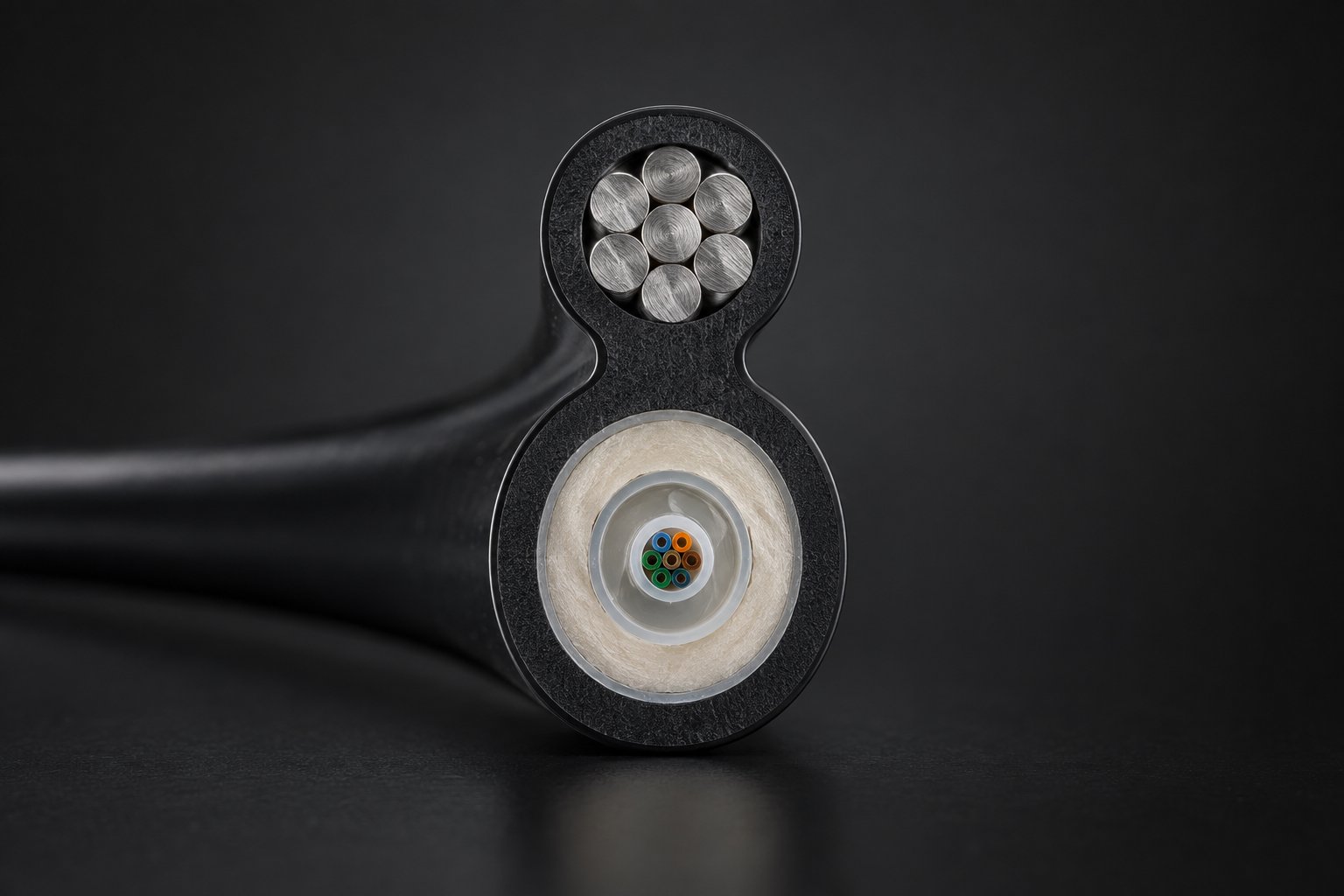
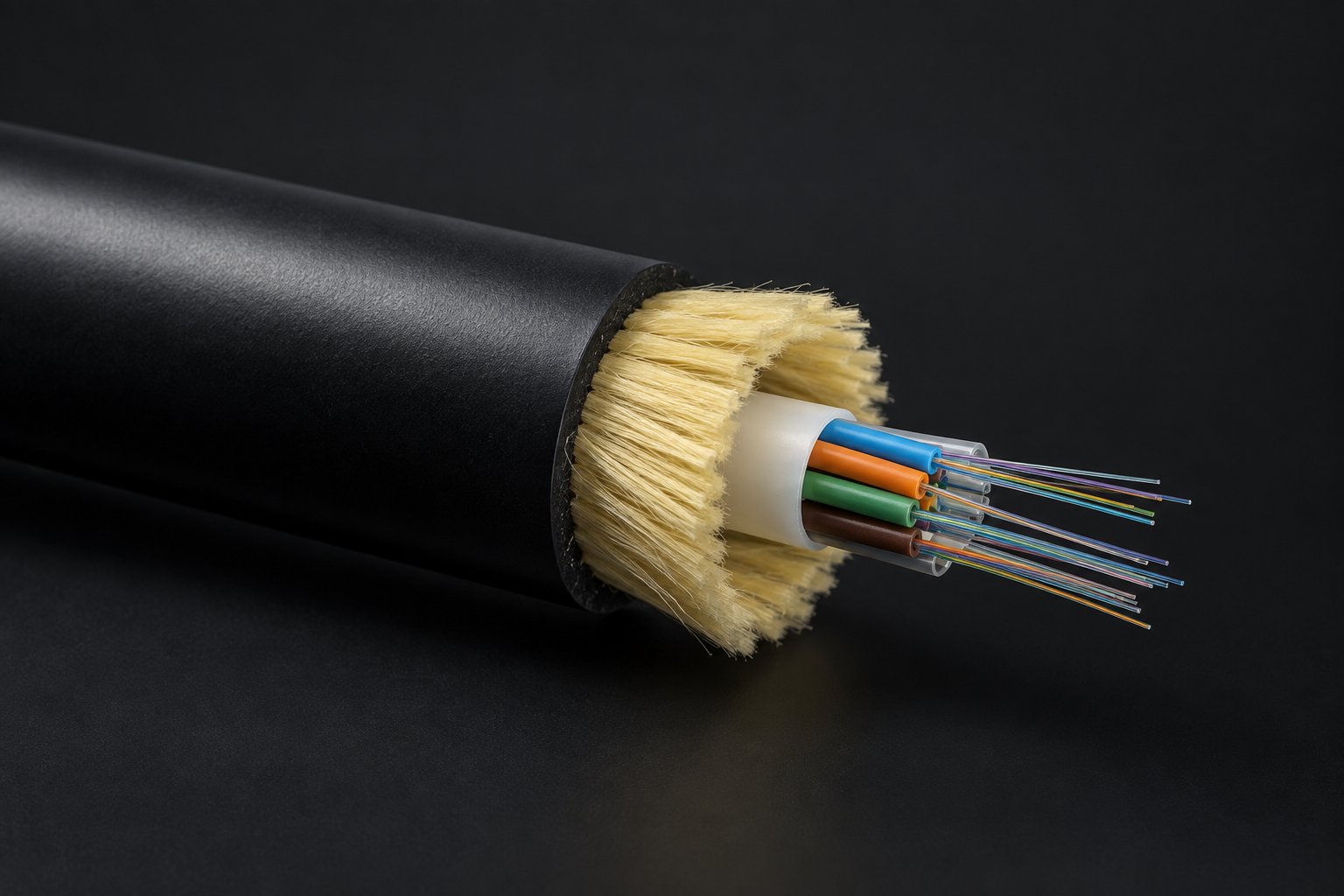
Figure-8 self-supporting fiber optic cable with an integrated messenger for single-pass aerial installation.
Fiber type
Single mode
Application
Aerial spans, rural and urban distribution
Jacket
PE, UV-resistant
Product Notes
- Integrated messenger
- Single-pass aerial installation
- No separate lashing required
- UV-resistant PE jacket
Specifications
Fiber type, connector, test data, packaging proof and sample-kit notes are kept in the same quote sheet.
| Fiber type | G.652D single mode (standard) |
|---|---|
| Fiber count | 4-144 cores (custom) |
| Messenger | Steel strand or FRP |
| Jacket | PE, UV-resistant |
| Installation | Aerial, self-supporting |
| Application | Aerial spans, rural and urban distribution |
Application Notes
Why aerial crews choose a Figure-8 self-supporting cable
Every aerial fiber build ends at the same bottleneck: the span between poles. With a conventional loose-tube cable, the crew must first string a separate messenger wire, then lash or clamp the cable to it. That is two passes up the pole line, two sets of hardware, and two chances for a sagging or misaligned span. A Figure-8 self-supporting cable removes that second pass by bonding the optical core and an integrated messenger into one figure-eight cross-section at the factory. The crew pulls a single reel, the messenger carries the mechanical load, and the fiber core is not tensioned directly.
For rural and urban distribution networks, this is the difference between a two-trip install and a one-trip install. The fewer field operations a span requires, the more predictable the labor cost and the lower the risk of a rework call-back.
What the Figure-8 structure actually solves
Buyers evaluating aerial cable are not asking whether it works; they are asking whether the installed cost and the long-term reliability are controllable. The Figure-8 construction addresses both variables in one design:
- Single-pass installation: the messenger and the optical core are pulled together, so no separate messenger stringing or lashing pass is required.
- Messenger carries the tension: the steel strand or FRP messenger absorbs the mechanical load across the span, keeping the fiber core free of direct tensile stress and reducing the risk of strain-related attenuation.
- No separate lashing hardware: conventional aerial cable needs lashing wire or suspension clamps; the Figure-8 profile removes that step and the associated tools and consumables.
For a buyer, the practical result is a shorter construction window, fewer field operations, and a more predictable aerial link. The advantage grows with the number of spans, which is why the structure is common on pole-dense rural and urban routes.
Specifications and selection criteria
| Item | Specification | Selection note |
|---|---|---|
| Fiber type | G.652D single mode (standard) | Standard single-mode aerial spans; compatible with mainstream ODN and FTTx equipment |
| Fiber count | 4–144 cores (custom) | Choose by network plan and leave headroom for future expansion |
| Messenger | Steel strand or FRP | Steel strand offers higher tensile strength; FRP is lighter and metal-free for lightning or corrosion-sensitive routes |
| Jacket | PE, UV-resistant | UV-stabilized PE jacket suited to long-term outdoor aerial exposure |
| Installation | Aerial, self-supporting | Self-supporting over aerial spans; no separate support structure |
| Application | Aerial spans, rural and urban distribution | Overhead distribution segments in rural and urban access networks |
When selecting, confirm the span length and the local wind and ice loading before choosing the messenger material and fiber count. Steel strand suits long spans and high-tension routes; FRP suits routes where weight and metal content matter. Size the fiber count to current demand plus a reasonable margin so you do not have to re-run the span for expansion.
Choosing between a steel strand and an FRP messenger
The messenger is the load-bearing member of a Figure-8 cable, so its material directly affects the span capability and the long-term reliability of the route.
- Steel strand: higher tensile strength, the conventional choice for long spans and high-tension routes. Because it is a metal member, routes in lightning-prone or highly corrosive areas need additional grounding and protection planning.
- FRP (glass-fiber-reinforced plastic): lighter and metal-free, suited to weight-sensitive routes or where lightning and corrosion resistance matter. FRP does not conduct, which reduces induced-lightning risk, but its tensile strength is generally lower than steel strand, so the achievable span must be confirmed for the project.
List the span length, local wind and ice loading, pole spacing, and lightning requirements together, then confirm the messenger and fiber-count match with the supplier. On lightning-prone or coastal high-salt routes, the metal-free FRP option may be preferable; on long spans with wide pole spacing, the tensile strength of steel strand is the deciding factor.
Installation and maintenance considerations
- Pulling tension control: the messenger carries the load, but still follow the manufacturer's recommended pulling speed and tension to avoid over-bending the optical core.
- Bend radius: maintain adequate bend radius at poles, corners, and terminations to avoid microbend loss.
- Termination and splicing: at both ends of the aerial segment, leave enough slack and secure the cable before it enters the distribution box or ODF for later splicing and maintenance.
- Outdoor protection: the UV-resistant PE jacket suits outdoor exposure, but splice closures and terminations still need proper sealing against moisture.
- Slack management: leave a small service loop at each pole to absorb thermal expansion and contraction and reduce stress on the fiber.
Aerial cable is exposed to temperature swings, wind vibration, and UV over its service life. The UV-resistant PE jacket is designed for that exposure, but bend radius during installation, pulling tension, and closure sealing remain the factors that decide link reliability.
Where Figure-8 cable fits in rural and urban distribution
Figure-8 self-supporting cable is a practical fit for pole-dense rural and urban distribution networks. In rural areas, pole spacing is wide and terrain is uneven, so a single-pass structure reduces the vehicle and labor hours needed to cover the route. In urban blocks, poles are dense and corners are frequent, so the no-lashing design makes installation more flexible and makes later fault location easier.
In ODN and FTTx networks, Figure-8 cable is commonly used for the aerial segment from the backbone cable to the distribution box and then to the subscriber. When choosing the fiber count, include the current subscriber count, future expansion, and redundancy in the plan so you avoid the cost of re-running the span later.
Buyer FAQ
How is a Figure-8 cable different from a conventional aerial cable?
A Figure-8 cable bonds the messenger and the optical core into one profile at the factory, so it is installed in a single pass and the messenger carries the tension. A conventional aerial cable usually needs a separate lashing wire or suspension clamps.
Should I choose a steel strand or an FRP messenger?
Steel strand offers higher tensile strength for long spans and high-tension routes; FRP is lighter and metal-free for weight-, lightning-, or corrosion-sensitive routes. The choice depends on the span length and the local environment.
Can the fiber count be customized?
Yes. The standard range is 4–144 cores and can be customized to the network plan. We recommend sizing to current demand plus a margin so you do not have to re-run the span for expansion.
Is the jacket suitable for long-term outdoor exposure?
The jacket is a UV-resistant PE material suited to long-term outdoor aerial exposure. Splice closures and terminations still need proper sealing against moisture.
What inspection is done before shipment?
Our factory quality-control process, supported by 30+ QC staff and 12 production lines, covers outgoing inspection of the cable. The specific test items and reports can be confirmed when you request a quotation.
Request a quotation
To help us confirm the specification and prepare a quotation, please provide the span length and installation environment, the required fiber count, the messenger preference (steel strand or FRP), the jacket and length requirements, and the environmental conditions of the project area. Our team will confirm the specification and respond to your inquiry.
Request product detailsTags
Related Fiber Products
Get A Quote
Send fiber type, connector, quantity, application and packaging requirement. The response can include test data and sample-kit notes.
OEM & Customization
Connector types, fiber counts, cable lengths, jacket materials and packaging can be configured to your project specification.
Technical Support
Our engineering team helps you confirm product selection, installation details and documentation before you place the order.
Quality & Testing
Every order is inspected before shipment, and test data or inspection reports can be provided with the goods on request.