
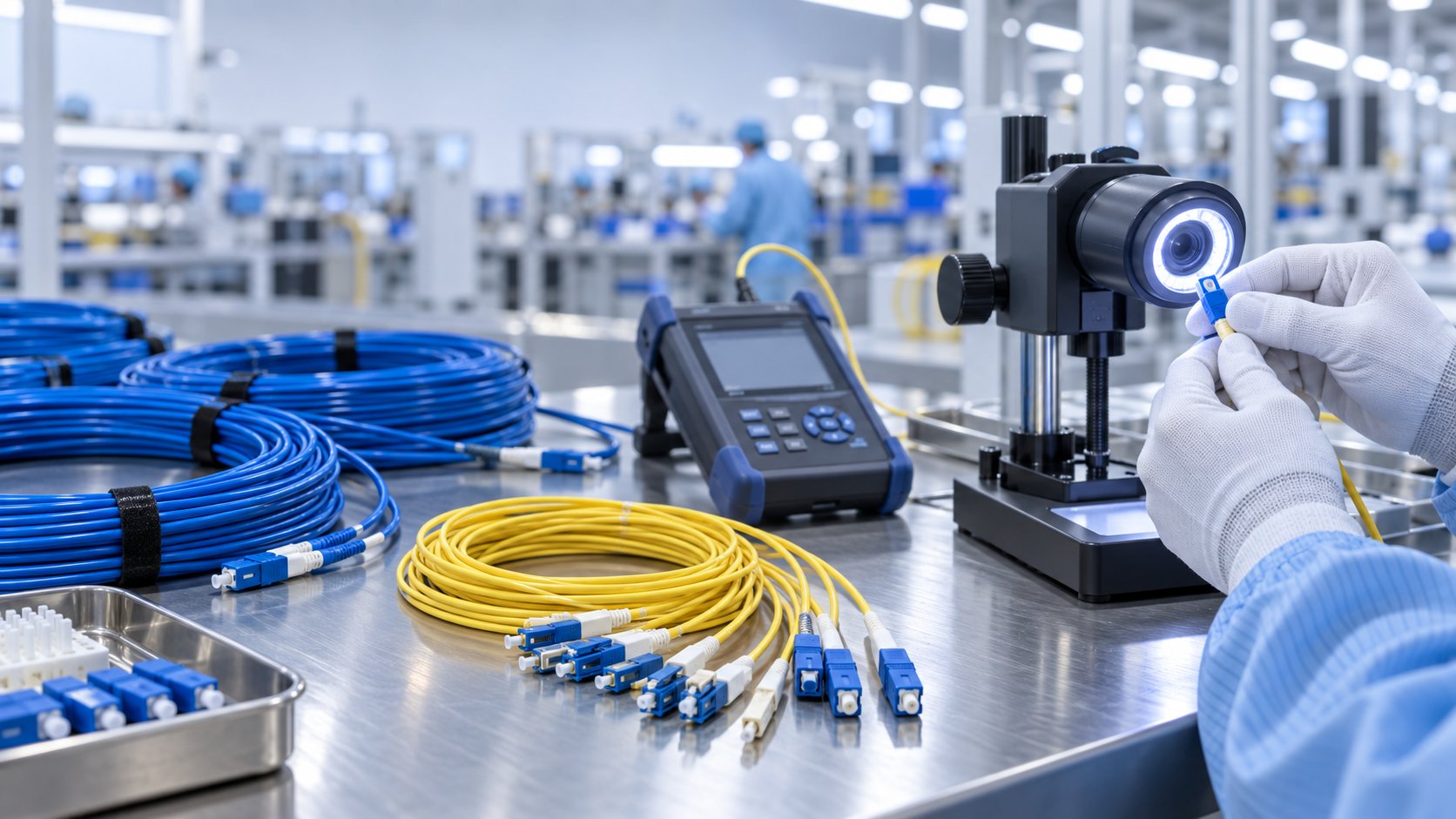
How Nexora verifies fiber optic cable and patch cord quality before shipment, covering incoming material, in-process and final inspection, test data buyers can request, and how to run receiving inspection.
Every fiber optic buyer eventually asks the same question before a purchase order is confirmed: how do I know the cable, patch cords and adapters I receive will actually match the specification I approved? This article explains how Nexora verifies fiber optic cable and patch cord quality before shipment, what each inspection stage covers, which test data a buyer can request, and how to set up your own incoming inspection so that a container of fiber optic products does not become a project delay.
Why does pre-shipment quality verification matter for fiber optic buyers?
Fiber optic products are difficult to inspect after installation. Once a cable is pulled through a duct, a patch cord is routed through a data center cabinet, or an adapter is mounted into a patch panel, replacing a defective item means labour, downtime and re-testing. The cost of a bad connector or a damaged cable is therefore far higher than the unit price difference between two suppliers.
That is why pre-shipment verification is not a formality. For a telecom operator, ISP, distributor, system integrator or data center contractor, the inspection report that accompanies a shipment is the first real evidence that the order matches the approved sample. It also protects the buyer during the warranty period, because the test data recorded before dispatch becomes the baseline for any later dispute.
There is a second reason that is easy to overlook. Fiber optic links are built from many small components that must work together: cable, pigtails, patch cords, adapters and the equipment ports they connect to. A single out-of-specification component can degrade a link that is otherwise correctly designed. Because the failure appears at the system level, it can take a long time to trace back to the component that caused it. Pre-shipment verification moves that discovery to the factory, where it is cheap to fix.
Nexora manufactures fiber optic cables, patch cords, pigtails and adapters for global B2B customers, and quality control runs through the whole production process rather than being a single final check. The sections below describe what that means in practice, stage by stage, so you can compare it with your own requirements and with the quotations you receive from other suppliers.
What does incoming material inspection cover?
Quality problems in fiber optic products usually start with the raw material, not with the assembly line. Incoming material inspection is therefore the first control point, and it happens before any cable is cut or any connector is assembled.
The main items checked at this stage are:
- Fiber and cable raw material — the fiber type and grade are confirmed against the purchase specification, and the cable construction (jacket material, strength members, water-blocking elements) is checked against the approved drawing.
- Connector components — ceramic ferrules, alignment sleeves, housings and dust caps are checked for dimensional consistency, because a ferrule that is out of tolerance will produce high insertion loss no matter how carefully it is assembled.
- Adapters and hardware — the alignment sleeve inside an adapter is the part that actually holds two connectors in contact, so sleeve concentricity and housing fit are verified before the adapters enter assembly.
- Boots, strain relief and accessories — the mechanical parts that protect the connector-to-cable joint are checked so that the finished assembly can survive handling and installation.
- Documentation — material certificates and batch records are filed so that a finished product can be traced back to the material batch it came from.
For a buyer, the practical value of this stage is traceability. If a problem appears months later, a supplier that can trace a finished cable back to its fiber batch can identify whether the issue affects one reel or a whole production run. A supplier that cannot do this will usually ask you to accept a replacement without explaining the root cause.
It is worth asking a potential supplier how incoming material is handled when it fails inspection. A documented non-conformance process — quarantine, return to supplier, root-cause analysis — is a better sign than a general statement that all material is checked.
How is quality controlled during production?
In-process inspection catches problems while they are still cheap to fix. In fiber optic cable production, the critical steps are fiber handling, jacketing and cable marking; in patch cord and pigtail production, the critical steps are cutting, stripping, cleaving, connector assembly and polishing.
The checks that matter most during production are:
- Fiber handling and routing — bend radius is controlled throughout the line, because excessive bending during manufacturing introduces attenuation that will not disappear later.
- Jacket and dimension checks — outer diameter, wall thickness and jacket concentricity are measured against the specification, since these affect both mechanical protection and how the cable fits into ducts, trays and closures.
- Connector assembly — ferrule insertion, epoxy or crimp parameters and cable strain relief are controlled, because a connector that is not properly bonded to the cable will fail mechanically even if its optical performance is acceptable at first test.
- End-face polishing — the polish geometry (PC, UPC or APC) is checked against the connector type ordered, and end-face quality is inspected so that scratches, pits or epoxy residue do not reach the final test stage.
- Length and marking — cable length, meter marking and product identification are verified so that the delivered length matches the order and the cable can be identified on site.
- Workmanship and handling discipline — connector end faces are kept capped between process steps, and finished assemblies are handled so that contamination does not accumulate before final test.
This is also the stage where the difference between a standard product and a custom order becomes visible. When a customer orders a specific connector combination, a specific jacket colour, a specific length or a private-label marking, the in-process checks have to follow the approved drawing rather than a generic product specification.
For buyers, the useful question at this stage is not whether in-process inspection exists, but what happens to a unit that fails it. Units that fail should be corrected or removed from the batch, and the batch record should show that the correction happened. A process that only records the final result cannot tell you whether a problem was fixed or simply passed downstream.
What is checked in final inspection and functional testing?
Final inspection is where the product is measured against the specification the buyer approved. For fiber optic products, the functional tests are the ones that determine whether the link will actually work.
| Test item | What it verifies | Why the buyer should care |
|---|---|---|
| Insertion loss | Signal loss introduced by the connector pair or adapter | Directly consumes the loss budget of the link; a high-loss batch can force re-termination on site |
| Return loss | Reflections sent back toward the transmitter | Poor return loss disturbs sensitive links, especially in FTTH and CATV networks using APC connectors |
| End-face inspection | Scratches, pits, contamination and polish geometry | End-face defects are a common cause of intermittent faults that only appear after installation |
| Attenuation (cable) | Signal loss along the fiber length | Confirms the cable meets the attenuation requirement for the route distance |
| Continuity | That every fiber in the cable is intact | Prevents discovering a broken fiber only after the cable has been pulled |
| Interferometry (where applicable) | Ferrule end-face geometry such as radius of curvature and apex offset | Geometry determines how reliably two connectors mate, especially in high-density panels |
| Visual and dimensional check | Housing, boot, marking, length and packaging | Confirms the delivered item matches the ordered configuration |
Not every order requires every test. A standard patch cord order for an enterprise network and a long-haul outdoor cable project have different risk profiles, and the test plan should reflect that. What matters is that the test plan is agreed before production, and that the results are recorded per batch or per reel rather than summarised in a single line on a packing list.
It also helps to agree the acceptance criteria in writing. Insertion loss and return loss limits should be stated as values with a test method, not as a general promise of low loss. When the criteria are explicit, both sides can read the same test record and reach the same conclusion, which removes most of the argument that otherwise follows a quality claim.
How does Nexora handle packaging and delivery verification?
Packaging is the last chance to prevent damage in transit, and for fiber optic products it deserves more attention than it usually receives. Cable drums, patch cord spools and adapter cartons all travel long distances by sea, rail or air, and the handling they receive is not gentle.
Packaging and delivery verification typically covers:
- Cable drum protection — drums are checked for flange integrity, and the cable end is secured so that it does not unwind or kink during transport.
- Bend radius in packing — patch cords and pigtails are coiled at a radius that respects the minimum bend radius of the fiber, because a tight coil in a carton can introduce permanent loss.
- Connector protection — every connector is fitted with a dust cap, and patch cords are individually bagged so that end faces are not contaminated or scratched in the carton.
- Carton and pallet integrity — carton strength, sealing and pallet stacking are checked so that the shipment survives container loading and unloading.
- Label and document check — shipping marks, quantities, model numbers and packing lists are verified against the order before the container is sealed.
For buyers who consolidate shipments from several suppliers, this stage also determines how easily your warehouse can receive the goods. Clear marking and an accurate packing list reduce receiving time and make it much easier to match delivered items to the purchase order.
If your project has a fixed installation window, it is worth confirming the packing format early as well. Whether cable is supplied on drums or in coils, and whether patch cords are packed individually or in bulk, affects how the goods are stored on site and how quickly they can be issued to installation crews.
What test data and documentation can a buyer request?
The most useful question a buyer can ask a fiber optic supplier is not "is your quality good?" but "what data can you give me with the shipment?" Documentation is what turns a quality claim into something you can verify.
Depending on the product and the order, the documentation that supports a fiber optic shipment can include:
- Insertion loss and return loss test records for patch cords, pigtails and adapters
- Attenuation and continuity test records for cable reels or drums
- End-face inspection results, where the order requires them
- Material batch or traceability records linking finished goods to incoming material
- Packing list with quantities, lengths, model numbers and shipping marks
- Inspection records for the agreed inspection stages
Two points are worth keeping in mind when you review this documentation. First, agree the test method and the acceptance criteria before production starts, not after the goods are ready — a test result is only meaningful against a stated limit. Second, confirm which items are covered by the record. A test record for one patch cord model does not automatically cover a different connector type or a different fiber type in the same order.
It is also reasonable to ask how long records are retained. If a project is installed over several phases, or if a warranty claim arises a year after delivery, the ability to retrieve the original test record is what makes the documentation useful rather than decorative.
How can buyers set up their own incoming inspection?
Even with a thorough pre-shipment process at the supplier, a receiving inspection at your own warehouse is worth the effort. It is the only check that verifies what actually arrived, and it creates a record you can use if a problem appears later.
A practical incoming inspection for fiber optic products can be built around a few steps:
- Check the shipment against the packing list — quantities, lengths, model numbers and connector types, before the goods are put away.
- Inspect packaging condition — look for crushed cartons, damaged drums, missing dust caps or signs of moisture.
- Sample-test optical performance — measure insertion loss and return loss on a sample of patch cords and adapters using a calibrated test set, and compare the results with the supplier's records.
- Inspect end faces — use an end-face inspection scope on a sample, because contamination and scratches are the most common causes of intermittent faults.
- Verify cable length and marking — confirm the delivered length and identification match the order.
- Record the results — keep the inspection record with the supplier's test data so that both sides work from the same baseline if a claim is needed.
The sample size should reflect the risk of the order. A small order of standard patch cords for an office network needs less sampling than a large outdoor cable order destined for a long-haul route, where a single defective reel can affect a whole span.
Two practical details make receiving inspection much easier to run. First, keep the test equipment calibrated and record the calibration date with the results, because an uncalibrated measurement is difficult to defend in a claim. Second, store the inspection record together with the supplier's test data for the same batch, so that a comparison can be made without searching two systems.
How should a buyer evaluate a fiber optic supplier's quality system?
When you compare suppliers, the quality system is often harder to assess than the price. The following questions tend to separate suppliers who genuinely control quality from those who simply state that they do.
- Where are the inspection points? A supplier that only inspects finished goods is reacting to problems; a supplier that inspects incoming material and in-process stages is preventing them.
- What is recorded, and at what granularity? Per-batch or per-reel records are far more useful than a single summary sheet.
- Who performs the tests, and with what equipment? Ask how test equipment is calibrated and how often.
- What happens when a batch fails? A clear non-conformance process — quarantine, root-cause analysis, corrective action — matters more than a promise that failures never happen.
- Can the supplier trace a finished product back to its material batch? Traceability is what makes a recall or a targeted replacement possible.
- How are custom and OEM/ODM orders controlled? Custom configurations need the approved drawing to drive inspection, not a generic specification.
- How is the agreed test plan documented? A written plan that both sides have seen is easier to audit than an informal understanding.
Nexora's production is organised around these controls: a 16,000+ m² facility in Shenzhen, 12 production lines, 30+ QC stations covering incoming material, component, in-process, functional, visual, final and packaging inspection, and more than 500 OEM/ODM projects delivered for customers in 50+ countries. Those figures describe the company's manufacturing and quality infrastructure; the specific test plan for your order is agreed separately, based on the products and the project requirements.
What are the most common quality issues in fiber optic orders?
Understanding the typical failure modes helps you decide where to focus your own inspection. In practice, the issues that cause the most trouble for buyers are not exotic.
- Contaminated or scratched end faces — often caused by missing dust caps or careless handling in packing, and a frequent source of intermittent loss.
- Connector polish mismatch — a UPC connector mated to an APC port produces high return loss and may not work at all.
- Insertion loss above the agreed limit — usually traceable to ferrule or sleeve tolerance, or to assembly parameters.
- Bend-induced loss in patch cords — caused by coiling below the minimum bend radius during packing or installation.
- Cable jacket or dimension deviation — affects fit in ducts, trays and closures, and can indicate a material or extrusion problem.
- Length or marking errors — a delivery problem rather than a technical one, but it still costs receiving time and can disrupt installation schedules.
Each of these is preventable with a defined inspection stage, which is why the process matters more than any single test. It is also why the most useful conversations with a supplier happen before production, when the specification, the test plan and the acceptance criteria can still be adjusted without cost.
How does quality verification support OEM and ODM projects?
For OEM and ODM customers, quality verification has an extra dimension: the product is defined by the customer's own specification, so inspection has to be driven by the approved drawing, sample and test criteria rather than by a catalogue item.
In practice this means the inspection plan is built around the customer's requirements from the start. Connector combinations, jacket colours, printing and private-label marking, cable lengths and packaging formats are all confirmed before production, and the inspection stages then verify the finished goods against that agreed configuration. For buyers developing a new product, the sample approval stage is the point where the specification is frozen, and it is worth treating that stage as carefully as the production order itself.
Two habits make OEM and ODM projects run more smoothly. First, keep a single approved drawing or sample as the reference for both production and inspection, so that there is no ambiguity about which version is current. Second, confirm the inspection criteria at the same time as the specification, because a specification without acceptance limits cannot be verified consistently across batches.
How does quality verification connect to the products you order?
The inspection stages described above apply across the fiber optic product range, but the emphasis changes with the product. For outdoor cable such as outdoor G.652D single mode fiber optic cable and ADSS fiber optic cable, attenuation, continuity, jacket dimensions and drum packing carry most of the risk. For armored fiber optic cable and figure-8 self-supporting cable, the mechanical construction and the integrity of the strength members matter alongside the optical tests.
For FTTH drop cable, the priorities shift toward dimensional consistency and handling, because these cables are installed in large numbers and terminated in the field. For assemblies, LC-LC duplex single mode patch cord and fiber optic pigtail orders depend on end-face quality, insertion loss and return loss, while SC/UPC single mode fiber optic adapter orders depend on sleeve concentricity and housing fit.
If you are still selecting products, our guides on how to choose fiber optic cable and how to choose patch cords and adapters cover the selection decisions that come before the quality plan.
How do you write a quality specification that a supplier can actually meet?
Most quality disputes in fiber optic purchasing do not start with a dishonest supplier. They start with a specification that was never precise enough to be verified. If the purchase order says "low insertion loss" without a number, a test method and a sampling rule, then both sides can look at the same shipment and reach different conclusions.
A specification that can be verified usually contains four elements for each requirement:
- The parameter — for example insertion loss, return loss, attenuation, outer diameter or length.
- The value and unit — a number with a unit, and where relevant a maximum or minimum rather than a vague description.
- The test method — how the value is measured, at what wavelength, and with what kind of equipment.
- The acceptance rule — whether the requirement applies to every unit, to a sample, or to a batch average, and what happens if a unit fails.
When these four elements are present, the inspection record becomes a simple comparison rather than an interpretation. That is also what makes a supplier's test data useful to you: you can check it against your own criteria instead of accepting it on trust.
For custom and OEM/ODM orders, the specification should be tied to the approved drawing or sample. If the drawing changes, the specification and the inspection criteria should change with it, and the current version should be unambiguous on both sides.
How should sampling be decided for a fiber optic order?
Testing every unit is not always practical, and testing too few units does not give useful assurance. Sampling is the compromise, and it should be chosen deliberately rather than by habit.
The factors that usually drive the sampling decision are:
- Order size — a larger order contains more units, so a fixed sample size gives less coverage of the batch.
- Product criticality — a component that is difficult to replace after installation justifies more testing than one that can be swapped easily.
- Process stability — a new product, a new material batch or a changed process carries more risk than a repeat order of a stable item.
- Cost of failure — a defective reel in a long-haul route is far more expensive than a defective patch cord in an office cabinet.
- History with the supplier — a supplier with a consistent record may need less verification than a new one, but the criteria should still be written down.
For buyers, the practical point is that sampling should be agreed in advance and recorded. If a problem appears later, a documented sampling plan shows what was and was not verified, which makes the conversation about responsibility much clearer.
What should a fiber optic inspection report contain?
An inspection report is only useful if it lets you connect a result to a specific item. A report that lists a single average for a whole shipment is difficult to act on, because it does not tell you which units were measured or which ones passed.
A report that supports a buyer's decision usually identifies:
- The product and configuration — model, connector type, fiber type, length and any custom marking.
- The batch or reel identifier — so that the result can be linked to the goods you received.
- The test items and the measured values — not only a pass or fail, but the actual readings where the order requires them.
- The acceptance criteria applied — so that you can confirm the result was judged against your specification.
- The date and the equipment used — including calibration status where relevant.
- The result per item or per sample — so that an individual failure is visible rather than averaged away.
When you receive a report, it is worth checking that the configuration described matches what you ordered. A report for the right product family but the wrong connector type or fiber type does not verify your order, even if the numbers look good.
How do you handle a quality problem after delivery?
Even a well-controlled process can produce a problem that only appears after delivery. What matters then is how quickly the issue can be contained and how clearly the cause can be identified.
A workable process for handling a quality claim usually follows a few steps:
- Contain the problem — identify which batches, reels or cartons are affected and stop them from entering the network.
- Compare records — put your receiving inspection results next to the supplier's pre-shipment data for the same batch.
- Identify the scope — determine whether the issue affects one unit, one batch or a wider production run, using traceability records.
- Find the cause — establish whether the problem originated in material, assembly, packing or transport.
- Agree corrective action — replacement, rework or a process change, with a clear scope and timeline.
- Verify the fix — confirm on the next shipment that the corrective action actually worked.
The reason traceability and per-batch records matter so much is that they make step three possible. Without them, a supplier can only replace the units you noticed, and you have no way to know whether other affected units are already in your warehouse.
How does fiber optic quality verification differ by application?
The same inspection framework applies across applications, but the emphasis changes with how the product is used and how expensive a failure would be.
| Application | Typical products | Where inspection focus usually sits |
|---|---|---|
| FTTH and access networks | Drop cable, pigtails, SC and LC adapters | Dimensional consistency, end-face quality and loss, because these items are installed in large numbers and terminated in the field |
| Data centers | LC patch cords, high-density adapters | Insertion loss consistency across many connections, end-face cleanliness and connector geometry |
| Metro and backbone | Outdoor single mode cable, armored cable | Attenuation, continuity, jacket dimensions and drum packing for long routes |
| Aerial routes | ADSS and figure-8 self-supporting cable | Strength member integrity and mechanical construction alongside optical performance |
| Enterprise and LAN | Multimode patch cords and adapters | Connector type and polish matching, plus loss within the link budget |
This is why a single generic test plan is rarely the best answer. The right plan reflects the product, the route and the cost of a failure in that specific application.
What should buyers confirm before the first production run?
The most effective quality control happens before production starts, when changes are still free. A short pre-production checklist prevents most of the problems that would otherwise be discovered at final inspection.
- Specification and drawing — confirm the current version and make sure both sides are working from the same document.
- Test plan and acceptance criteria — agree the parameters, values, methods and sampling rules in writing.
- Sample approval — approve a physical sample where the product is custom, and keep it as the reference for production.
- Documentation expectations — confirm which records will accompany the shipment and at what granularity.
- Packing and marking — agree the packing format, shipping marks and labelling before the goods are packed.
- Delivery schedule — confirm the production and inspection timeline so that testing does not become a last-minute bottleneck.
Buyers who complete this checklist before the first run usually find that the inspection stage becomes a confirmation rather than a negotiation. The specification is fixed, the criteria are known, and the records can be read against a shared standard.
How does quality verification support long-term supplier relationships?
Quality verification is sometimes treated as a way to catch a supplier out. In practice, its greater value is in making a supply relationship predictable. When the specification, the test plan and the documentation are agreed and stable, repeat orders become faster to place and easier to receive, because both sides already know what will be checked and what evidence will be provided.
For buyers running multi-phase projects, this predictability matters more than a marginal price difference. A supplier that delivers consistent, documented quality reduces the receiving workload, lowers the risk of installation delays and makes it easier to plan the next phase of a rollout. Over several orders, that reliability is usually worth more than a small saving on unit price.
It also creates a useful feedback loop. When inspection records are shared and reviewed, both sides can see where variation appears and address it before it becomes a claim. That is a more productive relationship than one in which quality is only discussed after something has failed.
What equipment is used to verify fiber optic quality?
Buyers do not need to own every instrument, but understanding what each one measures makes it much easier to read a test report and to ask the right questions.
- Optical power meter and light source — the standard combination for measuring insertion loss on a patch cord, pigtail or adapter. The result depends on the launch condition and the reference method, which is why the test method should be stated with the value.
- Optical time domain reflectometer (OTDR) — used on cable to locate loss events along the fiber and to confirm continuity over a long length. It is particularly useful for outdoor cable, where a fault may be far from either end.
- End-face inspection scope — a microscope or video scope used to examine the connector end face for scratches, pits and contamination. It is the fastest way to find the defects that cause intermittent faults.
- Interferometer — used to measure ferrule end-face geometry such as radius of curvature and apex offset, which determine how reliably two connectors mate.
- Dimensional instruments — callipers, micrometers and gauges used to check cable diameter, wall thickness and connector dimensions against the specification.
Two points are worth remembering when you review test data. First, the same parameter measured with a different method can produce a different number, so the method matters as much as the value. Second, equipment calibration affects the reliability of every result, so it is reasonable to ask how calibration is managed and recorded.
How do you compare quotations when quality is part of the price?
Fiber optic quotations are often compared on unit price alone, which makes it difficult to see what is actually included. Two suppliers can quote the same product at different prices because they are offering different levels of testing, documentation and packing.
A more useful comparison looks at what each quotation includes:
- Specification clarity — does the quotation state the connector type, fiber type, polish, length and construction precisely, or only a general product name?
- Test coverage — which tests are performed, on what proportion of the order, and are the results provided?
- Documentation — what records accompany the shipment, and at what granularity?
- Packing standard — how the goods are protected for transport, and whether the packing format suits your site.
- Customisation control — for OEM and ODM orders, how the approved drawing drives production and inspection.
- Response to problems — what process applies if a batch fails or a claim arises after delivery.
When these items are compared side by side, the price difference usually becomes explainable. A quotation that includes per-batch test data and stronger packing is not directly comparable to one that does not, and the buyer can decide which level of assurance the project actually needs.
Frequently asked questions about fiber optic quality verification
What tests are performed on fiber optic patch cords before shipment?
Typical tests include insertion loss, return loss, end-face inspection and a visual and dimensional check of the connector, boot, length and marking. The exact test plan depends on the connector type, fiber type and the requirements agreed with the buyer.
Can I request test data for my order?
Yes. Buyers can request insertion loss and return loss records for patch cords, pigtails and adapters, attenuation and continuity records for cable reels or drums, and packing documentation. It is best to agree the test method and acceptance criteria before production starts.
How do I verify fiber optic cable quality when it arrives?
Check the shipment against the packing list, inspect packaging condition, sample-test insertion loss and return loss with a calibrated test set, inspect end faces on a sample, and verify cable length and marking. Record the results alongside the supplier's test data.
What is the difference between insertion loss and return loss?
Insertion loss is the signal power lost as light passes through a connection, and it consumes the loss budget of the link. Return loss measures how much light is reflected back toward the transmitter; poor return loss can disturb sensitive links, particularly in FTTH and CATV networks using APC connectors.
Why does connector polish matter for quality?
UPC and APC connectors have different end-face geometries and must not be mixed in the same link. Mating a UPC connector to an APC port produces high return loss and can prevent the link from working, so the polish must match on both ends and at the equipment port.
How can I reduce the risk of receiving defective fiber optic products?
Agree the specification and test criteria before production, request per-batch or per-reel test data with the shipment, and run a receiving inspection at your own warehouse. Traceability records also help if a problem appears after installation.
Does every order need the same test plan?
No. The test plan should reflect the product and the risk of the project. A standard patch cord order and a long-haul outdoor cable order have different priorities, so the tests and the sampling level are agreed for each order rather than applied uniformly.
How long should test records be kept?
Records are most useful when they can still be retrieved during the warranty period or across phased installations. Ask your supplier how long records are retained and how they can be retrieved if a claim is needed later.
Next step for your fiber optic order
If you are preparing a fiber optic cable, patch cord, pigtail or adapter order and want to confirm the inspection and test plan before production, share your product specification, connector and fiber type, quantities and project requirements with our team. We can confirm a suitable configuration, explain which test data can accompany the shipment, and provide a quotation that matches your network design.
Request a quotation and test plan
Send us your fiber optic product specification, connector and fiber type, quantities and delivery requirements. Our team will review the configuration and confirm the inspection and test documentation available for your order.