
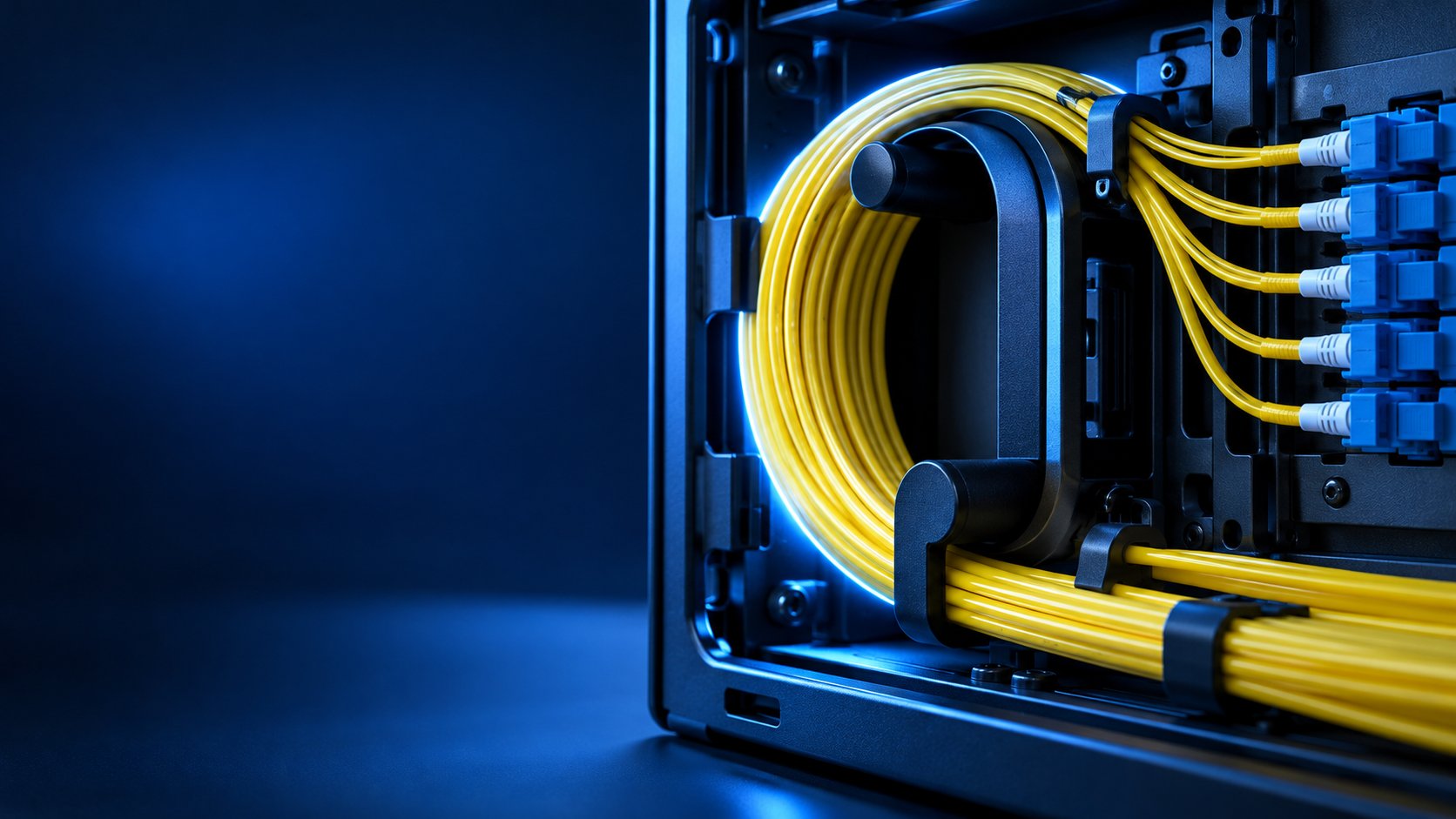
A buyer's guide to choosing between G.657.A1, A2 and B3 bend-insensitive fiber for FTTH, indoor and data center cabling, with grade selection logic, G.652D compatibility, datasheet review points and procurement questions.
Every FTTH rollout, enterprise LAN upgrade, and data center retrofit eventually hits the same physical constraint: the fiber has to turn. It turns where the cable enters a wall box, where it crosses a ceiling corner, where it wraps around a splice tray, and where it routes through a compact ODF with barely 20 mm of clearance. On those turns, a conventional G.652D single-mode fiber starts to leak light. The question most buyers arrive at is therefore not whether bend-insensitive fiber matters, but which grade of it to specify — G.657.A1, G.657.A2, or G.657.B3 — and for which part of the network.
Choosing wrong costs money in both directions. Specify too little bend tolerance and you inherit a stream of intermittent loss complaints that are expensive to trace. Specify too much and you pay a premium on every kilometer of straight backbone route where a standard fiber would have performed identically. This guide explains how the G.657 classification actually works, what changes between the grades, how each grade maps to real products such as FTTH drop cable, indoor tight-buffered cable, and patch cords, and what to confirm with your supplier before you commit a project-scale order.
What Bend-Insensitive Fiber Actually Is
Bend-insensitive fiber is single-mode optical fiber engineered so that light stays guided even when the fiber is bent at a much smaller radius than conventional designs tolerate. The physics is straightforward. In a standard single-mode fiber, the light travels in a core roughly 9 microns in diameter, surrounded by cladding that carries part of the mode. When the fiber bends, the outer edge of that mode has to travel a longer path than the inner edge. If the bend is tight enough, the outer portion of the light can no longer keep up and radiates away as loss. A bend-insensitive design adds a low-index trench around the core, which acts like a barrier that reflects escaping light back into the guided mode. The result is that the fiber can survive bends of 10 mm, 7.5 mm, or even 5 mm radius with only a small, well-controlled amount of additional attenuation.
The relevant standard is ITU-T Recommendation G.657, titled "Characteristics of a bending-loss insensitive single-mode optical fibre and cable." The current edition defines several fiber categories, each with its own minimum bend radius and macro-bending loss limits measured under standardized mandrel-wrap test conditions. It is worth understanding what the standard does and does not promise. It defines how the fiber performs at specified test radii and wavelengths — it does not mean you can tie the fiber in a knot or route it with zero margin. Every cable datasheet still states a minimum dynamic bend radius for installation and a minimum static bend radius for long-term operation, and those cable-level numbers are what installers must respect.
A second point that buyers sometimes miss: bend-insensitive does not mean low-loss in general. The intrinsic attenuation of a good G.657 fiber is essentially in the same range as a good G.652D fiber. The trench design changes how the fiber behaves under stress, not its baseline transmission quality. When a datasheet quotes a typical attenuation of around 0.20 dB/km at 1550 nm for either fiber type, treat that as a typical value to be confirmed against the specific fiber lot and the cable specification sheet, not as a universal guarantee.
The G.657 Classification, Category by Category
The G.657 recommendation divides bend-insensitive fibers into two families. Category A fibers are designed to be fully compatible with G.652.D fibers — same mode field diameter class, same splicing behavior — while adding bend tolerance. Category B fibers push bend performance further and are optimized specifically for tight-space deployments, with somewhat different transverse and chromatic dispersion characteristics. Within each family there are subcategories with progressively tighter bend requirements.
The table below summarizes the commonly used grades and their standardized minimum bend radii. These radii are defined by the ITU-T recommendation under its specified test conditions; always verify the exact test wavelength, number of mandrel turns, and loss limits against the current edition of the standard and the fiber supplier's datasheet.
| Grade | Category | Minimum bend radius (per ITU-T G.657 test conditions) | Typical deployment focus |
|---|---|---|---|
| G.657.A1 | A — G.652.D compatible | 10 mm | General FTTH drops, building cabling, patch cords |
| G.657.A2 | A — G.652.D compatible | 7.5 mm | Dense indoor routing, compact ODFs, device terminations |
| G.657.B3 | B — bend-optimized | 5 mm | Extreme confinement: inside devices, ONT/ONU internals, very tight trays |
Three practical notes on reading this table. First, the radius numbers describe the fiber itself under the standard's mandrel test; a finished cable will normally have a larger minimum bend radius because the cable structure — strength members, jacket, and buffer — adds its own stiffness and limits. Second, the loss limits at each radius are defined at specific wavelengths (commonly 1550 nm and 1625 nm in the current editions of the test procedures); the number that matters for your network is the loss at your operating wavelength, measured under the standard's conditions. Third, some fiber suppliers market intermediate or enhanced variants. If a datasheet does not cite a G.657 grade explicitly, ask which grade the fiber corresponds to and request the macro-bending test data in writing.
G.657.A1 vs G.657.A2: Where the Real Difference Lies
The most common comparison buyers face is A1 versus A2. The headline difference is the minimum bend radius — 10 mm versus 7.5 mm — but the decision should not stop at that number, because the two grades differ in a second dimension that matters in real installations: macro-bend loss at larger radii.
A2 fiber is specified to maintain its low-loss performance not only at 7.5 mm but also at intermediate radii such as 10 mm and 12.5 mm, with tighter loss limits than A1 at those radii. A1 fiber is specified at 10 mm, and its performance guarantee at even larger radii is correspondingly more relaxed. In a route where the fiber passes through several moderate bends in sequence, A2 accumulates less incremental loss at each one. In a route with a single controlled turn, the difference between the grades is often negligible.
That leads to the practical selection logic used by most FTTH and in-building designers:
- Choose G.657.A1 when the installation is controlled and the bends are few. A standard subscriber drop, a home-run from the entry point to the ONT with one or two turns, or a building riser with conventional raceway routing usually does not need more than A1. The fiber is fully G.652.D compatible, widely available, and cost-efficient at project scale.
- Choose G.657.A2 when the routing is dense or the clearance is small. Multi-dwelling units with tight wall-box entries, patch cabinets where dozens of cables share the same corner, ODF shelves with limited spooling space, and any run where the cable repeatedly changes direction over a short distance are the classic A2 environments. The premium per kilometer is modest, and it buys headroom where loss failures concentrate.
- Reserve G.657.B3 for genuinely confined, fiber-only paths. B3 tolerates a 5 mm radius, which is smaller than most finished cables can physically follow anyway. Its natural home is inside equipment — optical network terminals, small form-factor pluggable modules, pigtails inside instrument housings — where the protected fiber, not the cable, makes the tight turn. Specifying B3 for outdoor cable plant usually adds cost without changing the cable-level bend limit.
A fourth situation deserves its own mention. If your project mixes existing G.652.D backbone fiber with new bend-insensitive drops, the compatibility question is not optional — it determines whether splices perform. The next section covers what compatibility actually requires.
Compatibility with G.652D: Why Category A Matters for Splicing
Category A fibers were deliberately designed so that a fusion splicer cannot tell the difference between a G.657.A fiber and a G.652.D fiber in normal operation. Their mode field diameter sits in the same nominal class as G.652.D — nominally around 9 microns at 1310 nm, with the exact tolerance set by the standard — and their splicing loss behavior is comparable. For a contractor, that means an A1 or A2 drop can be fusion-spliced onto an existing G.652.D feeder without special splicer profiles, and the resulting joint loss will fall within the same acceptance range used for conventional work.
Category B fibers are different by design. Their refractive index profiles are optimized for bend performance rather than for mode-field matching, so a B3 fiber spliced to a G.652.D fiber can show a higher joint loss than the same splice between two compatible fibers. The splice still works — fusion splicers handle it — but the loss budget has to account for it. That is one more reason B3 is positioned for device-internal use where the entire path is B3, rather than for mixed outside-plant routes.
For buyers, the practical checklist is short. Confirm that the bend-insensitive product you are purchasing is Category A if it will be spliced to legacy plant. Ask the supplier to state the fiber grade and the mode field diameter class on the specification sheet. If your acceptance criteria specify a maximum splice loss, ask for the typical and maximum splice loss values the supplier expects between the proposed fiber and G.652.D — and treat any figure not confirmed in writing as a typical value to be validated with your first shipment's test reports rather than assumed.
Mapping the Grades to Real Products
Grade selection is easier when you think in terms of the products that carry the fiber rather than the fiber alone. A complete access network uses several cable types, and the appropriate grade can legitimately differ among them within one project.
FTTH drop cable. The drop is the segment where bend-insensitive fiber earns its place, because subscriber-side routing is unpredictable. A flat bow-type FTTH drop cable built on G.657.A1 fiber handles the wall entries, corner clips, and short horizontal runs inside subscriber premises with margin to spare. The flat profile and the strength-member construction take care of the mechanical side; the A1 fiber takes care of the optical side. For multi-dwelling buildings where drop cables share congested riser space and make more turns, A2 is a defensible upgrade.
Indoor tight-buffered cable. Inside buildings, cable runs through cable trays, conduits, and patch-panel ducts where turns are frequent but generally engineered. An indoor tight-buffered fiber optic cable on G.657.A2 fiber gives installers the freedom to route close to corners and through narrow ducts without planning every bend, which matters when the route is being finalized on site rather than on a drawing.
Patch cords and pigtails. Patch cords live in the highest-density, highest-handling environment in the network. They get dressed by hand, bent behind equipment, and re-routed during moves and changes. A1 is the everyday standard for patch cords; A2 appears in high-density racks and equipment closets where clearance behind panels is measured in centimeters. Pigtails spliced into ODF trays benefit from the same logic. For high-density data center shelves, the pairing of an A2 cord with a low-loss adapter, such as an LC/UPC duplex fiber optic adapter, keeps the connection-level loss budget predictable.
Outdoor and backbone cable. Here the bend story mostly ends. Backbone routes are engineered, duct and trench installations have generous radii, and the cable structure dominates the mechanical behavior. G.652.D remains the default choice for long outside-plant runs, and specifying G.657 there typically adds cost without adding usable margin. The exception is at transition points — the building entry, the splice closure, the cross-connect cabinet — where a short bend-insensitive section or a bend-insensitive patch cord bridges from the engineered route to the confined one.
The unifying principle: put bend tolerance where bends are uncontrolled, and put standard fiber where they are not. Networks that follow this principle get the reliability benefit where it counts and keep the bill of materials honest.
A Grade Selection Matrix for Common Project Scenarios
The sections above explain the logic; the matrix below condenses it into the situations procurement teams actually face. Treat it as a starting framework for discussion with your design team, not a substitute for reviewing the specific route drawings and the cable datasheets you will order against.
| Scenario | Bend profile | Recommended fiber grade | Why |
|---|---|---|---|
| Suburban FTTH drop to a single home | Few turns, installers can control routing | G.657.A1 | A1 margin covers wall entries and clips at the lowest premium |
| Multi-dwelling unit riser and floor distribution | Many turns, shared confined pathways | G.657.A2 | Tighter loss limits at intermediate radii where turns accumulate |
| Enterprise horizontal cabling in trays and ducts | Frequent but engineered turns | G.657.A2 (or A1 on simple routes) | Route is finalized on site; A2 tolerates deviations |
| Data center shelf and rack cabling | Very short, very dense, hand-dressed | G.657.A2 cords | Clearance behind panels is minimal; cords see repeated re-dressing |
| Outdoor backbone in duct or trench | Long straight runs, generous radii | G.652.D | Bend tolerance adds cost with no usable margin at this scale |
| Inside ONT/ONU or test equipment | Fiber-only path with tight component spacing | G.657.B3 | 5 mm radius tolerance is designed for exactly this confinement |
Two observations from practice. First, most real projects end up specifying two grades — one for the outside or engineered plant and one for the confined indoor segments — rather than standardizing on a single grade everywhere. Second, when a project team debates grades for weeks, the argument is usually about cost allocation rather than performance; settling the bend-density classification of each segment early, with the route drawings on the table, resolves most of it in one meeting.
Bend Radius Is a Cable Property Too — and Often the Binding One
A recurring misunderstanding in procurement conversations is treating the fiber's bend radius as the cable's bend radius. They are related but not equal, and the cable number is almost always the larger one — which makes it the one installers must actually respect.
A finished cable adds stiffness through its strength members, its buffer type, and its jacket. A flat drop cable with steel strength members, a tight-buffered indoor cable with aramid yarn, and an outdoor loose-tube cable with a steel-tape armor each behave very differently when bent, even if all three carry the same G.657.A1 fiber. The cable datasheet therefore states its own minimum bend radii — commonly one value during installation (dynamic) and a smaller value once installed (static). Respecting those numbers is what protects the fiber's performance in the long run; the fiber grade guarantees what happens inside the cable, not what happens when the cable itself is forced around a corner sharper than its construction allows.
Installation practice should reinforce, not fight, the cable's limits:
- Use the radii stated on the cable datasheet, not the fiber grade's number. If a datasheet is silent on bend radius, request it before ordering. A supplier who cannot state dynamic and static bend radii for a cable is a supplier to be cautious about.
- Respect pull tension during installation. Excessive pulling force at bends compounds optical loss with mechanical risk. The datasheet's maximum installation tension and the bend radius are two halves of the same constraint.
- Support the cable at turns. Corner guides, bend-control clips in FTTH work, and properly sized spooling in ODF trays keep the actual installed radius close to the design radius throughout the route, not just at the point an inspector happens to check.
- Re-check after moves and changes. Bend problems often appear months after installation, when someone re-dresses a cabinet or pushes equipment back into a rack. A routine inspection of bend points during maintenance visits catches the slow-developing losses before they become fault tickets.
When suppliers and installers share these numbers, the conversation shifts from "why is this link lossy" to "which bend point is out of spec" — a far cheaper conversation to have.
FTTH Subscriber Premises: Where the A1 Margin Pays Off
The subscriber drop deserves its own section because it is where bend-insensitive specifications are won or lost in daily work. Inside a subscriber's home, the installer does not control the geometry. Wall boxes sit where the builder put them, skirting boards turn at awkward angles, and the final meter to the ONT is routed around whatever furniture and door frames exist. The installer's tools are corner clips, cable clips, and judgment — and the specification's job is to make sure that reasonable judgment is enough.
Three practices make the difference on subscriber premises. First, fix the cable at every direction change rather than letting spans between fixing points carry the bend. A cable that is clipped at a corner holds its radius permanently; a cable that is pulled taut across a corner takes its radius from however hard the installer pulled. Second, keep the ONT approach generous. The last 30 centimeters before the connector are where forced bends concentrate, and they are also the point most often disturbed later by the subscriber rearranging furniture. Third, leave service loops where the route allows. A short, properly coiled reserve at the wall box lets a future technician re-terminate or re-route without pulling a new drop.
Buyers can support these practices contractually. Include the cable datasheet's bend radii in the installation method statement, specify bend-control clips for interior corners in the bill of materials, and make a bend-point inspection part of the acceptance walk-through. On the next project these items cost almost nothing; on the current one they prevent the intermittent, hard-to-diagnose loss tickets that erode subscriber satisfaction and consume maintenance hours.
Five Buying Mistakes That Show Up as Field Failures
Across FTTH and in-building projects, the same selection mistakes recur. None of them are exotic; all of them are avoidable at specification time.
Mistake 1: Over-specifying B3 for outside plant. B3's 5 mm radius tolerance is genuinely impressive, but outside-plant cables cannot physically follow 5 mm paths anyway — the cable construction limits them first. Paying a B3 premium on kilometers of duct route buys nothing. Reserve B3 for the fiber-only, device-internal segments where it was designed to operate.
Mistake 2: Under-specifying at the congested points. The inverse error appears when a project standardizes on G.652D everywhere to simplify the bill of materials, then discovers that the multi-dwelling risers and wall-box entries — the exact points where cables crowd — generate the loss complaints. A targeted A2 specification for indoor segments, mixed with standard fiber outdoors, usually resolves it at a fraction of the cost of a full A2 build.
Mistake 3: Ignoring splice compatibility when mixing grades. Ordering B3 drops to splice onto a G.652.D feeder without checking joint-loss expectations is how projects end up re-testing splice acceptance criteria mid-rollout. If your plant mixes categories, get the expected splice loss values confirmed before the crew is on the pole.
Mistake 4: Confusing fiber-grade numbers with cable datasheet numbers. A "5 mm bend-insensitive" claim on a marketing page does not mean the cable can be installed at 5 mm. The binding constraint is the cable's own datasheet radius. Buyers who write the cable radii into the installation spec — rather than the fiber grade — avoid the majority of bend-related field disputes.
Mistake 5: Skipping the macro-bend test data. "Bend-insensitive" without test conditions is a slogan. The standard defines macro-bending loss at specific radii, turn counts, and wavelengths. A datasheet that quotes those values (for example, loss at 1550 nm with a specified number of turns at a 10 mm mandrel) lets you compare fibers on equal terms. One without them leaves you comparing adjectives.
How to Read a Fiber Optic Cable Datasheet for Bend Performance
A disciplined datasheet review takes minutes and prevents weeks of remediation. When you evaluate a bend-insensitive cable offering, work through the document in this order.
Fiber identification. Look for the explicit fiber category and grade — for example "G.657.A1 single-mode fiber" or "G.657.A2". If the sheet names only a proprietary fiber code, ask which ITU-T grade it corresponds to and request the fiber datasheet from the fiber manufacturer. Reputable suppliers provide this without friction.
Macro-bending specification. The fiber section should state bend performance as loss at defined mandrel radii and wavelengths. Compare the values against the ITU-T G.657 limits for the claimed grade. Remember that these are the fiber maker's test conditions; the numbers are usually expressed as maximum permitted values, and typical measured values will be lower — ask which you are looking at.
Cable bend radii and tension limits. The cable section should state minimum dynamic bend radius, minimum static bend radius, maximum installation tension, and maximum long-term (operational) tension. These four numbers govern installation quality. Write them into the method statement for your crews.
Attenuation. Standard single-mode cable datasheets quote attenuation at 1310 nm and 1550 nm — commonly around 0.35 dB/km and 0.21 dB/km respectively as typical industry values — and bend-insensitive fibers add the mandrel-test conditions on top. Treat every attenuation figure as a typical value until the specific production lot's test report confirms it. For FTTH work at short distances, the attenuation difference between grades is rarely the deciding factor; the bend behavior is.
Environmental ratings. Temperature range, crush resistance, and impact ratings tell you whether the cable survives the environment while the fiber handles the bends. A bend-insensitive fiber inside a jacket that cannot take the installation's mechanical load does not solve the field problem.
If any of these five items is missing or ambiguous, resolve it before ordering. The cost of one clarifying email is trivial compared with re-terminating a building's worth of drops.
Testing and Acceptance: Verifying Performance Before and After Delivery
Specifications only become real when they are tested. On the manufacturing side, fiber and cable producers verify bend-related performance through the standardized macro-bending tests that underpin the G.657 grade, together with routine attenuation measurement on each production length. The exact test plan differs among manufacturers, so the useful move for a buyer is to ask which tests are performed on every reel and which are performed per batch, and to request the corresponding reports with each shipment. A manufacturer that measures and documents routinely can usually supply attenuation traces and test summaries without drama; a supplier who hesitates at that request is telling you something.
On the project side, acceptance testing closes the loop. A typical FTTH or in-building acceptance plan measures end-to-end insertion loss or an OTDR trace on each link, and records the values against the loss budget calculated from the cable attenuation, splice losses, and connector losses. Bend-related problems reveal themselves in characteristic ways: an OTDR shows a localized step loss at a position where the route turns, or an insertion-loss value sits just outside budget while the trace looks clean except at one point. Because bend sensitivity varies with wavelength, testing at 1550 nm or 1625 nm — where macro-bend loss is most visible — is a common way to confirm a bend diagnosis before anyone climbs a ladder.
For buyers writing acceptance criteria, two habits prevent disputes. First, define the acceptance method (insertion loss, OTDR, or both), the pass thresholds, and the wavelengths in the contract documents, so field crews and supervisors measure the same thing the same way. Second, keep the first articles: retain the factory test reports from the initial shipment and compare a sample of field measurements against them. When the two agree, the specification chain — fiber grade, cable construction, installation method — is working as designed, and any later anomaly is a local event rather than a systemic one.
Cost, Inventory, and the Case for Standardizing Deliberately
Bend-insensitive fiber carries a modest price premium over standard G.652.D fiber, and at project scale that premium scales with kilometers. The economics work in the buyer's favor when the specification is deliberate: standard fiber on the long, straight, engineered routes; A1 where subscriber-side handling is expected; A2 where routing density concentrates; B3 only inside devices. Networks specified this way buy exactly the bend tolerance each segment needs.
Inventory follows the same logic. Contractors who stock one drop cable SKU, one indoor SKU, and one patch cord family per grade can cover most FTTH and enterprise work. Because Category A fibers are G.652.D compatible, a stock of A1 or A2 patch cords also serves as field spares for legacy plant without compatibility risk — a flexibility that B3 stock does not offer. From a procurement standpoint, A-grade bend-insensitive products are the safer default for a mixed-network inventory.
Lead time and customization deserve a note as well. Manufacturers typically offer bend-insensitive fiber options across their cable families — drop cables, indoor cables, and patch cords can all be built on the same fiber grade for a coherent project specification. When requesting quotations, state the grade, the fiber count, the jacket type, and the environment in one RFQ; this lets the supplier confirm feasibility and quote accurately in one pass instead of trading revisions. If your project needs a grade that is not in a supplier's standard catalog, ask directly whether custom builds are supported and what the minimum order and lead time look like — terms vary by manufacturer and order size, so confirm the specific numbers for your requirement rather than assuming catalog defaults.
Questions to Ask Before You Place the Order
A short, specific question list separates serious suppliers from brochure suppliers. Before committing to a bend-insensitive cable order, put these to the manufacturer and expect concrete, written answers:
- Which ITU-T G.657 grade is used in this product, and can you provide the fiber manufacturer's datasheet showing the macro-bending test conditions?
- What are the cable's minimum dynamic and static bend radii, and its maximum installation and long-term tension values?
- Is this fiber Category A (G.652.D compatible) — and what typical splice loss should our crews expect against existing G.652.D plant?
- What attenuation values will appear on the production test reports, and at which wavelengths are each reel measured?
- Which tests are performed on every production length, and what documentation ships with each reel?
- Can the same grade be supplied across the drop cable, indoor cable, and patch cord families we need, so the whole project runs on one coherent specification?
- What customization is available — fiber counts, jacket materials (LSZH, PE), lengths, connector types — and what are the minimum order quantity and lead time for our configuration?
- What warranty applies to the delivered cable, and what does the claims process require?
The quality of the answers is itself a data point. A manufacturer that produces its own cable will answer from its process — naming test stages, lot traceability, and report formats. A trading intermediary will answer from marketing copy. For fiber infrastructure that has to last decades, that difference is worth the ten-minute conversation.
Frequently Asked Questions
Can I splice G.657.A1 or A2 fiber directly to existing G.652D fiber?
Yes. Category A fibers are designed for G.652.D compatibility, including fusion splicing, and joint losses fall in the same range as conventional same-type splices under normal workmanship. Expect the splice to behave like any other single-mode joint; verify against your project's acceptance criteria with the first splices, and confirm expected values with the supplier in writing for large-scale work.
Does bend-insensitive fiber have lower attenuation than G.652D?
No. Baseline attenuation of both fiber types sits in the same range. Bend-insensitive design changes loss under bending, not intrinsic attenuation. Datasheet figures for either type should be treated as typical values and confirmed against the production lot's test report.
Is G.657.B3 always the better choice because it bends the tightest?
No. B3 achieves its 5 mm radius tolerance with an index profile that is not optimized for G.652.D compatibility, and most finished cables cannot follow a 5 mm path regardless of the fiber inside it. B3 belongs in device-internal, fiber-only paths. For cable plant, A1 or A2 is almost always the right specification.
What bend radius should my installers actually respect?
The cable's datasheet values — minimum dynamic radius during installation and minimum static radius in service — are the binding numbers. The fiber grade's radius describes performance inside the cable under the standard's test conditions, not an installation instruction for the cable.
Does G.657 apply to multimode fiber as well?
No. ITU-T G.657 is a single-mode fiber recommendation. Multimode fiber has its own bend-optimized designs and grading, so if your project mixes single-mode and multimode cabling, the grades must be evaluated separately for each type. Confirm the bend performance of the specific multimode product with its datasheet rather than assuming the single-mode numbers transfer.
How much more does A2 cost than A1?
The premium varies with fiber supplier, order volume, and cable construction, and it changes over time, so quoting a universal percentage would mislead. The practical approach is to request quotations for both grades on your exact configuration and compare them on delivered cost per kilometer against the bend density of each segment. On straight routes the difference buys nothing; on congested indoor routes it typically costs far less than the field labor to chase intermittent losses.
Why is my link lossy even though I used bend-insensitive fiber?
Bend-insensitive fiber raises the tolerance floor; it does not remove installation constraints. Check whether any bend point violates the cable's stated radius, whether pull tension during installation exceeded the datasheet limit, and whether connectors are clean and properly mated. Bend-related loss develops at specific points — an OTDR trace usually localizes it.
Can I get bend-insensitive fiber in LSZH or outdoor jackets?
Yes. The fiber grade is independent of jacket material; manufacturers offer bend-insensitive fiber in LSZH, PE, and other sheathing options across drop, indoor, and outdoor cable families. Confirm the combination you need in the RFQ, including any flame-rating requirement for the installation environment.
What warranty applies to Nexora fiber optic cable?
Nexora products are covered by a warranty of 12 months from shipment date. Review the warranty terms with your sales contact when ordering so your project documentation and any acceptance criteria align with it.
Summary: A Simple Rule for a Confusing Standard
The G.657 classification looks technical, but the buying decision reduces to one rule: match the bend tolerance to the concentration of bends in each segment, and keep compatibility with your existing plant. G.657.A1 covers controlled FTTH drops and everyday patch cords at the lowest premium. G.657.A2 adds margin where routing is dense and clearance is small. G.657.B3 stays inside devices where only fiber makes the turn. Category A keeps splicing simple against legacy G.652.D plant; the cable datasheet's own bend radii govern what your crews install to; and every performance figure gets confirmed against the production lot's test report before acceptance.
If you are planning an FTTH rollout, an in-building backbone, or a data center cabling refresh and want to align the fiber grades across your drop cable, indoor cable, and patch cord orders, contact Nexora with your route profiles and installation environment. As a manufacturer of fiber optic cables, patch cords, adapters, and related FTTH products with OEM/ODM support, we can help you build a single coherent specification — and confirm MOQ, lead time, and customization options for your exact configuration before you commit the budget.