
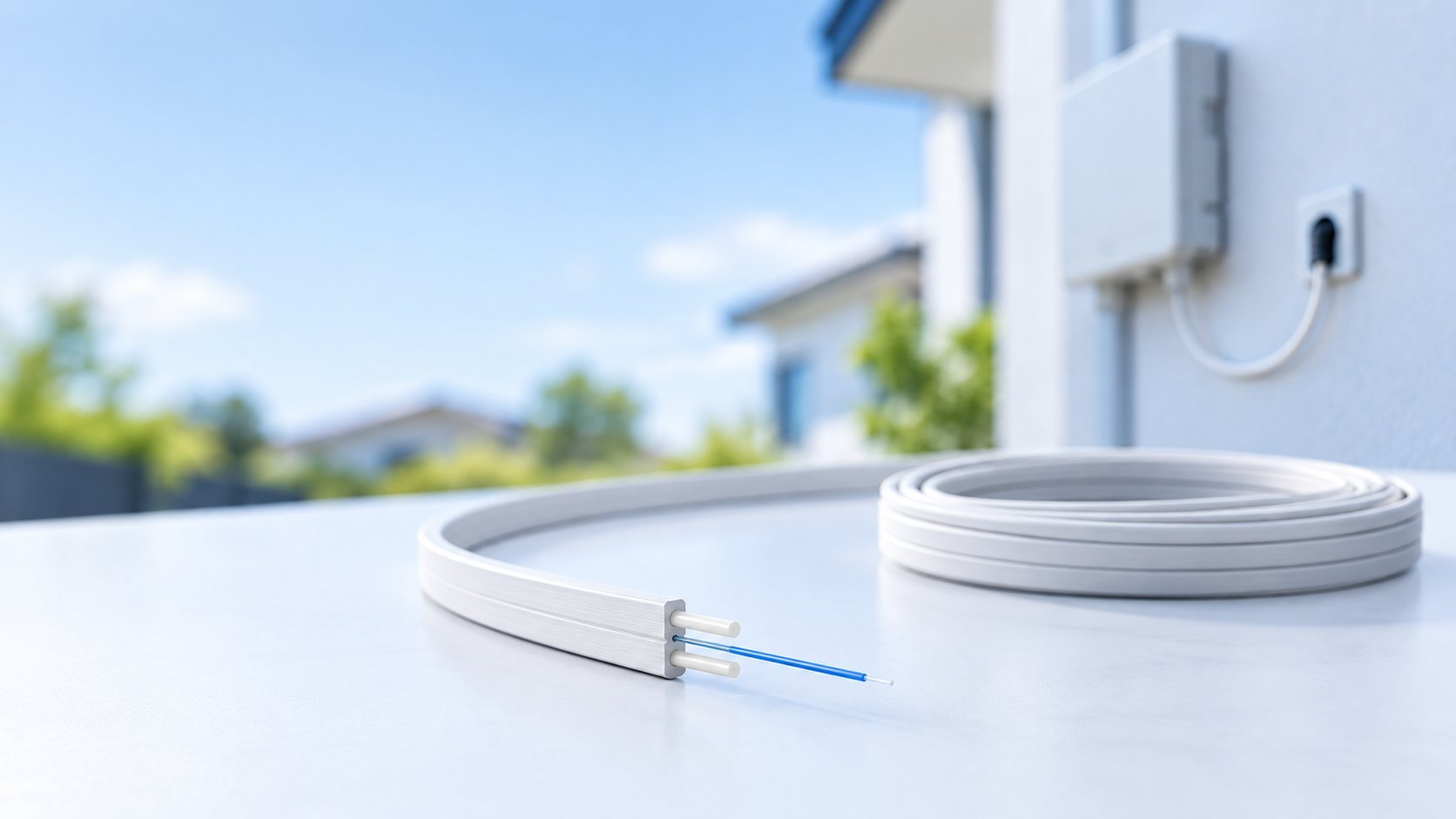
Una guida pratica alla scelta del cavo di derivazione FTTH per un rollout fiber-to-the-home, che copre tipo di fibra, costruzione del cavo, materiale della guaina, metodo di terminazione, dati di test e una checklist per l'acquirente.
Every fiber-to-the-home rollout eventually reaches the same bottleneck: the drop segment. It is the shortest part of the network and the part that touches the most subscribers, which is why it decides your cost per home passed, your rework rate and your installation schedule. This guide explains how to choose an FTTH drop cable for a real deployment, what the specification actually means, how the drop segment differs from the feeder and distribution layers, and which questions a buyer should settle with a supplier before the first drum is ordered.
What makes the FTTH drop cable different from the rest of the network?
A fiber-to-the-home network is built in three layers. The feeder layer carries traffic from the central office to the distribution point. The distribution layer fans that traffic out across a neighborhood. The drop layer carries the final connection from the distribution point to the subscriber premises. Each layer has a different job, and the drop layer is the one that behaves least like a conventional outdoor cable.
The reason is simple. A drop cable is installed in the most awkward places in the network. It runs along a building facade, through a wall entry, around a corner, into a riser, across a ceiling void and finally to an optical network terminal inside a home or apartment. It is handled by installation crews many times per day, coiled into small radii, stapled or clipped to surfaces, and pulled through short, tight conduits. A cable designed for a long duct route is not automatically the right cable for that job.
That is why the FTTH drop cable has its own construction. The most common type is the bow-type flat drop cable, sometimes called a figure-8 drop or a flat drop. It has a flat profile with the optical fiber in the center, two strength members on either side, and a jacket that can be opened with a simple stripping tool to expose the fiber for field termination. The flat shape is not cosmetic: it spreads the load across the strength members, allows the cable to be stapled flat against a wall without crushing the fiber, and makes it possible to bend the cable tightly around a corner without exceeding the fiber's bend limit.
For a buyer, the practical consequence is that the drop cable specification has to be read differently from a backbone cable specification. Attenuation still matters, but bend performance, jacket material, strength member type, fiber count and termination method matter just as much, because they determine whether the cable can actually be installed in the environment the crew will face.
Which fiber type should an FTTH drop cable use?
Almost every FTTH drop cable in production today uses a bend-insensitive single mode fiber, most commonly G.657A. The reason is the installation environment described above. Standard G.652D fiber is designed for long-haul and metro routes where the cable is installed in ducts, trays and closures with generous bend radii. A drop cable is installed in the opposite conditions: tight corners, small wall entries, shallow raceways and short coils inside a subscriber's premises.
G.657A fiber is specified to tolerate much tighter bends than G.652D without a significant increase in attenuation. That tolerance is what allows a flat drop cable to be routed around a 90-degree wall corner or coiled into a small indoor enclosure without introducing loss that would only appear later as a weak or intermittent signal. It is also compatible with G.652D at the system level, which means a drop cable using G.657A fiber can be spliced or connected to a G.652D distribution network without a mode mismatch.
In practice, a buyer should confirm three things about the fiber in a drop cable order:
- The fiber standard — G.657A is the usual choice for drop cable, and the supplier should state which variant (for example G.657A1 or G.657A2) is used, because the bend tolerance differs between them.
- Compatibility with the rest of the network — the drop fiber must be compatible with the distribution and feeder fiber so that splices and connectors behave predictably.
- The fiber count — most subscriber drops use one or two fibers, but a drop cable can be supplied with up to four fibers where a single cable serves more than one subscriber or where a spare fiber is required.
Nexora's FTTH drop cable uses G.657A bend-insensitive single mode fiber, compatible with G.652.D, and is available with one to four cores. That range covers the common subscriber drop as well as small multi-subscriber configurations, and it keeps the drop cable compatible with the G.652D distribution cable used elsewhere in the same network.
How does the cable construction affect installation?
The construction of a drop cable determines how it behaves on site, and it is worth understanding each element before comparing quotations, because two cables with the same fiber can perform very differently during installation.
The flat bow-type profile
The bow-type profile places the fiber in the center of a flat, slightly curved jacket, with strength members on both sides. This geometry protects the fiber from the compressive force of staples and clips, because the load is carried by the strength members rather than the fiber. It also allows the cable to be bent in the flat plane around a corner without the fiber being forced into a tight radius. A round drop cable can be used, but it is harder to secure flat against a wall and generally needs a larger bend radius for the same fiber.
The strength members
Drop cables typically use either steel wire or FRP (fiber-reinforced plastic) as the strength member. Steel wire provides high tensile strength and is common in aerial and long facade runs. FRP is non-metallic, which can matter where electrical isolation or corrosion resistance is a concern, and it is often chosen for indoor and mixed indoor-outdoor routes. The choice affects the cable's tensile rating, its weight and how it behaves when it is tensioned between two fixing points.
The jacket material
The jacket is the part of the cable that the installer and the environment actually touch, and it is usually specified as either LSZH (low smoke zero halogen) or PE (polyethylene). LSZH is the common choice for indoor and mixed routes because it limits smoke and halogen release in a fire, which matters for building code compliance in occupied premises. PE is more common for outdoor and buried sections because it resists moisture and UV exposure well. A cable that crosses the indoor-outdoor boundary has to satisfy both sets of requirements, which is one reason the drop specification deserves attention early in the project.
How many fibers does a subscriber drop need?
The fiber count in a drop cable is a planning decision, not just a purchasing one. Most single-subscriber drops use one fiber, with a second fiber sometimes included as a spare or for a future service. Where a single drop cable serves a small multi-dwelling unit or a pair of subscribers, a two- or four-fiber drop cable can reduce the number of separate cables that have to be installed.
The trade-off is straightforward. A higher fiber count gives more capacity per cable and can reduce the number of installation runs, but it also increases the cable's stiffness and cost, and it requires the distribution point to be planned for the additional fibers. For most residential rollouts, a one- or two-fiber drop cable covers the requirement, and the fiber count is confirmed against the distribution plan rather than chosen in isolation.
It is worth confirming the fiber count together with the connector and termination plan, because the two decisions interact. A drop cable that is terminated with a factory-fitted connector at one end and spliced at the other has different handling requirements from a cable that is spliced at both ends, and the fiber count affects how much slack the crew needs at each end.
Pre-terminated or field-terminated: which drop cable should you order?
One of the most consequential choices in an FTTH rollout is whether the drop cable arrives with connectors already fitted or is terminated on site. The two approaches have different cost structures, different skill requirements and different failure modes, and the right answer depends on the scale and geography of the project.
Pre-terminated drop cable
A pre-terminated drop cable is assembled and tested in the factory, with a connector fitted to one or both ends and a pull protection fitted for installation. The optical performance is verified before the cable leaves the factory, which removes the risk of a poor field termination and reduces the skill level required from the installation crew. The trade-off is that the cable has to be ordered to the correct length, and the connector has to survive being pulled through the route, which is why a robust pulling eye or protective cap is important.
Pre-terminated drops are often the better choice for large rollouts where the same drop length is repeated many times, and for projects where the available installation crews are not experienced in fusion splicing. They also move the quality control to the factory, where a defective termination can be detected and corrected before the cable is shipped.
Field-terminated drop cable
A field-terminated drop cable is supplied as a plain cable and terminated on site, either by fusion splicing a pigtail onto the fiber or by fitting a field-installable connector. This approach gives the installer freedom to cut the cable to the exact length required, which is useful where drop lengths vary widely or where the route is not fully known until the crew is on site. It also avoids the need to order and stock many pre-cut lengths.
The trade-off is that field termination depends on the skill of the crew and on the quality of the splicing or connector-fitting equipment. A poorly prepared end face or an incorrect splice will produce high insertion loss or a reflection problem that may not be obvious until the subscriber reports a fault. Field termination also takes time per drop, which matters when the project is measured in thousands of homes.
Many projects use a mix of the two. Pre-terminated drops are used where the route and length are predictable, and field-terminated cable is kept for the cases where the length cannot be fixed in advance. The important point for a buyer is to decide the termination strategy before ordering, because it determines the cable specification, the packaging and the test data that should accompany the shipment.
What should you check in the drop cable specification?
When you compare quotations for an FTTH drop cable, the specification sheet is where the real differences appear. The following table lists the items that matter most for a subscriber drop and explains why each one affects the installation.
| Specification item | What to confirm | Why it matters on site |
|---|---|---|
| Fiber type | Bend-insensitive single mode, for example G.657A, compatible with the distribution fiber | Determines whether the cable survives tight corners and small enclosures without added loss |
| Fiber count | 1 to 4 cores, matched to the distribution plan | Sets how many subscribers or spare paths one cable can serve |
| Construction | Bow-type flat profile with two strength members | Protects the fiber from staples and clips and allows tight corner routing |
| Strength member | Steel wire or FRP, with the tensile rating stated | Determines how the cable behaves in aerial and facade runs and whether it is electrically non-conductive |
| Jacket material | LSZH for indoor and mixed routes, PE for outdoor and buried sections | Affects fire performance indoors and moisture and UV resistance outdoors |
| Bend radius | Minimum bend radius for installation and for long-term use | Sets the smallest corner and coil the crew can use without damaging the fiber |
| Attenuation | Attenuation per kilometer at the operating wavelengths | Contributes to the optical loss budget of the subscriber link |
| Termination | Pre-terminated or field-terminated, with the connector type and polish stated | Determines the installation method, the skill required and the test data needed |
| Test data | Insertion loss and return loss records, and attenuation and continuity records for the cable | Provides the evidence that the delivered cable meets the agreed limits |
Two habits make this comparison easier. First, ask for the specification in writing rather than relying on a catalogue description, because the same product name can cover different fiber grades and jacket materials. Second, confirm which items are covered by the test record, because a test record for one drop cable configuration does not automatically cover a different fiber count or connector type in the same order.
How does the drop cable fit into the wider FTTH network?
The drop cable does not exist in isolation. It connects to a distribution point, which is fed by a distribution cable, which in turn is fed by the feeder network. Understanding how the layers fit together helps a buyer specify the drop cable in a way that works with the rest of the bill of materials.
In a typical FTTH architecture, the feeder cable runs from the central office to a distribution hub or a fiber distribution point. From there, a distribution cable fans out across the neighborhood, and the drop cable makes the final connection to each subscriber. The distribution point is where the drop cables are connected, usually through a splitter and a patch panel or a distribution box. The connector type and polish used at that point have to match the drop cable, which is why the drop specification and the distribution specification should be decided together.
This is also where the choice of connector polish becomes relevant. In FTTH and passive optical network deployments, APC connectors are the common standard because the network carries multiple wavelengths and is sensitive to back reflection. A drop cable ordered with the wrong polish will not mate correctly with the distribution point, and the mismatch will produce high return loss that may not be obvious until the link is tested. Confirming the polish across the whole bill of materials, from the distribution point to the subscriber terminal, prevents one of the most common and costly ordering mistakes in an FTTH project.
For buyers who also source the distribution and feeder layers, it helps to treat the whole network as one specification exercise. The fiber type, the connector polish and the test criteria should be consistent from the central office to the subscriber, so that a fault can be traced to a layer rather than to an inconsistent component.
What does the drop cable cost, and what drives it?
Drop cable is usually the lowest-cost cable in an FTTH network per unit length, but it is also the cable that is installed in the largest quantity, so small differences in unit price and installation time add up quickly across a rollout. Understanding what drives the cost helps a buyer compare quotations on a like-for-like basis.
The main cost drivers are the fiber type and count, the strength member material, the jacket material, the cable length and the termination. A bend-insensitive fiber costs more than a standard single mode fiber, a four-fiber drop cable costs more than a one-fiber cable, and a pre-terminated drop costs more than a plain cable because it includes the connector, the assembly labor and the factory test. None of these differences is large per unit, but across thousands of drops they determine the project budget.
The cost that is easiest to underestimate is the installation cost. A cable that is difficult to strip, hard to bend around a corner or awkward to secure flat against a wall adds minutes to every drop, and those minutes multiply across the project. A cable that is easy to terminate and easy to route can be cheaper overall even if its unit price is slightly higher, because it reduces the labor content of each installation. When you compare quotations, it is worth asking the supplier how the cable is stripped and terminated, and whether the design has been used in comparable rollouts.
It is also worth confirming the packaging and the delivered length. Drop cable is often supplied on spools or in coils, and the packing format affects how easily the crew can pull the cable and how much waste is generated at the end of a run. A packing format that matches the way the crew works reduces both handling time and scrap.
How should you evaluate an FTTH drop cable supplier?
The supplier question is as important as the product question, because the drop cable is installed in large quantities over a long period, and consistency between batches matters more than the performance of any single sample. The following questions tend to separate suppliers who can support a rollout from those who can only supply a sample.
- Can the supplier state the fiber grade and jacket material in writing? A supplier who can only describe the product in general terms is harder to hold to a specification.
- What test data accompanies the shipment? Insertion loss and return loss records for terminated drops, and attenuation and continuity records for the cable, are the evidence that the delivered goods meet the agreed limits.
- How is the cable tested, and with what equipment? Ask how the test equipment is calibrated and how often, because an uncalibrated measurement is difficult to defend in a claim.
- What happens when a batch fails inspection? A documented non-conformance process, with quarantine and root-cause analysis, is a better sign than a general promise that failures do not happen.
- Can the supplier support custom lengths, connector types and private-label marking? Rollouts often need a specific drop length, a specific connector and the operator's own marking, and the supplier should be able to confirm what can be customized.
- Can the supplier scale with the project? A rollout may need a steady supply over many months, so production capacity and lead time matter as much as the sample quality.
- Is the supplier able to trace a finished drop back to its material batch? Traceability is what makes a targeted replacement possible if a problem appears later.
Nexora manufactures FTTH drop cable and other fiber optic products for global B2B customers, with a 16,000+ m² facility in Shenzhen, 12 production lines and 30+ quality control stations covering incoming material, component, in-process, functional, visual, final and packaging inspection. Those figures describe the company's manufacturing and quality infrastructure; the specific specification and test plan for a rollout are agreed separately, based on the products and the project requirements.
How does the drop cable connect to the rest of the product range?
The drop segment is one part of a fiber access network, and the products around it are chosen to work together. For the aerial sections of an access network, where the cable is supported between poles, an ADSS fiber optic cable or a figure-8 self-supporting cable is often used because it can be installed without a separate messenger. For the subscriber end, the drop cable is usually terminated with a fiber optic pigtail or connected through a patch cord and adapter at the distribution point. Where the drop cable meets the distribution layer, the connector polish and fiber type have to match the rest of the network, which is why the drop specification is best decided alongside the distribution and feeder specifications.
For buyers who are building a complete access network, this means the drop cable is one line item in a bill of materials that also includes the distribution cable, the aerial cable, the pigtails and the connectors. Confirming the fiber type, the connector polish and the test criteria across the whole bill of materials is what keeps the network consistent from the central office to the subscriber.
How does the drop route change the cable you need?
The route a drop cable follows is one of the strongest influences on the specification, and it is often decided by the site rather than by the buyer. Aerial drops, buried drops and facade drops each place different demands on the cable, and a single rollout frequently contains all three.
Aerial drops
An aerial drop runs between a pole and a subscriber premises, usually supported by the cable's own strength members or by a separate messenger. The cable has to carry its own weight plus the load of wind and, in some regions, ice, so the tensile rating of the strength members matters. A drop cable with steel strength members is common here because it provides the required tensile performance, while an FRP strength member may be preferred where electrical isolation is required. The span length, the sag allowance and the fixing method all affect the load the cable has to carry, so the aerial drop specification should be confirmed against the actual span rather than assumed.
Buried drops
A buried drop is installed in a duct or directly in the ground, and it faces a different set of risks: moisture, soil movement, and accidental damage during later excavation. A PE jacket is the usual choice because it resists moisture and abrasion, and the cable may need additional protection where it enters the ground or where the route crosses a driveway or a paved area. Buried drops also need to be planned with the correct bend radius at the transition from the ground to the building, because that is where a cable is most likely to be bent too tightly.
Facade and indoor drops
A facade drop runs along the outside of a building before entering it, and an indoor drop continues inside to the subscriber terminal. These routes are where the flat bow-type profile earns its place, because the cable can be secured flat against a wall or a skirting board and bent around corners without the fiber being forced into a tight radius. The jacket material matters here as well: an indoor section usually needs LSZH to meet fire performance requirements, while the outdoor section may need PE for weather resistance. Where a single cable crosses the boundary, the specification has to satisfy both conditions.
For a buyer, the practical lesson is to map the drop routes before finalizing the specification. A rollout that assumes every drop is the same will usually end up ordering a cable that is over-specified for some routes and under-specified for others, and the under-specified routes are the ones that generate rework.
How should the drop segment be tested and troubleshot?
The drop segment is the part of the network that is closest to the subscriber and the part that is most exposed to handling, so it is also the part where faults are most likely to appear. Understanding how the drop is tested helps a buyer specify the test data that should accompany a shipment and plan the acceptance checks at the receiving end.
For a terminated drop, the two measurements that matter most are insertion loss and return loss. Insertion loss tells you how much signal is lost through the connector or splice, and it directly consumes the optical loss budget of the subscriber link. Return loss tells you how much light is reflected back toward the transmitter, and it matters especially in passive optical networks, where a reflection from one subscriber can interfere with other subscribers on the same wavelength. Both measurements should be made against an agreed limit, with a stated test method, so that the result can be compared with the supplier's record.
For the cable itself, attenuation and continuity are the key measurements. Attenuation confirms that the fiber meets the loss requirement for the drop length, and continuity confirms that the fiber is intact from end to end. A continuity check is particularly valuable before installation, because it is far cheaper to replace a defective drop before it is routed than after it has been fixed to a wall.
End-face inspection is the third check, and it is the one that is most often skipped. A connector can meet its insertion loss limit on the day of test and still fail later if the end face is contaminated or scratched, because contamination migrates and scratches grow with repeated mating. Inspecting the end face with a scope before installation, and cleaning it before mating, prevents a large share of the intermittent faults that are otherwise difficult to trace.
What are the most common mistakes in FTTH drop cable procurement?
Most problems in the drop segment are not caused by a defective product. They are caused by a specification or planning decision that was made too late, or by a mismatch between components that were ordered separately. The following mistakes appear repeatedly in FTTH rollouts.
- Ordering the drop cable without confirming the connector polish. In a passive optical network, the distribution point and the subscriber terminal usually use APC connectors. A drop cable ordered with UPC polish will not mate correctly, and the mismatch produces high return loss that may not be obvious until the link is tested.
- Using a standard outdoor cable for the drop segment. A cable designed for duct and tray installation is usually too stiff and too large for a wall entry or a tight corner, and forcing it into a small radius introduces loss that only appears later.
- Ignoring the indoor-outdoor boundary. A cable that crosses from an outdoor facade into an indoor riser has to satisfy both the weather resistance requirement outside and the fire performance requirement inside. Choosing a jacket for only one side of the boundary leads to rework.
- Not agreeing the test criteria before production. A test result is only meaningful against a stated limit. If the acceptance criteria are agreed after the goods are ready, both sides may read the same record and reach different conclusions.
- Accepting a single average test result for the whole order. An average can hide an individual drop that is out of specification, and it is the individual drop that will fail on site. Ask for records per batch or per spool.
- Underestimating the installation time. A cable that is difficult to strip, bend or secure adds minutes to every drop, and those minutes multiply across thousands of installations. The cheapest cable per meter is not always the cheapest cable per subscriber.
- Planning the fiber count in isolation. The fiber count in the drop cable has to match the distribution plan and the termination strategy. Choosing it without reference to the rest of the bill of materials usually means either wasted capacity or an early upgrade.
Each of these mistakes is avoidable with a specification review before the order is placed. The review does not need to be elaborate; it needs to confirm the fiber type, the fiber count, the construction, the jacket material, the connector polish and the test criteria as a single consistent set, rather than as separate line items.
How do you compare FTTH drop cable options side by side?
When two suppliers quote for the same drop cable, the quotations often look similar at the headline level and differ in the details that determine whether the cable works in your rollout. The following comparison framework helps a buyer read the quotations on a like-for-like basis.
| Comparison point | What to look for | Why it changes the outcome |
|---|---|---|
| Fiber grade | The exact bend-insensitive standard, for example G.657A1 or G.657A2 | Different variants tolerate different bend radii, which affects how tightly the cable can be routed |
| Fiber count | 1 to 4 cores, matched to the distribution plan | Determines how many subscribers or spare paths one cable serves |
| Strength member | Steel wire or FRP, with the tensile rating stated | Sets the aerial span capability and whether the cable is electrically non-conductive |
| Jacket material | LSZH or PE, matched to the route | Affects fire performance indoors and moisture and UV resistance outdoors |
| Termination | Pre-terminated or field-terminated, with the connector type and polish | Determines the installation method, the skill required and the test data needed |
| Test data | Insertion loss, return loss, attenuation and continuity records, per batch or per spool | Provides the evidence that the delivered goods meet the agreed limits |
| Packing format | Spool or coil, and the delivered length per unit | Affects handling time, waste and how easily the crew can pull the cable |
| Customization | Custom lengths, connector types and private-label marking | Determines whether the cable can be supplied to the operator's own specification |
The most useful habit when comparing quotations is to ask the same set of questions of every supplier and to record the answers in the same format. A supplier who can answer precisely about the fiber grade, the strength member, the jacket material and the test data is easier to hold to a specification than one who answers in general terms. Over a rollout of thousands of drops, that precision is what keeps the network consistent and the rework rate low.
How does the drop cable support the subscriber installation?
The final part of the drop route is inside the subscriber premises, and it is the part that the subscriber actually sees. A drop cable that is easy to route and terminate inside a home or apartment reduces the time the crew spends on site and the disruption to the occupant, which matters when a rollout is measured in thousands of homes.
Inside the premises, the drop cable usually runs from the entry point to an optical network terminal, often through a small enclosure or a wall box. The cable has to be routed around door frames, along skirting boards and through short conduits, and it has to be secured without being crushed. The flat bow-type profile is well suited to this because it can be stapled or clipped flat against a surface, and the strength members carry the load of the fixing rather than the fiber. The bend-insensitive fiber allows the cable to follow the corners of a room without exceeding its bend limit.
The termination inside the premises is the last step, and it is where the choice between pre-terminated and field-terminated cable becomes visible to the subscriber. A pre-terminated drop arrives with the connector already fitted and tested, so the crew only has to route and connect it. A field-terminated drop requires the crew to splice or fit a connector on site, which takes longer and depends on the skill of the installer. For a rollout where the same internal route is repeated many times, a pre-terminated drop with the correct length can reduce the time per subscriber significantly.
It is worth confirming the internal route and the terminal location before ordering, because the drop length and the connector type both depend on it. A drop cable that is too short cannot be extended without adding a splice, and a drop cable that is too long leaves slack that has to be coiled and stored, which can introduce a bend if the coil is too tight. Confirming the route and the length together is one of the simplest ways to reduce both waste and rework in the subscriber segment.
Common questions buyers ask about FTTH drop cable
What is an FTTH drop cable?
An FTTH drop cable is the final cable in a fiber-to-the-home network, connecting the distribution point to the subscriber premises. It is usually a flat bow-type cable with bend-insensitive single mode fiber, two strength members and a jacket suitable for the installation environment.
Why does FTTH drop cable use bend-insensitive fiber?
Because the drop cable is installed in tight corners, small wall entries and short coils inside a building. Bend-insensitive fiber such as G.657A tolerates much tighter bends than standard G.652D fiber without adding significant attenuation, which is what allows the cable to be routed in the confined spaces of a subscriber installation.
Can I use a standard outdoor cable as a drop cable?
It is possible in some routes, but a standard outdoor cable is designed for duct, tray and closure installation with generous bend radii, and it is usually too stiff and too large to route through a wall entry or around a tight corner. A drop cable is designed for the handling and bend conditions of the subscriber segment.
Should I order pre-terminated or field-terminated drop cable?
It depends on the project. Pre-terminated drops move the termination and testing to the factory and reduce the skill required on site, which suits large rollouts with predictable lengths. Field-terminated cable gives the crew freedom to cut to the exact length, which suits routes where the length cannot be fixed in advance. Many projects use both.
What connector polish should an FTTH drop cable use?
In FTTH and passive optical network deployments, APC connectors are the common standard because the network is sensitive to back reflection. The polish must match the distribution point and the subscriber terminal, so it should be confirmed across the whole bill of materials before ordering.
What test data should accompany an FTTH drop cable shipment?
For terminated drops, insertion loss and return loss records; for the cable itself, attenuation and continuity records. Agree the test method and the acceptance limits before production, and ask for the records per batch or per spool rather than as a single average for the whole order.
How many fibers does a subscriber drop need?
Most single-subscriber drops use one fiber, with a second fiber sometimes included as a spare. Where one drop cable serves a small multi-dwelling unit or a pair of subscribers, a two- or four-fiber drop cable can reduce the number of separate installation runs.
Next step for your FTTH drop cable order
If you are planning an FTTH rollout and need to confirm the drop cable specification, share the installation environment, the fiber count, the termination method and the connector polish with our team. We can help confirm a suitable drop cable configuration and provide a quotation that matches your network requirements.
Request FTTH drop cable details
Send us your drop length, fiber count, jacket requirement and connector type, and our team will confirm a suitable configuration and the test data available for your order.