
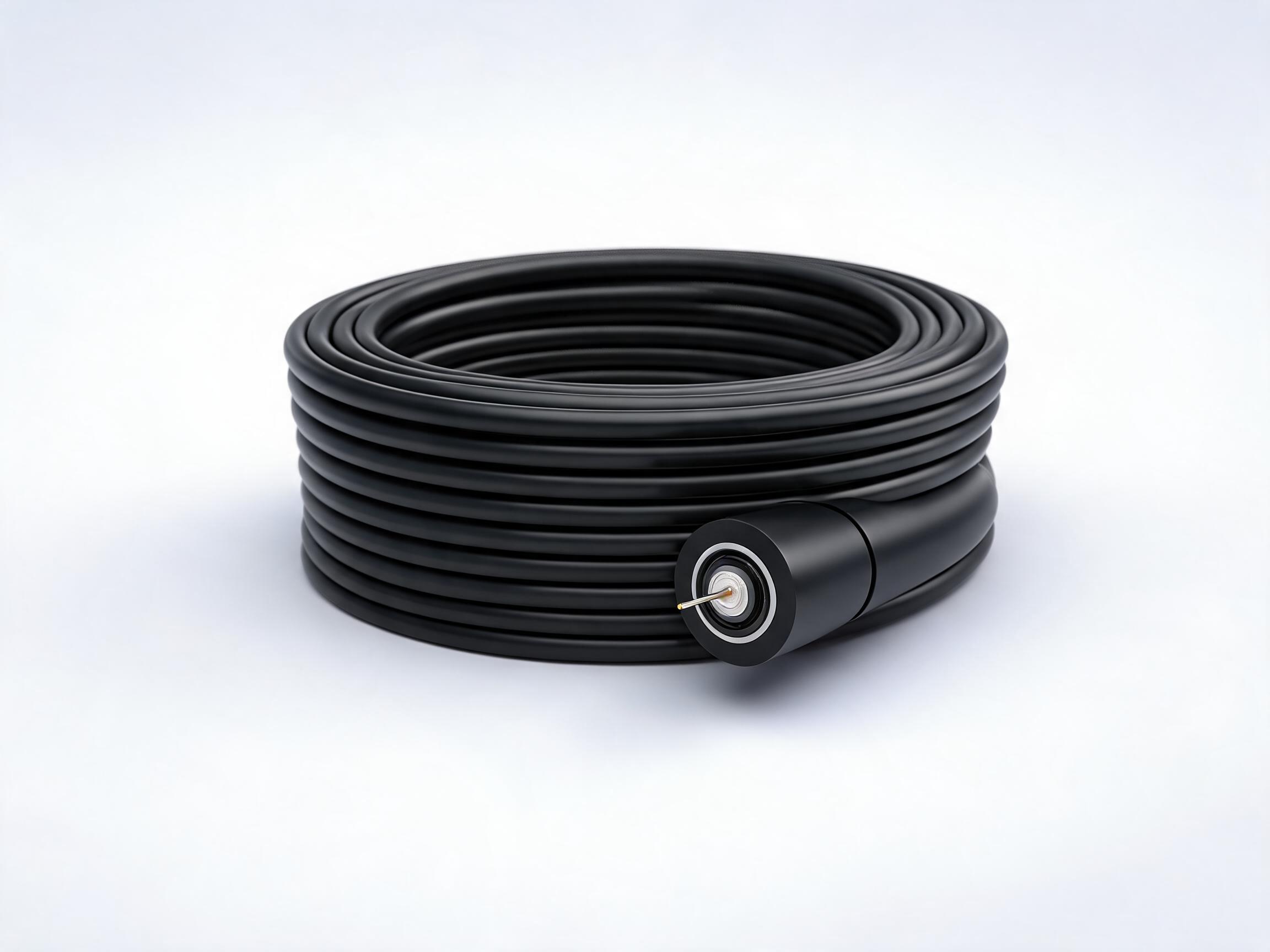
Outdoor Fiber Patch Cable: Specifying for Weather Exposure
A jumper between buildings is not an indoor jumper left outside. UV, water and temperature swing decide the jacket, the armor and the entry hardware.
The shortest cable on a campus is often the one that fails first: an ordinary indoor jumper run between buildings degrades in sunlight within a season and wicks water at the first connector. An outdoor fiber patch cable is specified against three exposures — UV, moisture and temperature swing — and each one has a construction answer.
The three exposures and their answers
| Exposure | Failure mode | Construction answer |
|---|---|---|
| UV sunlight | Jacket chalks and cracks | UV-stabilized PE jacket (never indoor PVC/LSZH outdoors) |
| Moisture | Water migrates along the cord into connectors | Water-blocking yarn/tape; sealed entry glands; end caps on storage coils |
| Temperature swing | Attenuation drifts seasonally | Loose-tube or armored outdoor constructions rated −40 °C to +70 °C (typical) |
Where the outdoor cord starts and stops
- Between buildings. Run the outdoor-rated cord for the full external leg and terminate inside at a patch panel or media converter on each side.
- At the entry. Drip loops and sealed glands keep water from following the jacket inside — the same entry discipline as our bulk cable guide.
- Aerial short spans. For anything beyond a protected conduit run, prefer a proper aerial construction; figure-8 and ADSS options are covered in the ADSS span guide.
- Mixed connector ends. Outdoor cords terminate in SC or LC to match each building's panel; hybrid ends (e.g. the LC-SC hybrid patch cord) avoid an extra mated pair in a wet box.
Cord or cable — which do you actually need?
Short, accessible, connector-to-connector runs justify a patch cable with outdoor jacketing. Long routes, direct burial or conduit pulls need a real outdoor cable ordered on reels — see the outdoor G.652D single-mode cable — spliced or pre-terminated at the ends. Choosing a cable and adding pigtails usually beats forcing a patch cord to do a cable's job.
Key specifications at a glance
| Parameter | Typical value |
|---|---|
| Fiber | OS2 G.652D single mode (or OM3/OM4 for short MM runs) |
| Jacket | UV-stabilized PE; LSZH indoor only at the transition |
| Operation temperature | −40 °C to +70 °C (typical) |
| Insertion loss | ≤0.3 dB typical / ≤0.5 dB max per connector pair (1310/1550 nm) |
| MOQ | 100 pcs per SKU |
| Lead time | 7–15 working days after deposit |
| Payment | 30% T/T deposit, balance before shipment |
| Warranty | 12 months from shipment date |
Buyer FAQ
Can we just use armored indoor jumpers outside?
Armor answers rodents and crush, not sunlight. Without a UV-stabilized outdoor jacket the sheath degrades regardless of armor. Outdoor exposure needs outdoor jacketing first.
How long can an outdoor patch run be?
Practically tens of meters between adjacent buildings; beyond that, attenuation, tension and handling favor a proper outdoor cable with pre-terminated or spliced ends.
Do the connectors need weather protection?
Terminate indoors wherever possible. When a connector must live outside, use an IP-rated closure or box around it — a bare connector in a gland is not a weatherproof joint.
Entscheidungshilfe
Welche Exposition gefährdet Ihre Außenleitung?
Wählen Sie die Exposition als Antwort — die Rückmeldung wiederholt die Wetterregeln auf dieser Seite.
Lösungsangebot anfordern
Beschreiben Sie Ihr Einsatzszenario, die benötigten Steckertypen, Faserzahlen und Zielmengen. Je spezifischer Ihre Angaben, desto schneller können unsere Ingenieure die passenden Produkte und die Lieferzeit bestätigen.