
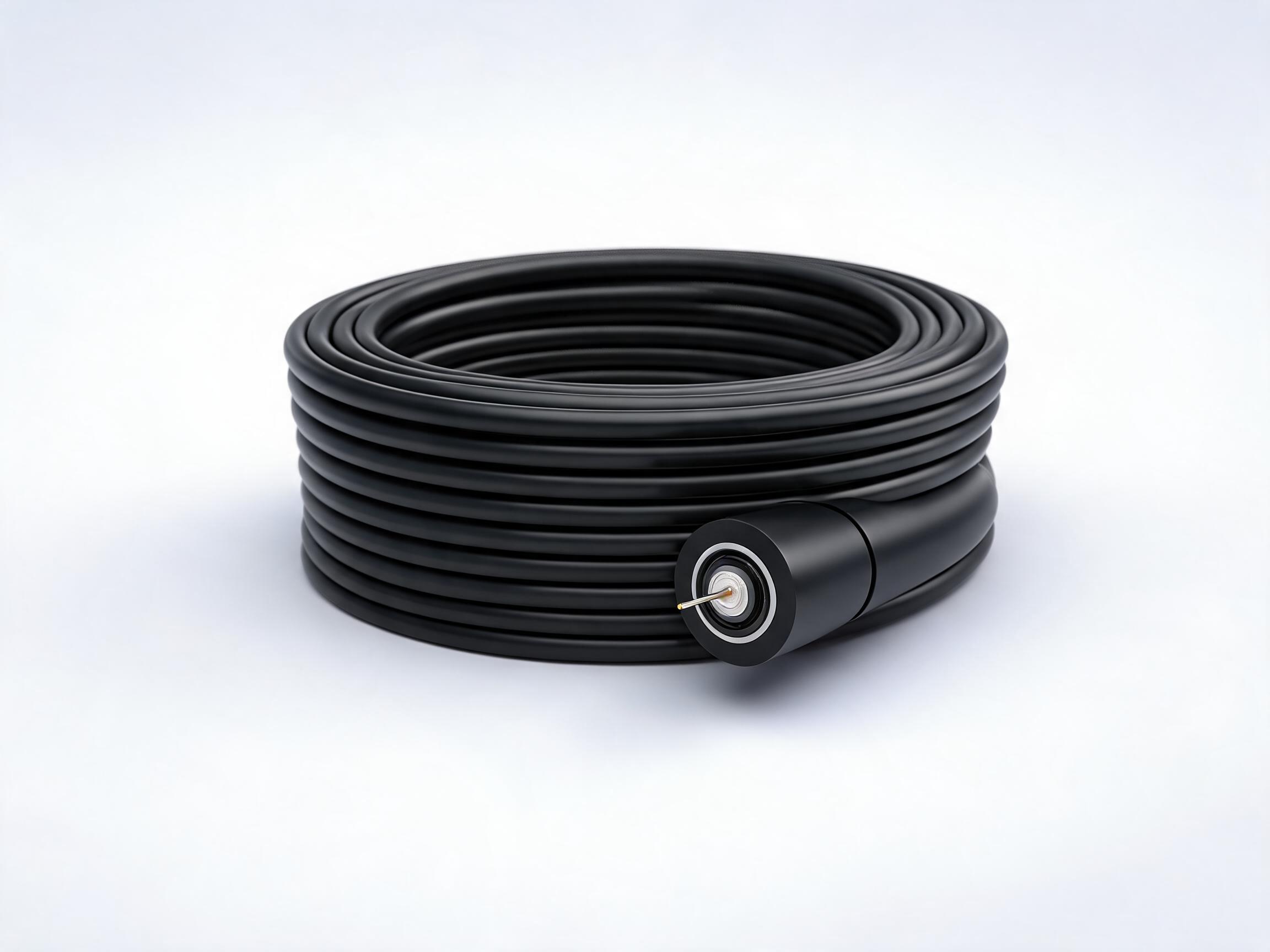
Outdoor Fiber Patch Cable: Specifying for Weather Exposure
A jumper between buildings is not an indoor jumper left outside. UV, water and temperature swing decide the jacket, the armor and the entry hardware.
The shortest cable on a campus is often the one that fails first: an ordinary indoor jumper run between buildings degrades in sunlight within a season and wicks water at the first connector. An outdoor fiber patch cable is specified against three exposures — UV, moisture and temperature swing — and each one has a construction answer.
The three exposures and their answers
| Exposure | Failure mode | Construction answer |
|---|---|---|
| UV sunlight | Jacket chalks and cracks | UV-stabilized PE jacket (never indoor PVC/LSZH outdoors) |
| Moisture | Water migrates along the cord into connectors | Water-blocking yarn/tape; sealed entry glands; end caps on storage coils |
| Temperature swing | Attenuation drifts seasonally | Loose-tube or armored outdoor constructions rated −40 °C to +70 °C (typical) |
Where the outdoor cord starts and stops
- Between buildings. Run the outdoor-rated cord for the full external leg and terminate inside at a patch panel or media converter on each side.
- At the entry. Drip loops and sealed glands keep water from following the jacket inside — the same entry discipline as our bulk cable guide.
- Aerial short spans. For anything beyond a protected conduit run, prefer a proper aerial construction; figure-8 and ADSS options are covered in the ADSS span guide.
- Mixed connector ends. Outdoor cords terminate in SC or LC to match each building's panel; hybrid ends (e.g. the LC-SC hybrid patch cord) avoid an extra mated pair in a wet box.
Cord or cable — which do you actually need?
Short, accessible, connector-to-connector runs justify a patch cable with outdoor jacketing. Long routes, direct burial or conduit pulls need a real outdoor cable ordered on reels — see the outdoor G.652D single-mode cable — spliced or pre-terminated at the ends. Choosing a cable and adding pigtails usually beats forcing a patch cord to do a cable's job.
Key specifications at a glance
| Parameter | Typical value |
|---|---|
| Fiber | OS2 G.652D single mode (or OM3/OM4 for short MM runs) |
| Jacket | UV-stabilized PE; LSZH indoor only at the transition |
| Operation temperature | −40 °C to +70 °C (typical) |
| Insertion loss | ≤0.3 dB typical / ≤0.5 dB max per connector pair (1310/1550 nm) |
| MOQ | 100 pcs per SKU |
| Lead time | 7–15 working days after deposit |
| Payment | 30% T/T deposit, balance before shipment |
| Warranty | 12 months from shipment date |
Buyer FAQ
Can we just use armored indoor jumpers outside?
Armor answers rodents and crush, not sunlight. Without a UV-stabilized outdoor jacket the sheath degrades regardless of armor. Outdoor exposure needs outdoor jacketing first.
How long can an outdoor patch run be?
Practically tens of meters between adjacent buildings; beyond that, attenuation, tension and handling favor a proper outdoor cable with pre-terminated or spliced ends.
Do the connectors need weather protection?
Terminate indoors wherever possible. When a connector must live outside, use an IP-rated closure or box around it — a bare connector in a gland is not a weatherproof joint.
Инструмент выбора
Какое воздействие угрожает вашему наружному шнуру?
Выберите условие эксплуатации — ответ повторяет правила по погодным воздействиям на этой странице.
Запросить коммерческое предложение на решение
Опишите ваш сценарий развёртывания, требуемые типы коннекторов, количество волокон и целевые объёмы. Чем конкретнее ваши данные, тем быстрее наши инженеры подтвердят подходящие продукты и срок производства.