
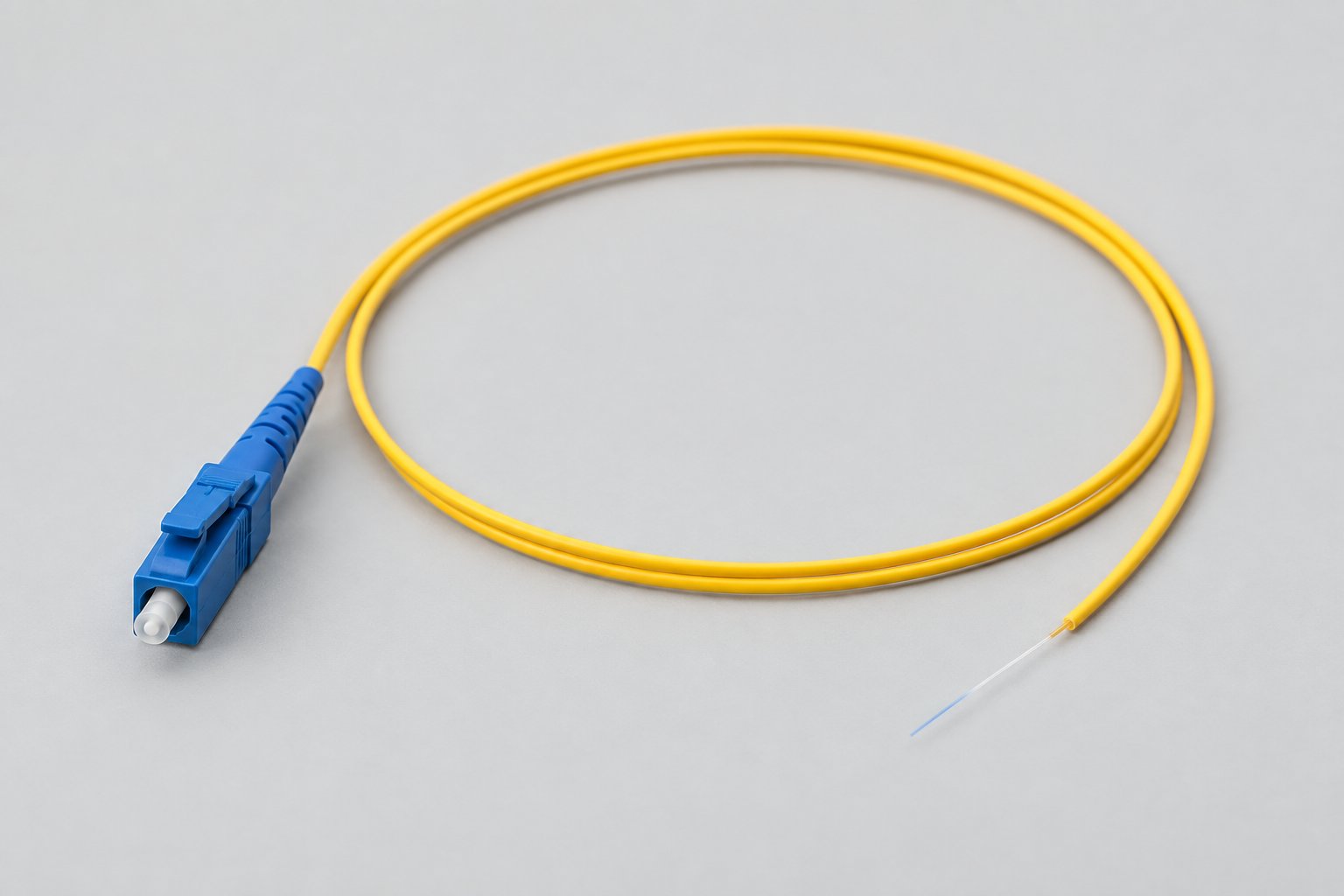
Fiber Optic Pigtail: Splice-On Termination Done Right
Why factory-terminated pigtails fused onto loose tube fibers outperform field polish: where they belong, how to order lengths, and what the splice crew needs.
A fiber optic pigtail is a short cord with a factory-polished connector on one end and bare fiber on the other, fusion-spliced onto a loose tube fiber at the ODF or closure. It is the standard termination for outdoor cable plant because the difficult part — polishing the connector — happens under factory conditions, and the field crew only makes one low-loss splice per fiber.
Pigtail vs field polish vs pre-terminated panel
| Method | Field work | Best for |
|---|---|---|
| Factory pigtail + fusion splice | One splice per fiber | ODFs, closures, any loose-tube outdoor cable — the default |
| Field-polished connectors | Strip, epoxy/crimp, polish, test per fiber | Tight-buffered indoor cords only; skill-dependent quality |
| Pre-terminated panel/trunk | Plug-in only | Measured indoor routes needing fast fit-out |
Our fiber optic pigtail line covers SC, LC and FC in single mode and multimode; the pigtails land on standard panels such as the LC/UPC duplex adapter.
Ordering details the splice crew cares about
- Connector and polish per end. SC/APC for FTTH closures, LC/UPC for enterprise ODFs, FC for test gear — state it per position, not per box.
- Pigtail length. Standard 1 m and 1.5 m builds reach most splice trays; measure unusually deep closures before ordering.
- Fiber match. G.652D pigtails on G.652D cable; multimode pigtails only on multimode plant. Mode mismatch at a splice is silent but permanent.
- Splice protection. 60 mm heat-shrink protectors on every splice; count them with the pigtails.
Acceptance the crew should record
After splicing, record splice loss and the pigtail's connector IL/RL with an OTDR or IL/RL test set — connector insertion loss ≤0.3 dB typical (≤0.5 dB max) and return loss UPC ≥50 dB / APC ≥60 dB typical are the reference figures to test against. A row per fiber in the ODF log turns tomorrow's fault call into a five-minute lookup.
Key specifications at a glance
| Parameter | Typical value |
|---|---|
| Fiber | OS2 G.652D or OM1–OM4, 900 µm tight-buffered tail |
| Connectors | SC, LC, FC; UPC or APC polish |
| Insertion loss | ≤0.3 dB typical / ≤0.5 dB max (1310/1550 nm) |
| Return loss | UPC ≥50 dB / APC ≥60 dB (typical) |
| Pigtail lengths | 1 m / 1.5 m standard; custom on request |
| MOQ | 100 pcs per SKU |
| Lead time | 7–15 working days after deposit |
| Payment | 30% T/T deposit, balance before shipment |
| Warranty | 12 months from shipment date |
Values marked typical are industry reference figures; the shipped datasheet for each SKU governs.
Buyer FAQ
Why splice a pigtail instead of polishing on site?
A factory connector is polished and tested under controlled conditions; a field polish depends on the technician. One fusion splice with a recorded loss is the more repeatable path for loose-tube fibers.
How many pigtails do we order for a 24-fiber ODF?
24 pigtails plus spares for rework and future fills — a common practice is one spare per tray. State the connector mix when ordering.
Can pigtails terminate tight-buffered indoor cable?
They can, but it is unnecessary: tight-buffered fibers accept direct connectorization. Pigtails earn their place on loose-tube outdoor and distribution cable.
Strumento decisionale
Come termineranno le fibre dell'ODF?
Scelga la domanda sulla terminazione — la risposta ribadisce le regole di giunzione di questa pagina.
Richiedi un preventivo per una soluzione
Descrivi il tuo scenario di deployment, i tipi di connettore richiesti, il numero di fibre e le quantità target. Più i tuoi input sono specifici, più rapidamente i nostri ingegneri potranno confermare i prodotti corrispondenti e il lead time.