
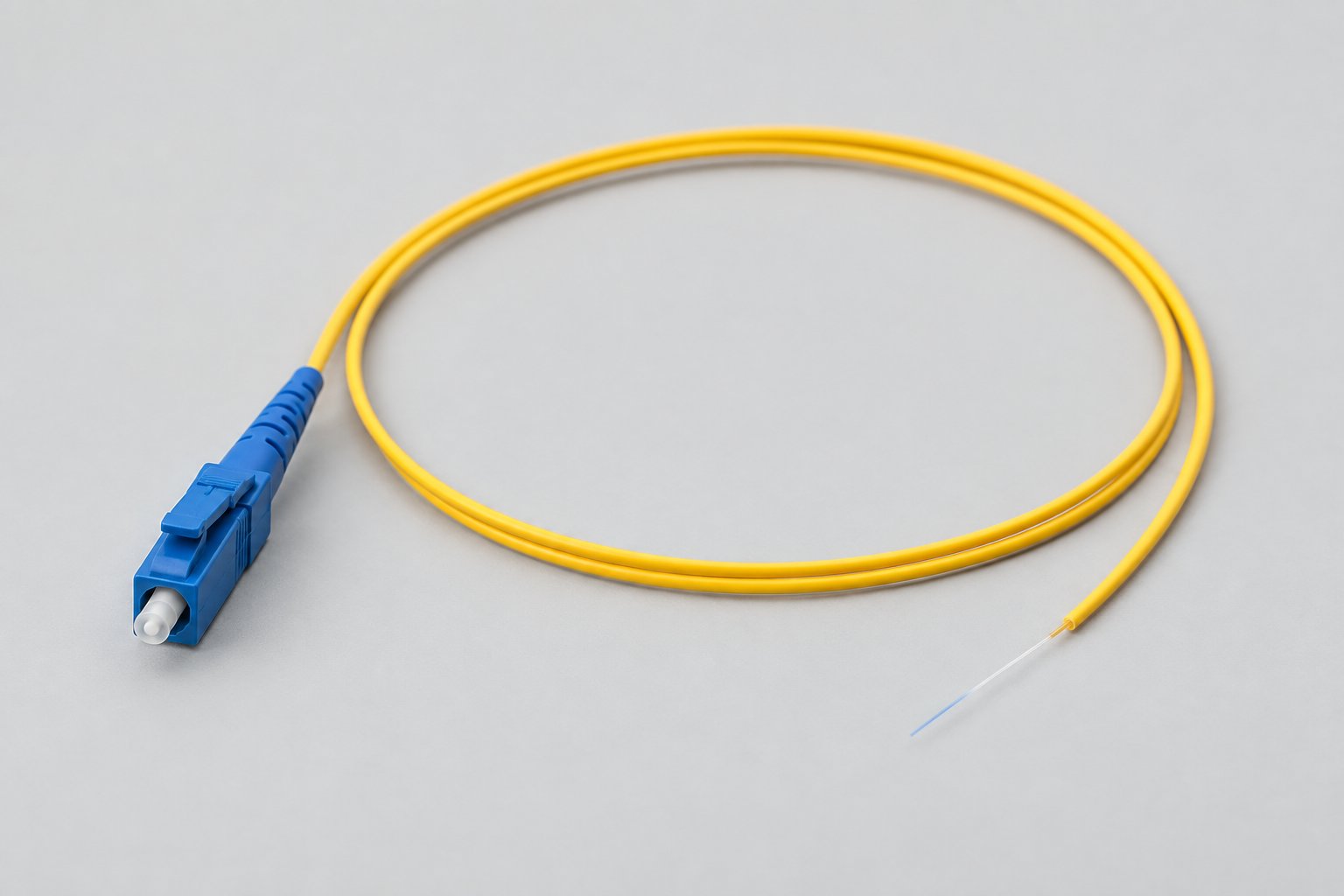
Fiber Optic Pigtail: Splice-On Termination Done Right
Why factory-terminated pigtails fused onto loose tube fibers outperform field polish: where they belong, how to order lengths, and what the splice crew needs.
A fiber optic pigtail is a short cord with a factory-polished connector on one end and bare fiber on the other, fusion-spliced onto a loose tube fiber at the ODF or closure. It is the standard termination for outdoor cable plant because the difficult part — polishing the connector — happens under factory conditions, and the field crew only makes one low-loss splice per fiber.
Pigtail vs field polish vs pre-terminated panel
| Method | Field work | Best for |
|---|---|---|
| Factory pigtail + fusion splice | One splice per fiber | ODFs, closures, any loose-tube outdoor cable — the default |
| Field-polished connectors | Strip, epoxy/crimp, polish, test per fiber | Tight-buffered indoor cords only; skill-dependent quality |
| Pre-terminated panel/trunk | Plug-in only | Measured indoor routes needing fast fit-out |
Our fiber optic pigtail line covers SC, LC and FC in single mode and multimode; the pigtails land on standard panels such as the LC/UPC duplex adapter.
Ordering details the splice crew cares about
- Connector and polish per end. SC/APC for FTTH closures, LC/UPC for enterprise ODFs, FC for test gear — state it per position, not per box.
- Pigtail length. Standard 1 m and 1.5 m builds reach most splice trays; measure unusually deep closures before ordering.
- Fiber match. G.652D pigtails on G.652D cable; multimode pigtails only on multimode plant. Mode mismatch at a splice is silent but permanent.
- Splice protection. 60 mm heat-shrink protectors on every splice; count them with the pigtails.
Acceptance the crew should record
After splicing, record splice loss and the pigtail's connector IL/RL with an OTDR or IL/RL test set — connector insertion loss ≤0.3 dB typical (≤0.5 dB max) and return loss UPC ≥50 dB / APC ≥60 dB typical are the reference figures to test against. A row per fiber in the ODF log turns tomorrow's fault call into a five-minute lookup.
Key specifications at a glance
| Parameter | Typical value |
|---|---|
| Fiber | OS2 G.652D or OM1–OM4, 900 µm tight-buffered tail |
| Connectors | SC, LC, FC; UPC or APC polish |
| Insertion loss | ≤0.3 dB typical / ≤0.5 dB max (1310/1550 nm) |
| Return loss | UPC ≥50 dB / APC ≥60 dB (typical) |
| Pigtail lengths | 1 m / 1.5 m standard; custom on request |
| MOQ | 100 pcs per SKU |
| Lead time | 7–15 working days after deposit |
| Payment | 30% T/T deposit, balance before shipment |
| Warranty | 12 months from shipment date |
Values marked typical are industry reference figures; the shipped datasheet for each SKU governs.
Buyer FAQ
Why splice a pigtail instead of polishing on site?
A factory connector is polished and tested under controlled conditions; a field polish depends on the technician. One fusion splice with a recorded loss is the more repeatable path for loose-tube fibers.
How many pigtails do we order for a 24-fiber ODF?
24 pigtails plus spares for rework and future fills — a common practice is one spare per tray. State the connector mix when ordering.
Can pigtails terminate tight-buffered indoor cable?
They can, but it is unnecessary: tight-buffered fibers accept direct connectorization. Pigtails earn their place on loose-tube outdoor and distribution cable.
Entscheidungshilfe
Wie werden die ODF-Fasern abgeschlossen?
Wählen Sie die Abschlussfrage — die Antwort wiederholt die Spleißregeln auf dieser Seite.
Lösungsangebot anfordern
Beschreiben Sie Ihr Einsatzszenario, die benötigten Steckertypen, Faserzahlen und Zielmengen. Je spezifischer Ihre Angaben, desto schneller können unsere Ingenieure die passenden Produkte und die Lieferzeit bestätigen.