
ADSS Cable: Matching Span and Tension Before You Order
All-dielectric aerial cable lives or dies by the span calculation: AT sheath class, rated tension, sag and hardware must all follow the real pole spacing.
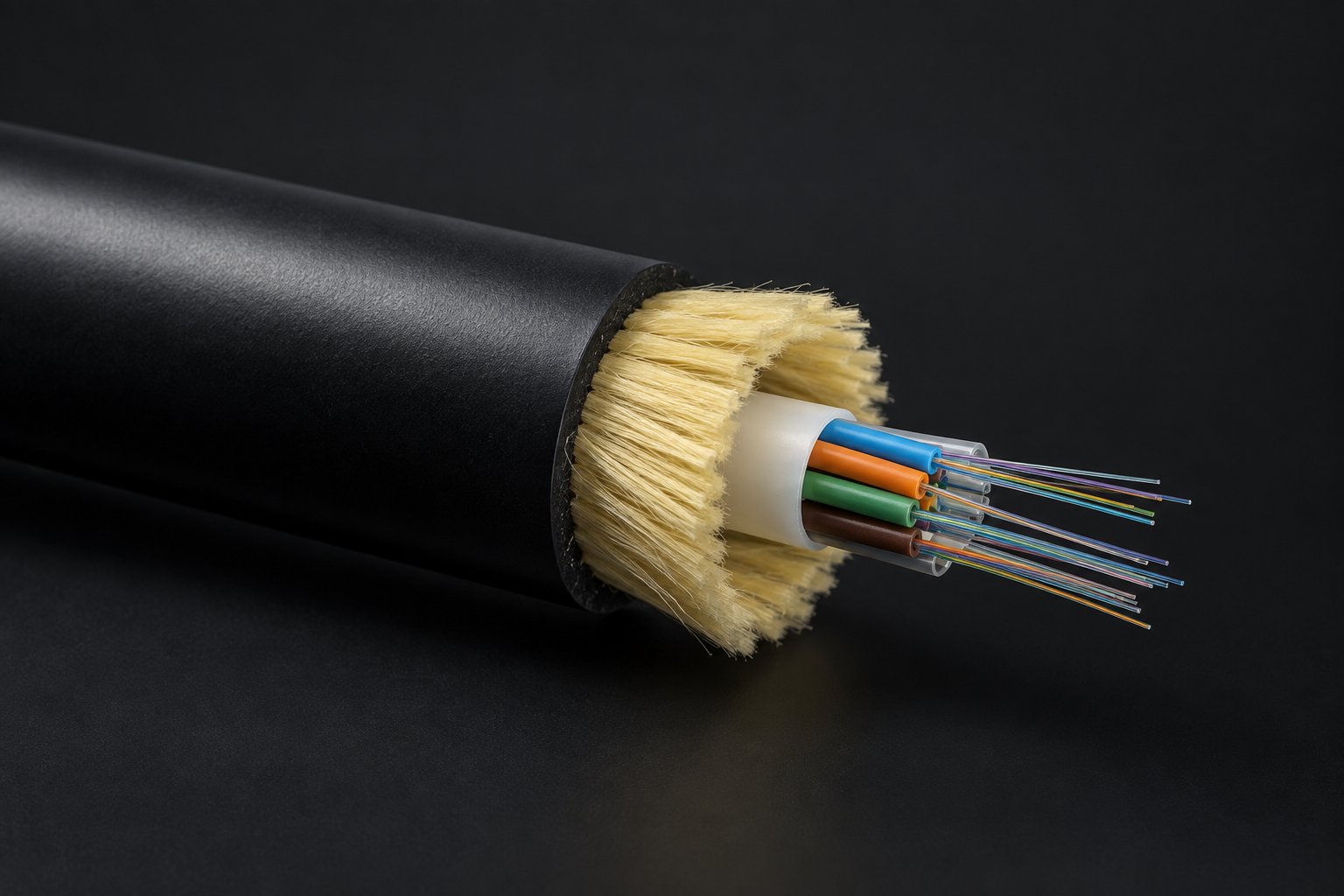
ADSS cable (All-Dielectric Self-Supporting) carries no metal at all: the aramid strength member takes the pole-to-pole load and the cable can ride power lines without grounding. That is exactly why its failure mode is quiet — an under-specified span does not short anything, it just sags into clearance or fatigues the sheath. Ordering ADSS correctly starts from the measured spans, not the catalog.
Span class decides the build
| Span class | Typical use | Build consequence |
|---|---|---|
| Short (up to ~100 m) | Urban feeder, building-to-building | Smaller aramid package; lighter dead-end hardware |
| Medium (100–300 m) | Rural distribution alongside LV lines | Higher aramid content; AT-rated outer sheath; mid-span closures possible |
| Long (300 m and beyond) | River crossings, terrain gaps | Full span engineering: sag/tension chart per tower, matched dead-ends and vibration dampers |
Span classes above are the common planning bands; the cable's rated tensile strength, sag and every span figure must be confirmed against the datasheet and the route survey for your project.
The four inputs a factory needs from your survey
- Maximum span. The longest single pole-to-pole distance sets the aramid package.
- Sheath environment. AT (anti-tracking) outer sheath where the cable runs under energized lines; PE elsewhere.
- Installation tension and sag target. The crew strings to a chart, not a feeling — the chart comes from the span data.
- Hardware list. Dead-ends, suspensions and dampers must match the cable diameter and rated tension.
ADSS or figure-8?
Where a cheap messenger wire is acceptable and spans are short, figure-8 self-supporting cable does the same job at lower cost. ADSS earns its premium when the route crosses power lines, when grounding is impractical, or when spans exceed what a figure-8 messenger supports — see the figure-8 self-supporting cable for that comparison.
Key specifications at a glance
| Parameter | Typical value |
|---|---|
| Fiber type | G.652D single-mode; counts per project |
| Structure | All-dielectric: FRP central member, aramid strength, loose tube core |
| Outer sheath | AT anti-tracking (under power lines) / PE |
| Attenuation @ 1310 / 1550 nm | ≤0.4 / ≤0.3 dB/km (typical; refer to datasheet) |
| Operation temperature | −40 °C to +70 °C (typical) |
| Lead time | 7–15 working days after deposit |
| Payment | 30% T/T deposit, balance before shipment |
| Warranty | 12 months from shipment date |
Buyer FAQ
Can ADSS be installed on live power routes?
The cable itself is all-dielectric, which is why it suits power corridors — but the installation method, clearance and any work near energized lines follow the route owner's electrical safety rules, not the cable datasheet.
What happens if we order a lower span class to save cost?
The cable will not fail immediately; it sags toward clearance limits and the sheath fatigue cycle shortens. Span class is a survey figure, not an estimate — measure the longest spans before ordering.
Do you supply the pole hardware with the cable?
Matched dead-end and suspension hardware is quoted against the cable's rated tension and diameter. Send the span survey so the hardware set and the cable are specified together.
Ferramenta de decisão
Qual é o seu vão mais longo?
Selecione a classe de vão a partir do seu levantamento — a resposta reitera as regras de construção ADSS nesta página.
Solicitar uma cotação de solução
Descreva o seu cenário de implementação, os tipos de conector necessários, as contagens de fibra e as quantidades pretendidas. Quanto mais específicos forem os seus dados, mais rapidamente os nossos engenheiros poderão confirmar os produtos correspondentes e o prazo de entrega.