
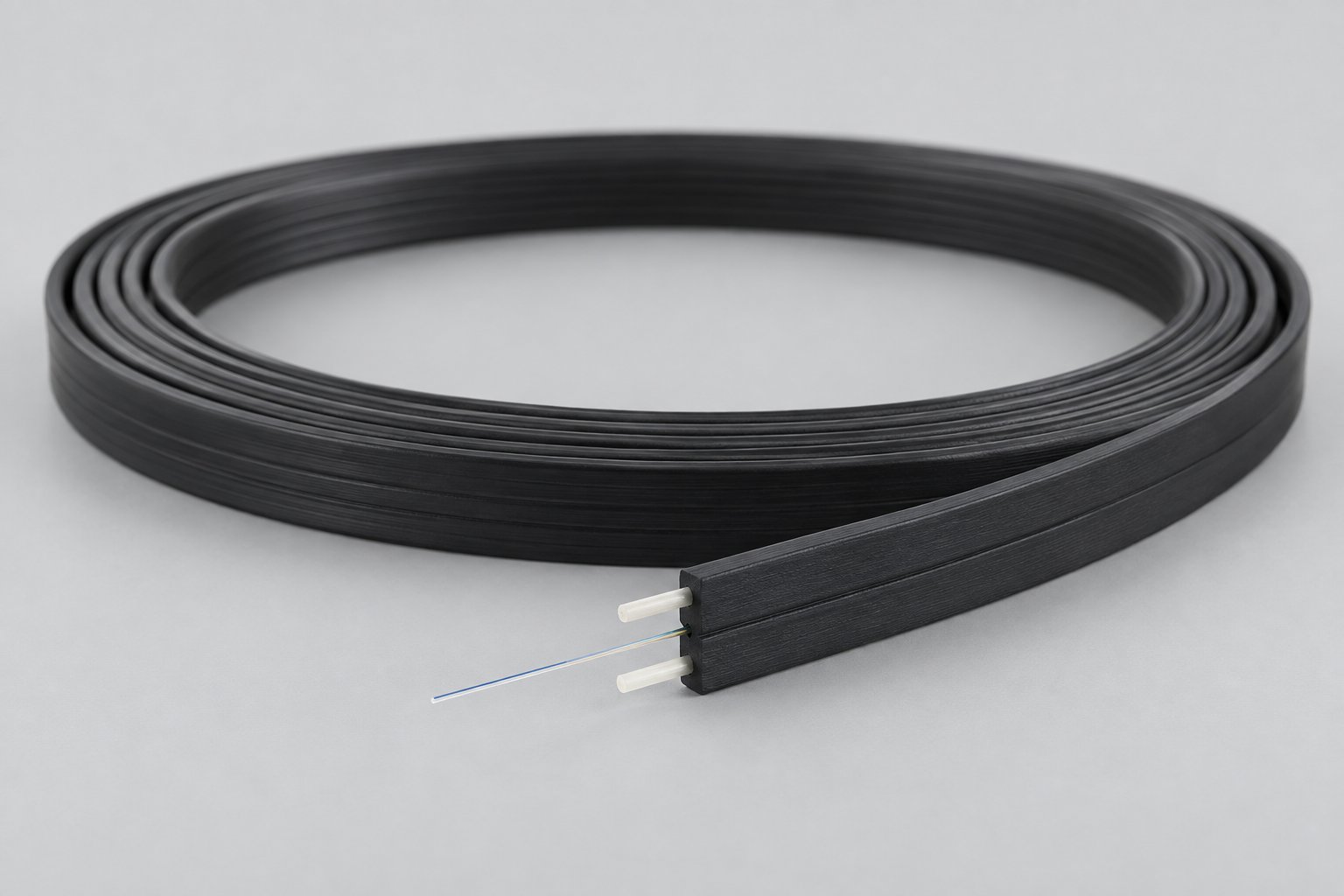
Bend-Insensitive Fiber Cable: G.657 Drop Wiring
G.657 bend-insensitive fiber survives the tight corners of a home drop. A1 vs A2 bend radii, where it replaces G.652D, and what to state on the order.
Indoor FTTH wiring is a geometry problem. The fiber enters through a 20 mm hole, runs along a skirting board and terminates on a wall-mounted ONT, and standard G.652D glass leaks light at every forced corner. G.657 bend-insensitive fiber keeps the same single-mode core but adds an index trench, so the signal survives bends a legacy fiber cannot. In a FTTH drop cable that difference decides whether the subscriber link tests clean on day one.
A1 vs A2: what the bend radius buys
| Fiber grade | Typical minimum bend radius | Best fit |
|---|---|---|
| G.652D | 30 mm | Backbone, duct and aerial runs with gentle routing |
| G.657.A1 | 10 mm | Drops, conduit and indoor premises wiring |
| G.657.A2 | 7.5 mm | The tightest indoor corners: skirting boards, clips, ONT ends |
Where G.657 actually replaces G.652D
- Indoor drop and premises wiring. Anywhere the route is forced through clips, corners and wall entries.
- Splicing is unchanged. G.657 splices to G.652D with typical splice losses below 0.1 dB, so mixed networks need no special handling.
- Not needed where radius is easy. Duct and long-haul backbones keep G.652D; paying for bend tolerance there buys nothing.
Key specifications at a glance
| Parameter | Typical value |
|---|---|
| Fiber class | G.657.A1 or G.657.A2 (single mode, G.652D-compatible) |
| Attenuation | ≤0.36 dB/km typical at 1310 nm; ≤0.22 dB/km typical at 1550 nm |
| Insertion loss (connectorized ends) | ≤0.3 dB typical / ≤0.5 dB max (1310/1550 nm) |
| Return loss | UPC ≥50 dB / APC ≥60 dB (typical) |
| MOQ | Typical 1,000 m per drop-cable SKU; patch cords from 100 pcs |
| Lead time | 7–15 working days after deposit |
| Payment | 30% T/T deposit, balance before shipment |
| Warranty | 12 months from shipment date |
Bend and attenuation figures are industry reference values; the shipped datasheet for each build governs.
Buyer FAQ
Can G.657 cable replace G.652D everywhere?
Technically yes — it is backward compatible — but there is no benefit on routes with gentle radii. Specify G.657 where the installation forces the bend.
Does A2 cost much more than A1?
The glass premium is small at drop-cable volumes; the practical choice is decided by the tightest corner on the route, not by price.
Which grade should a broadband operator standardize on?
Most operators specify G.657.A1 for drops and keep G.652D for backbones, moving to A2 only for constrained apartment entries.
Outil d'aide à la décision
Décision sur le rayon de courbure
À quel angle la fibre doit-elle résister ?
Demander un devis de solution
Décrivez votre scénario de déploiement, les types de connecteurs requis, le nombre de fibres et les quantités cibles. Plus vos informations sont précises, plus nos ingénieurs pourront confirmer rapidement les produits correspondants et le délai de livraison.