
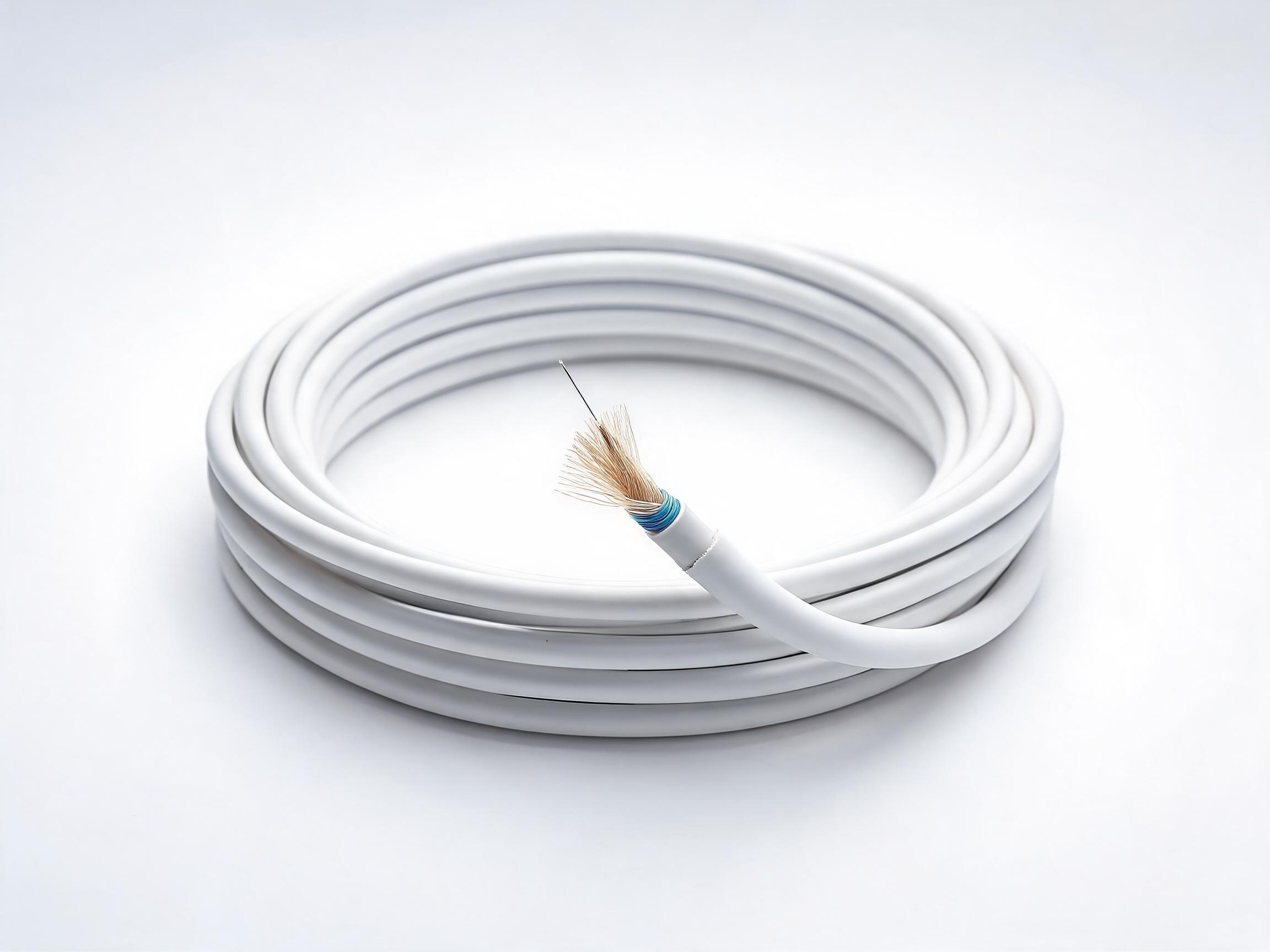
Tight Buffered Fiber Optic Cable: Indoor Routing Decisions
Where tight-buffered construction wins indoors, how riser and plenum ratings map to the building, and why it terminates to connectors without splice closures.
Tight buffered fiber optic cable is the indoor workhorse: each fiber carries its own 900 µm buffer, so the cable can be stripped and connectorized directly — no splice-on pigtail, no fan-out kit, no closure at the panel. The routing decisions that matter indoors are where the construction fits, which fire rating the path demands, and how tight a bend the route takes.
Where tight-buffered fits
| Route | Tight-buffered verdict | Why |
|---|---|---|
| Horizontal runs to workstations | Standard choice | Direct termination, small bend radius, manageable diameter |
| Riser shafts between floors | Choose riser-rated (OFNR) jacket | Fire code requirement for vertical paths |
| Plenum air spaces | Plenum-rated (OFNP) only | Low smoke and flame spread where air circulates |
| Outdoor legs or buried sections | Not suitable | No moisture protection — switch to an outdoor or armored construction at the building entry |
Termination without a splice truck
Because each fiber is protected by its own buffer, a crew can polish connectors straight onto tight-buffered fiber on site — the reason it dominates indoor panel work. For high-count backbones where factory-tested terminations are preferred, the same cable can be broken out at the cabinet; pigtails and factory-terminated options are covered by the fiber optic pigtail.
- Bend control. The 900 µm buffer tolerates indoor corners well, but panel routing still obeys the cable's minimum bend radius — confirm it on the datasheet.
- Count discipline. Standard builds run 2–24 fibers; beyond that, a distribution cable with subunits keeps the fibers organized.
- Pairing with outdoor plant. Join the outdoor cable at the entry in a closure or cabinet, then run tight-buffered indoors.
Key specifications at a glance
| Parameter | Typical value |
|---|---|
| Buffer | 900 µm tight buffer per fiber |
| Fiber counts | 2–24 fibers standard |
| Jacket ratings | OFNR riser / OFNP plenum; LSZH options |
| Attenuation (MM, 850 nm) | ≤3.0 dB/km OM1–OM4 class fibers (typical; refer to datasheet) |
| Operation temperature | −20 °C to +60 °C indoor class (typical) |
| Lead time | 7–15 working days after deposit |
| Payment | 30% T/T deposit, balance before shipment |
| Warranty | 12 months from shipment date |
Buyer FAQ
Can tight-buffered cable be used outdoors at all?
Only in protected, short transitions. Tight buffer is not water-blocked, so any outdoor leg needs an outdoor-rated construction joined at the building entry.
Riser or plenum — which do we order?
The building code decides, not preference: plenum (OFNP) where the path runs through air-handling spaces, riser (OFNR) for vertical shafts. When in doubt, the inspector's answer is cheaper than a re-pull.
Can we terminate it ourselves with field connectors?
Yes — direct connectorization is the construction's main advantage. For certified links, verify each connector's IL/RL with your test set after polishing.
Entscheidungshilfe
Wo verläuft das Kabel?
Wählen Sie den Innenweg — die Antwort gibt die Regeln für eng gebündelte Verlegung auf dieser Seite wieder.
Lösungsangebot anfordern
Beschreiben Sie Ihr Einsatzszenario, die benötigten Steckertypen, Faserzahlen und Zielmengen. Je spezifischer Ihre Angaben, desto schneller können unsere Ingenieure die passenden Produkte und die Lieferzeit bestätigen.