
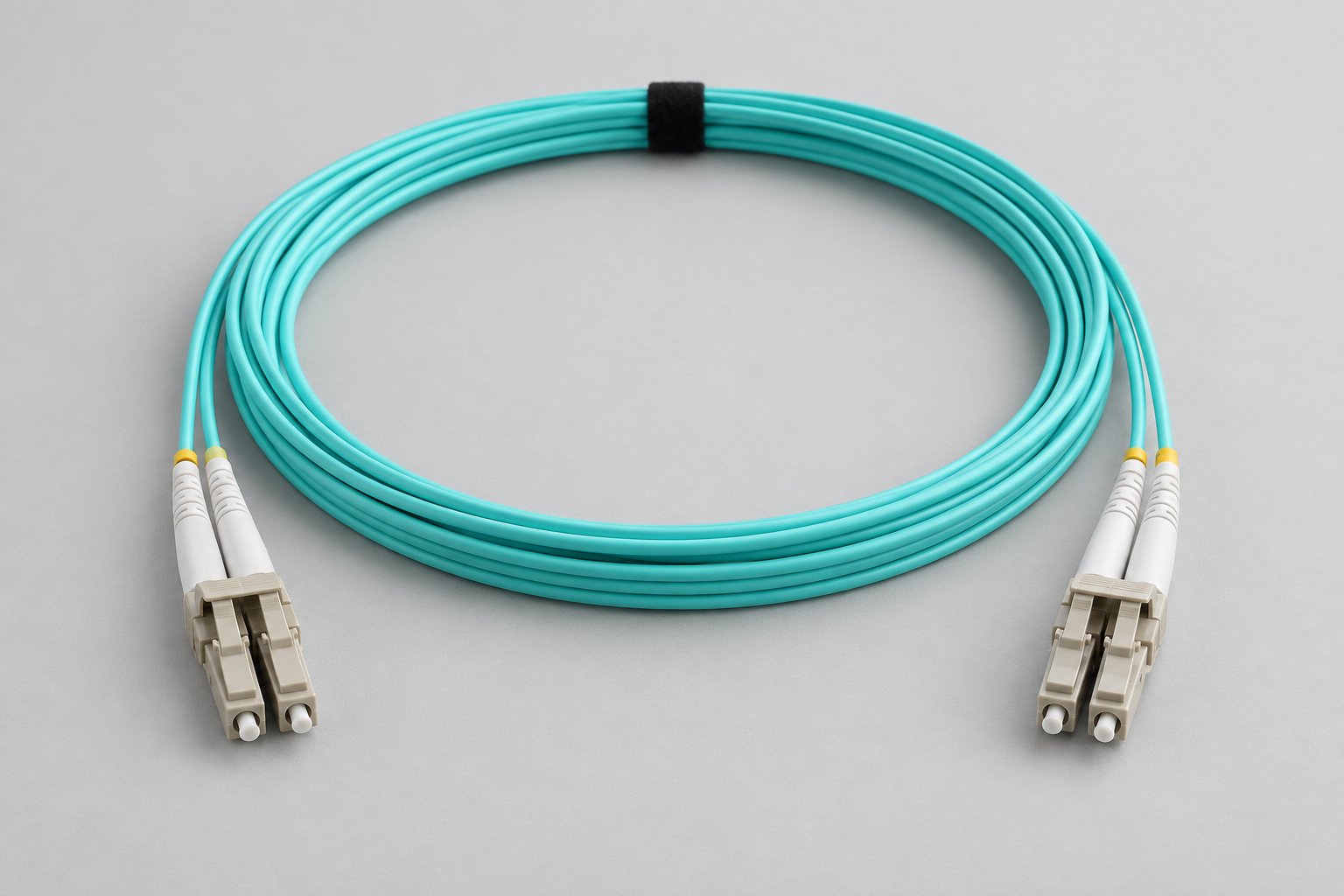
OM3 vs OM4 Premade Trunk Cables for Data Center Cabling
Reach budgets, polarity methods and pre-terminated trunk options for 10G–100G multimode links, with the typical specs to confirm per link before ordering.
Installing a rack row with field-terminated multimode cords costs hours per link; a premade fiber optic cable — a factory-terminated trunk — arrives tested, labeled and ready to pull. For 10G to 100G multimode links the two decisions that shape the order are the fiber class (OM3 or OM4) and the polarity method. This guide gives the reach budget for each class and explains how polarity maps ports before you buy.
Reach budget at a glance
| Standard | OM3 reach | OM4 reach |
|---|---|---|
| 10GBASE-SR | 300 m | 400 m |
| 40GBASE-SR4 | 100 m | 150 m |
| 100GBASE-SR4 | 100 m | 150 m |
Typical IEEE figures for the common transceiver families; the effective reach of a specific link also depends on total connector loss and patch congestion — confirm per link against the transceiver and datasheet.
Why buyers choose premade trunks
- Factory-tested links. Each trunk ships with measured insertion and return loss per leg instead of a field termination whose quality depends on the installer's day.
- Consistent polarity. Method A, B or C is fixed at the factory, so port mapping is predictable across every rack.
- Faster cutover. Pull, land, test — no fusion splicing or polishing on the floor. Field termination still wins where the route length is unknown until install day.
Polarity in one table
| Method | Trunk construction | Where it is used |
|---|---|---|
| Method A | Straight-through, key-up/key-down ends | Patch panels on both sides |
| Method B | Key-up/key-up (transposed) | Direct transceiver-to-transceiver links |
| Method C | Paired flip within the trunk | Cassettes with pair-level flipping |
Decide the method before ordering — it changes how the trunk maps transmit and receive, and mixed methods in one rack are the most common cause of a link that never comes up.
Key specifications at a glance
| Parameter | Typical value |
|---|---|
| Fiber class | OM3 ≥2,000 MHz·km / OM4 ≥4,700 MHz·km @ 850 nm (typical) |
| Insertion loss | ≤0.3 dB typical / ≤0.5 dB max per mated pair |
| Connector options | MPO-LC, MPO-SC and LC-LC trunks, 8/12/24-fiber variants |
| MOQ | 100 pcs per SKU |
| Lead time | 7–15 working days after deposit |
| Payment | 30% T/T deposit, balance before shipment |
| Warranty | 12 months from shipment date |
Buyer FAQ
Is OM4 backward-compatible with OM3 links?
OM4 is a higher-bandwidth fiber, so an OM4 trunk supports every reach an OM3 trunk does at the same transceiver — the reverse is not true. New builds commonly install OM4 so reach headroom exists for future rates.
Which polarity method should we order?
The method follows your panel architecture: Method A for panel-to-panel, Method B for direct transceiver links, Method C for cassette-based zones. Send us the rack diagram and we will map the trunks before quoting.
Can trunks be made to custom lengths?
Yes — custom lengths, fan-out configurations and connector mixes are OEM/ODM options. Provide the route lengths and connector plan with the inquiry.
Strumento decisionale
Quale classe di fibra si adatta al tuo link budget?
Seleziona il livello del data center per individuare la classe di patch cord corrispondente.
Richiedi un preventivo per una soluzione
Descrivi il tuo scenario di deployment, i tipi di connettore richiesti, il numero di fibre e le quantità target. Più i tuoi input sono specifici, più rapidamente i nostri ingegneri potranno confermare i prodotti corrispondenti e il lead time.