
Installing Fiber Optic Cable in Home: A Route-First Drop Cable Guide
A route-first framework for installing fiber optic cable in homes: how to match flat drop, self-supporting and figure-8 constructions to indoor, boundary and aerial legs.
Installing fiber optic cable in a home looks simple on a drawing, but the last 100 meters decide whether an FTTH subscriber gets a stable link or a service ticket. This guide walks through the real drop-route decisions a buyer or installer makes — indoor, boundary, or aerial — and maps each route to the Nexora drop cable constructions we build for ISPs and contractors.
Where the drop actually gets difficult
The indoor leg runs through wall passages, trunking and tight corners. The boundary leg crosses walls, eaves or short duct sections. The aerial leg hangs between a pole and the building. Each leg punishes a different property: bend radius indoors, crush and moisture at the boundary, tension and UV outdoors. One cable type rarely serves all three legs well, which is why route first, cable second is the rule we recommend.
Route 1 — Indoor tight-space runs
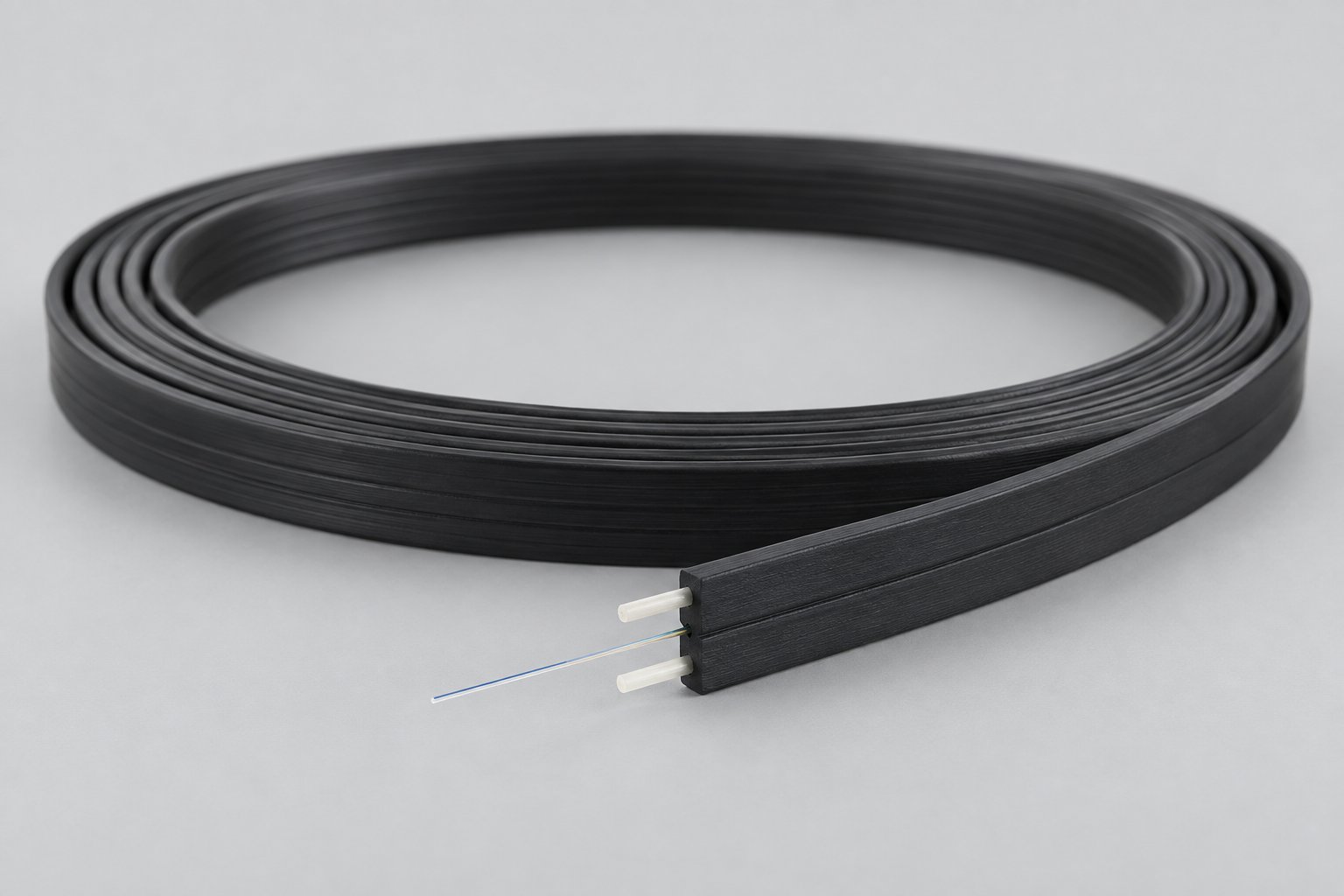
For in-home runs through conduit and trunking, choose a flat drop cable with a bend-insensitive single-mode fiber. Bend-insensitive fiber keeps attenuation stable at tight corners, and the flat profile staples or clips flat along skirting without a visible ridge.
Route 2 — Indoor-to-outdoor boundary
Where the drop leaves the house through a wall gland, moisture and temperature swing become the failure drivers. A self-supporting drop with a strength member handles the wall passage and short external runs without needing a separate messenger wire.
Route 3 — Pole-to-building aerial spans
Short aerial spans put constant tension and UV exposure on the cable. A figure-8 self-supporting construction keeps the messenger separate from the optical core so the fiber does not carry the load. Typical working tension for spans up to roughly 80–100 m is in the 600–1,000 N class for this construction — confirm the exact figure on the datasheet for your span length.
Key specifications at a glance
| Parameter | Typical value |
|---|---|
| Fiber type | G.657A2 bend-insensitive single-mode (G.652D available) |
| Fiber count | 1–4 cores, flat or round drop construction |
| Attenuation @ 1310 / 1550 nm | ≤0.4 / ≤0.3 dB/km (typical; refer to datasheet) |
| Operation temperature | −40 °C to +70 °C (typical) |
| Messenger / strength member | Steel or FRP, matched to span and environment |
| Jacket | LSZH indoor; UV-stabilized PE outdoor |
| MOQ | 100 pcs per SKU |
| Lead time | 7–15 working days after deposit |
| Payment | 30% T/T deposit, balance before shipment |
| Warranty | 12 months from shipment date |
Values marked typical are industry-standard reference figures; the shipped datasheet for your exact SKU governs.
How to match cable to route in 3 steps
- Measure the route, not the distance. Count corners, wall crossings and clamp points; each one is a bend or crush event.
- Pick the jacket for the worst segment. If any segment sits outdoors, that segment needs outdoor-rated jacket — split the run rather than over-speccing the indoor leg.
- Fix the span before ordering. Messenger type and strength member follow from span length and pole condition, not the other way round.
Buyer FAQ
Can one drop cable cover indoor and outdoor legs?
Only when the route is short and the outdoor exposure is mild. For most homes we supply two SKUs — LSZH flat drop indoors and PE self-supporting drop for the external leg — joined at the wall gland.
What is the minimum order and can we mix constructions?
MOQ is 100 pcs per SKU. Mixed SKUs within one order are welcome; tell us the per-SKU split when you request the quotation.
Do you support custom lengths and pre-connectorized ends?
Yes — custom lengths and pre-terminated ends are part of our OEM/ODM service. Send the connector types and lengths with your inquiry so the quote reflects the exact build.
Outil d'aide à la décision
Où passera le câble de raccordement ?
Choisissez l'environnement de cheminement et la note ci-dessous indique la construction de câble à présélectionner.
Demander un devis de solution
Décrivez votre scénario de déploiement, les types de connecteurs requis, le nombre de fibres et les quantités cibles. Plus vos informations sont précises, plus nos ingénieurs pourront confirmer rapidement les produits correspondants et le délai de livraison.