
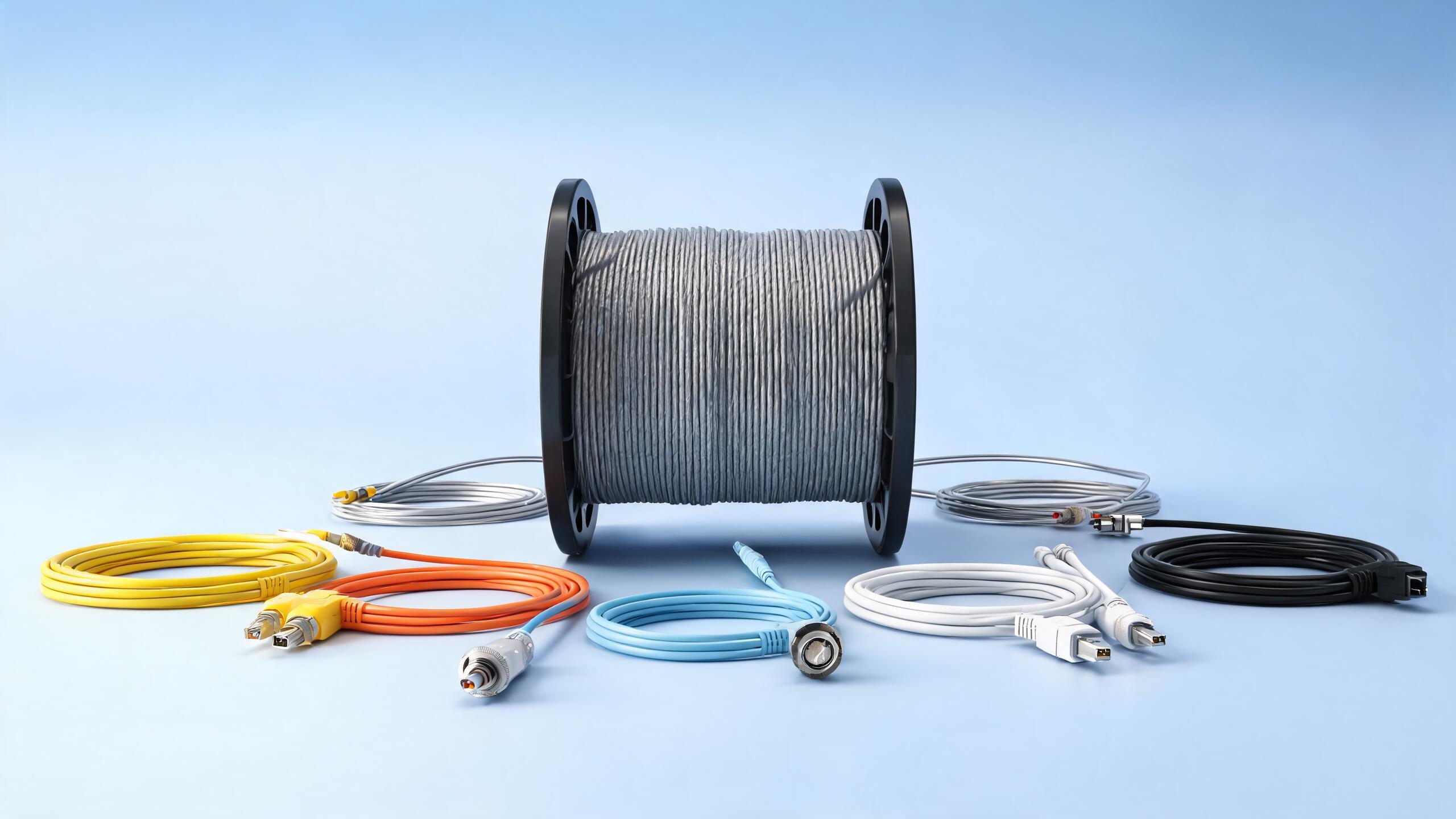
Un guide pratique pour sélectionner un câble à fibre optique selon le type de fibre, la structure du câble, l'environnement, le nombre de fibres et la distance, avec une liste de contrôle de l'acheteur.
What should you consider before choosing a fiber optic cable?
The right fiber optic cable depends on the distance, data rate and environment of the link you are building. Before comparing products, define the route: how far the signal travels, whether the cable runs indoors or outdoors, and what bandwidth the network must support. These three facts narrow the options quickly and help you compare quotations on an equal basis.
For a buyer sourcing fiber optic cable for a telecom, FTTH or data center project, the goal is to match the cable to the installation, not to pick the most expensive option. This article explains the decisions that matter most and gives you a checklist you can use when you talk to suppliers.
Single mode or multimode: which fiber type fits your link?
Single mode fiber, such as G.652D, suits long-distance backbone and metro links because it carries light over greater distances with low attenuation. Multimode fiber, such as OM3, is a common choice for shorter runs inside buildings and data centers where high data rates are needed over limited distances. Match the fiber type to your transceiver and distance budget rather than choosing by price alone.
If you already own equipment, check the transceiver specification first. Single mode and multimode fiber use different optics, and mixing incompatible types causes avoidable loss and rework. Confirm the connector polish, for example UPC or APC, matches the ports you are connecting as well.
Outdoor or indoor construction: how does the environment change the cable?
Outdoor cables use a loose-tube, gel-filled structure with a PE jacket to resist moisture, UV and mechanical stress, making them suitable for direct burial, duct and aerial routes. Indoor cables use a tight-buffered, flame-retardant design that is easy to strip and terminate for patch panels and distribution frames. Choose the construction that matches the installation environment and local building codes.
For a route that crosses both indoor and outdoor sections, you may need different cable types for each segment, or a cable designed for the transition. Confirm the jacket material, water-blocking and fire rating with your supplier so the cable meets the requirements of the full route.
How many fibers do you need in the cable?
Select a fiber count that covers current demand and leaves room for growth. Higher counts cost more but avoid re-cabling when the network expands. A backbone link that needs 12 fibers today may need 24 or 48 in a few years, so it is often cheaper to install extra capacity now than to pull a new cable later.
Confirm the count, sheath option and any custom lengths with your supplier before ordering. For FTTH and access networks, the fiber count per cable and the distribution plan affect both cost and installation time, so it is worth planning the count with the network design in mind.
What about attenuation, continuity and test data?
Attenuation tells you how much signal is lost along the cable, and continuity confirms the fibers are intact. Ask for attenuation and continuity test data before dispatch for critical links, and confirm the test method matches the standard your project requires. A supplier that can provide test data for each reel or drum is easier to audit than one that only provides a general specification.
For long outdoor routes, also confirm the cable length per drum and how splices are planned, because these affect both loss budget and installation cost.
Buyer checklist for fiber optic cable
- Confirm the link distance and data rate.
- Choose single mode or multimode to match your transceiver.
- Select outdoor or indoor construction for the route.
- Confirm fiber count, length and jacket requirements.
- Ask for attenuation and continuity test data before dispatch.
- Confirm the connector polish and termination plan.
Once you have these details, you can compare quotations on an equal basis and avoid the most common ordering mistakes.
Common questions buyers ask about fiber optic cable
How many types of fiber optic cable are there?
Fiber optic cable is grouped by fiber type (single mode or multimode) and by construction (outdoor or indoor). Within each group there are variants for different environments, such as armored, aerial or riser cable. The right type depends on your route and application.
What is fiber optic cable made of?
A fiber optic cable contains glass or plastic fibers surrounded by protective layers. The core and cladding carry the light, while the buffer, strength members and jacket protect the fiber from moisture, stress and damage during installation.
How much does fiber optic cable cost?
Cost depends on fiber type, fiber count, construction and length. Single mode and multimode differ in price, and outdoor armored cable costs more than indoor cable. Ask suppliers for a quotation based on your exact count, length and jacket requirements.
Next step for your fiber optic cable order
If you are unsure which cable fits your project, share your distance, environment and bandwidth requirements with our team. We can help confirm a suitable option and provide a quotation that matches your network design.