
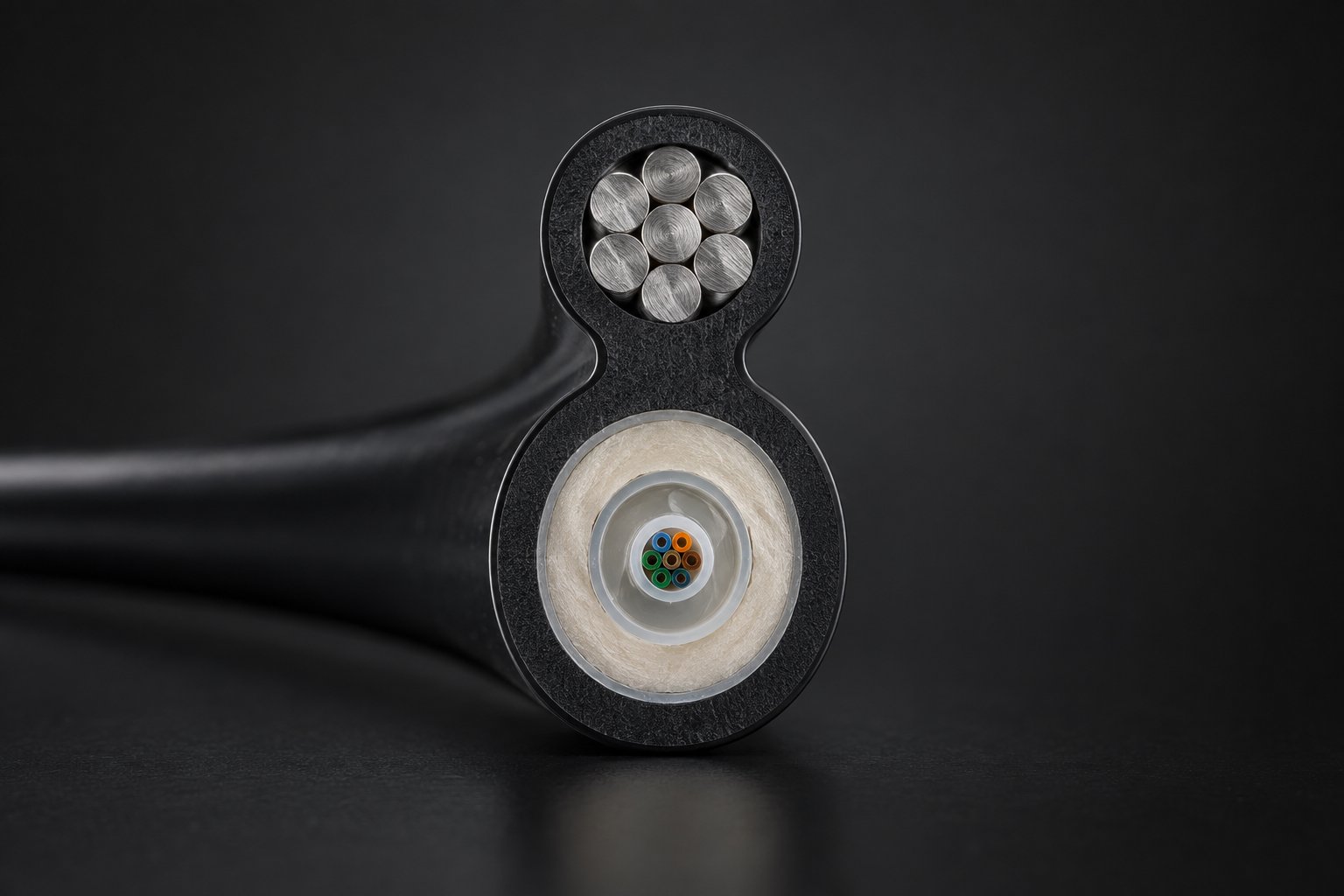
Fiber Distribution Cable: Sizing the Building Backbone
How to size an indoor distribution cable for a building backbone: subunit counts, riser paths, splice vs pre-terminated landings and the growth margin that saves a re-pull.
A fiber distribution cable is what carries a building's backbone: multiple fibers or subunits in one sheath, run riser-to-riser and floor-to-floor, feeding the panels each floor depends on. Size it right and one pull serves a decade of tenant changes; size it wrong and the second expansion means a second pull through the same shaft. This page walks the sizing decisions.
Sizing the backbone
- Count the landing points, not today's users. Each floor panel and each future floor position is a landing; fibers serve landings, not desks.
- Group into subunits. Distribution cables carry fibers in subunits (e.g. 6-fiber groups), so a 24-fiber cable breaks out as four clean subunits at the panel — count in subunit multiples.
- Keep a growth margin in the sheath. Spare subunits cost little on install day and everything on re-pull day; a common planning practice reserves roughly one subunit group beyond the known landings.
- Match the jacket to the shaft. Riser-rated (OFNR) for vertical paths, plenum (OFNP) where code demands it.
Splice or pre-terminate the landings?
Field-spliced landings keep the cable as one continuous run and suit tall buildings with stable floor plans. Pre-terminated subunits arrive factory-tested and land on the panel in minutes — the same factory-test argument as our premade trunk guide, applied indoors. The trade: pre-terminated lengths must be measured accurately, because extra slack coils, not adapts.
| Landing method | Best for | Watch for |
|---|---|---|
| Spliced at the panel | Tall risers, uncertain final lengths | Splice labor and closure space at each floor |
| Pre-terminated subunits | Measured shafts, fast floor fit-outs | Exact routed lengths required at order time |
Key specifications at a glance
| Parameter | Typical value |
|---|---|
| Fiber type | OM3/OM4 multimode or OS2 single-mode |
| Fiber counts | 12–144 fibers in 6- or 12-fiber subunits |
| Jacket ratings | OFNR riser / OFNP plenum |
| Subunit break-out | 900 µm tight-buffered subunits for direct termination |
| Attenuation (MM, 850 nm) | ≤3.0 dB/km OM3/OM4 class (typical; refer to datasheet) |
| Lead time | 7–15 working days after deposit |
| Payment | 30% T/T deposit, balance before shipment |
| Warranty | 12 months from shipment date |
For short point-to-point indoor runs, tight-buffered builds without subunits are often simpler — see the tight-buffered routing guide.
Buyer FAQ
How much growth margin should the backbone carry?
Plan subunits against known landings plus one spare group. The right margin depends on tenant churn — offices turn over faster than owner-occupied buildings.
Can one distribution cable mix single-mode and multimode?
Hybrid indoor backbones exist but complicate panels and testing. Where both glass types are needed, two constructions routed together keep the landing panels clean.
Do subunits need fan-out kits at the panel?
Subunits built on 900 µm tight-buffered fiber terminate directly; fan-out kits are for loose-tube fibers. Confirm the subunit construction on the datasheet before ordering panel hardware.
Entscheidungshilfe
Was dimensioniert das Backbone?
Wählen Sie die Dimensionierungsentscheidung, die Sie festlegen müssen — die Antwort gibt die Backbone-Regeln auf dieser Seite wieder.
Lösungsangebot anfordern
Beschreiben Sie Ihr Einsatzszenario, die benötigten Steckertypen, Faserzahlen und Zielmengen. Je spezifischer Ihre Angaben, desto schneller können unsere Ingenieure die passenden Produkte und die Lieferzeit bestätigen.