
Why the UPC vs APC Question Matters for Your Fiber Network
When you are planning a fiber optic network, one of the first decisions you will face is which connector polish to specify: UPC or APC. It looks like a small detail, but it has a direct impact on signal quality, on which equipment you can connect, and on whether your network will perform reliably over years of operation. For a B2B buyer sourcing fiber optic patch cords, adapters and pigtails, getting this decision wrong can mean ordering thousands of connectors that do not match the rest of the network, or paying for performance you do not actually need.
This guide explains what UPC and APC mean, how they differ in the way they are polished, why that difference changes return loss and back reflection, and how to choose the right option for FTTH, CATV, data center and general telecom applications. It also covers the compatibility rules you must follow, because mixing UPC and APC connectors is one of the most common and costly mistakes in fiber network deployment. By the end of this article, you will have a clear decision framework that you can apply to your own project, whether you are a network contractor, a system integrator, a distributor or an operator planning a large-scale deployment.
What Does UPC Mean in Fiber Optics?
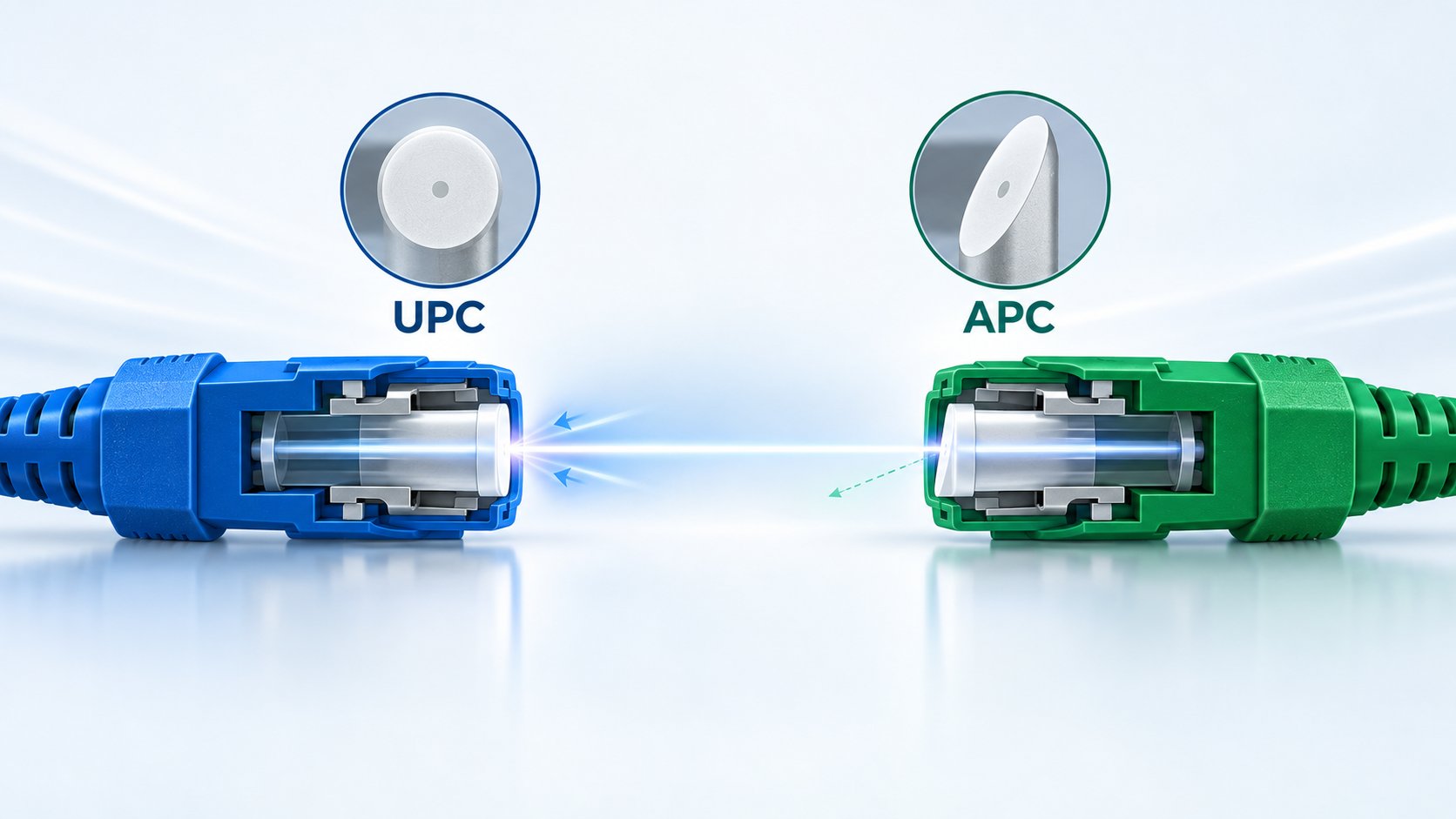
UPC stands for Ultra Physical Contact. It describes a method of polishing the end face of a fiber optic connector ferrule so that the two fibers make firm physical contact when two connectors are mated. The end face of a UPC connector is polished to a flat, slightly domed surface. The word "ultra" refers to the very tight control over the geometry of that polish, which keeps insertion loss low and repeatable.
In practical terms, a UPC connector is the workhorse of most fiber optic networks. It is used across single mode and multimode systems, in patch cords, pigtails, adapters and bulkhead connections. Because the end face is flat, UPC connectors are relatively simple to manufacture and to inspect, and they deliver excellent performance for the vast majority of applications. The flat surface also makes UPC connectors easier to clean, because there is no angled geometry to trap contaminants.
UPC connectors are most commonly identified by their blue color. If you see a blue connector boot, ferrule or adapter, it is almost always a UPC polish. This color coding is not just cosmetic; it is a safety and compatibility signal that helps installers avoid mixing polishes. The blue color is standardized across most manufacturers, so it is a reliable visual cue in the field.
The history of the polish is worth understanding. Earlier connector designs used a flat, non-contact polish that left a small air gap between fibers, which caused high insertion loss. The physical contact (PC) polish solved this by doming the end face so the fibers touch. UPC is a refinement of PC that controls the dome geometry more tightly, improving return loss and consistency. APC is a further evolution that adds the angle to suppress back reflection even more.
What Does APC Mean in Fiber Optics?
APC stands for Angled Physical Contact. Like UPC, it is a polishing method, but the end face of an APC connector is ground at an angle, typically 8 degrees, rather than being flat. The angled surface is designed to reflect light away from the fiber core instead of straight back into it. This dramatically reduces back reflection, which is also called return loss or optical return loss (ORL).
The 8-degree angle is the industry standard for APC connectors. When two APC connectors are mated, the angled faces press together and the small amount of light that is reflected at the interface is directed off to the side, away from the transmitting fiber. This is why APC connectors are preferred in applications where back reflection can degrade performance, such as passive optical networks (PON), CATV and RF-over-glass systems.
APC connectors are almost always green. The green color coding is a clear visual signal that the connector uses an angled polish and must never be mated with a flat UPC connector. The green color is as standardized as the blue of UPC, so it is a reliable field indicator.
It is worth noting that the angle is applied to the ferrule end face, not to the connector body. The connector still fits into the same adapter and patch panel as a UPC connector of the same type. The difference is entirely in the polish geometry. This is why it is so easy to accidentally mix them: the mechanical fit is the same, but the optical performance is completely wrong when they are mismatched.
The Core Difference: Return Loss and Back Reflection
The single most important technical difference between UPC and APC is how they handle reflected light. When light travels down a fiber and reaches a connector interface, a tiny fraction of that light is reflected back toward the source. This reflected light is called back reflection, and the measure of how well a connector suppresses it is called return loss, expressed in decibels (dB).
A higher return loss number means less reflected light and better performance. Because the APC end face is angled, it reflects light away from the core, so APC connectors achieve higher return loss than UPC connectors. In typical specifications, a well-polished UPC connector provides return loss in the range of about -50 dB, while an APC connector provides return loss of about -60 dB or better. The exact values depend on the polish quality, the connector type and the inspection process, but the general relationship holds: APC gives you more margin against back reflection.
Why does back reflection matter? In high-speed and long-reach systems, reflected light can interfere with the transmitted signal, causing bit errors and reducing the effective signal-to-noise ratio. In analog systems such as CATV and RFoG, back reflection is especially harmful because it can create ghosting and degrade picture quality. In PON systems, where a single optical line terminal serves many optical network units, reflected light from one connector can travel back and interfere with other subscribers on the same wavelength. For these reasons, APC is the standard choice in PON, CATV and other reflection-sensitive applications.
Insertion loss is a separate but related measure. It describes how much signal is lost as light passes through the connector. Both UPC and APC connectors are designed to keep insertion loss low, typically well under 0.3 dB for a good quality single mode connection. The choice between UPC and APC is driven mainly by return loss requirements, not by insertion loss, because both polishes can achieve similar insertion loss when properly made.
To understand the physics, imagine a light beam hitting a mirror. A flat surface reflects the beam straight back. An angled surface reflects it off to the side. In a fiber connector, the end face is the "mirror". A flat UPC end face reflects a small amount of light straight back into the fiber core, where it travels back toward the laser. An angled APC end face reflects that light off to the side, where it is absorbed by the ferrule or the connector body and never re-enters the core. This is the entire principle behind the difference, and it explains why APC is so effective at suppressing back reflection.
UPC vs APC: A Side-by-Side Comparison
| Characteristic | UPC (Ultra Physical Contact) | APC (Angled Physical Contact) |
|---|---|---|
| End face shape | Flat, slightly domed | Angled, typically 8 degrees |
| Typical return loss | Around -50 dB | Around -60 dB or better |
| Color coding | Blue | Green |
| Back reflection | Higher | Lower |
| Typical applications | Data centers, LAN, general telecom, patch panels | FTTH/PON, CATV, RFoG, reflection-sensitive links |
| Compatibility | Mates only with UPC | Mates only with APC |
| Cost | Generally lower | Generally slightly higher |
This table summarizes the practical differences. The most important takeaway is the compatibility row: a UPC connector and an APC connector cannot be mated together. The angled APC face will not seat properly against the flat UPC face, which causes high insertion loss, poor return loss and potential damage to the polished surfaces. You must match the polish across the entire link.
It is also worth noting that the return loss values in the table are typical figures for well-made connectors. The actual performance depends on the quality of the polish, the cleanliness of the end face and the inspection process. A dirty or damaged end face will degrade return loss regardless of whether it is UPC or APC, which is why proper cleaning and inspection are essential parts of any fiber installation.
Why You Must Never Mix UPC and APC Connectors
Mixing UPC and APC connectors is one of the most common mistakes in fiber network installation, and it is also one of the most damaging. When a flat UPC connector is mated with an angled APC connector, the two end faces do not make proper physical contact. The result is a gap or a misalignment at the interface, which produces high insertion loss and poor return loss. In some cases, the mismatch can also damage the polished end faces, especially if the connectors are forced together.
The green and blue color coding exists precisely to prevent this mistake. Before you mate any two connectors, check that both are the same polish. A green APC connector must only be connected to another green APC connector, and a blue UPC connector must only be connected to another blue UPC connector. This rule applies to patch cords, pigtails, adapters, bulkheads and every other connection point in the network.
If you are sourcing components for a project, make sure the polish is specified consistently across the bill of materials. A common error is to order UPC patch cords for a PON network that uses APC connectors at the optical network terminal, or to install an APC adapter in a panel that is otherwise UPC. Auditing the polish of every connector in the path before installation saves time, money and rework.
There is no adapter or converter that can bridge a UPC and an APC connection. Some people assume that a hybrid adapter will solve the problem, but it will not. The two polishes are fundamentally incompatible at the optical level, and the only correct solution is to replace one side so that both use the same polish. This is why it is so important to get the specification right before you order.
For a B2B buyer, the practical implication is that you should specify the polish on every line item of your purchase order. Do not assume that a patch cord or adapter is UPC by default. Confirm the polish with your supplier, and make sure the entire network uses a consistent standard. A few minutes of specification review can save you from a costly rework that delays your project and damages your reputation with your own customers.
When Should You Choose UPC?
UPC is the right choice for the majority of fiber optic applications where back reflection is not a critical concern. This includes most data center cabling, enterprise LANs, campus networks, patch panels and general telecom links. In these environments, the flat UPC end face delivers low insertion loss, reliable physical contact and excellent value.
Data centers are a particularly strong fit for UPC. High-density patching, structured cabling and most transceivers used in data center links are designed around UPC connectors. The LC duplex connector, which is the dominant interface in modern data centers, is most commonly supplied with a UPC polish. If you are building or expanding a data center, UPC is almost certainly the right specification for the bulk of your patch cords and adapters.
UPC is also the standard for many enterprise and campus networks where the distances are shorter and the signal budget is more forgiving. In these cases, the additional return loss margin of APC is not necessary, and UPC offers a simpler, more economical solution. The flat end face is also easier to clean and inspect, which reduces maintenance effort over the life of the network.
Another advantage of UPC is cost. Because UPC connectors are more widely produced and the polish is simpler to control, they tend to be slightly less expensive than APC connectors of the same type. For a large data center with thousands of connections, this cost difference can add up. If your application does not need the extra return loss margin, UPC is the more economical choice.
When Should You Choose APC?
APC is the right choice whenever back reflection can degrade performance. The clearest examples are passive optical networks (PON) used for fiber-to-the-home (FTTH) and fiber-to-the-building (FTTB), CATV and RF-over-glass systems, and any link where analog signals or high-power lasers are involved.
In FTTH and PON networks, APC is the industry standard. The optical line terminal, the splitters and the optical network units all use APC connectors, typically SC/APC, because the network carries multiple wavelengths and any back reflection can interfere with upstream and downstream signals. If you are sourcing components for an FTTH deployment, you should specify APC connectors throughout the subscriber drop and distribution segments.
CATV and RFoG systems also rely on APC. These systems carry analog RF signals over fiber, and back reflection causes visible ghosting and signal degradation. The angled APC end face suppresses this reflection, which is why APC is the standard for cable operators and RF-over-glass deployments.
APC is also used in some high-power laser and test applications where reflected light could damage the source or distort measurements. The FC/APC connector, with its threaded locking mechanism, is a common choice for test equipment and high-reliability single mode links because it combines the angled polish with a vibration-resistant connection.
In a PON network, the reason APC is so important comes down to the shared medium. A single optical line terminal (OLT) at the central office serves many optical network units (ONUs) at subscriber premises through passive splitters. All of these share the same fiber and the same wavelengths. If one connector in the path reflects light back toward the OLT, that reflected light can interfere with the upstream signals from other subscribers. The angled APC end face minimizes this risk, which is why APC is mandatory in PON deployments.
How to Choose Between UPC and APC for Your Project
Choosing between UPC and APC comes down to three questions: what type of network are you building, what does the existing equipment use, and how sensitive is the application to back reflection?
First, identify the network type. If you are building an FTTH or PON network, or a CATV or RFoG system, choose APC. If you are building a data center, enterprise LAN or general telecom link, choose UPC. This single decision covers most projects.
Second, check the existing equipment. The transceivers, optical network units, splitters and patch panels you are connecting to will dictate the polish you need. Never assume; verify the polish of the equipment at both ends of every link before ordering connectors. If the equipment uses APC, you must use APC throughout. If it uses UPC, use UPC throughout.
Third, consider the signal budget and reflection sensitivity. For long-reach single mode links, high-power lasers and analog signals, the extra return loss margin of APC is worth the slightly higher cost. For short, forgiving links, UPC is sufficient and more economical.
Finally, standardize across the project. Pick one polish for the whole network and document it in the bill of materials. This avoids the costly mistake of mixing polishes and makes installation and maintenance much simpler.
For a B2B buyer, there is a fourth consideration: your downstream customers. If you are a distributor or system integrator, you need to understand the end application to recommend the right polish. A contractor building an FTTH network for a telecom operator will need APC throughout. A data center integrator will mostly need UPC. Being able to advise your customers on this choice adds real value and helps you win repeat business.
Connector Types and Their UPC or APC Options
The UPC and APC polish is available across the main connector families used in fiber networks: SC, LC, FC and ST. Each connector type has its own mechanical design, but the polish choice is independent of the connector type. You can have an SC/UPC or an SC/APC connector, an LC/UPC or an LC/APC connector, and so on.
The SC connector is a push-pull connector widely used in FTTH, access networks and enterprise cabling. It is available in both UPC and APC versions. SC/APC is the standard for FTTH and PON, while SC/UPC is common in general telecom and data applications. The SC connector's square, push-pull design makes it easy to insert and remove, and it is one of the most widely deployed connector types in the world.
The LC connector is a small-form-factor connector that dominates data center and high-density applications. It is most commonly supplied as LC/UPC for data center links, but LC/APC is available for access networks and other reflection-sensitive applications. The LC duplex connector is the standard interface for modern transceivers. Its small size allows more connections in the same panel space, which is why it is the preferred choice for high-density data centers.
The FC connector uses a threaded coupling and is known for its vibration resistance. It is often used in test equipment, measurement and high-reliability single mode links. FC/APC combines the threaded locking with the angled polish for applications that need both mechanical stability and low back reflection. The threaded design prevents accidental disconnection, which is valuable in test and measurement environments.
The ST connector uses a bayonet locking mechanism and is most commonly found in legacy and enterprise multimode networks. ST connectors are typically multimode and are not commonly supplied with an APC polish, because multimode systems are less sensitive to back reflection. The bayonet lock provides a quick, secure connection, and ST remains common in older enterprise installations.
When you specify a connector, you are actually specifying three things: the connector type (SC, LC, FC, ST), the fiber mode (single mode or multimode), and the polish (UPC or APC). All three must be correct for the connector to work in your network. A common shorthand like "SC/APC" or "LC/UPC" captures all three, which is why it is important to use the full designation in your specifications.
Standards and Specifications to Know
Fiber optic connectors are governed by international standards that define their performance and geometry. Understanding these standards helps you specify the right product and verify that what you receive meets your requirements.
The most relevant standards for connector polish are published by the International Electrotechnical Commission (IEC) and the Telecommunications Industry Association (TIA). These standards define the geometry of the end face, the return loss and insertion loss limits, and the test methods used to verify performance. While you do not need to memorize the standard numbers, it is useful to know that your supplier's products should be tested against these recognized standards.
For return loss, the key specification is the optical return loss (ORL) of the connector. A UPC connector is typically specified to provide return loss of at least -50 dB, while an APC connector is specified to provide at least -60 dB. These are the values you should look for in a product specification, and they are the values a reliable manufacturer will test and guarantee.
For insertion loss, the key specification is the maximum insertion loss of a mated pair. A good quality single mode connector is typically specified at 0.3 dB or less. Multimode connectors may have slightly different limits. When you compare products from different suppliers, compare the insertion loss and return loss specifications directly, and ask for test data to back them up.
It is also worth knowing the color coding convention. The TIA standard specifies that UPC connectors are blue and APC connectors are green. This is a widely followed convention, and it is your first line of defense against mixing polishes. If you receive a connector that is not the expected color, verify the specification before using it.
Common Mistakes to Avoid When Sourcing Connectors
Even experienced buyers make mistakes when sourcing fiber optic connectors. Here are the most common ones and how to avoid them.
The first mistake is assuming the polish. Many buyers assume that a patch cord or adapter is UPC by default, and they do not specify the polish on the purchase order. This leads to receiving the wrong product, especially for FTTH and PON applications where APC is required. Always specify the polish explicitly on every line item.
The second mistake is mixing polishes in a single network. This happens when different parts of a project are sourced from different suppliers or ordered at different times. The result is a network where some connections are UPC and others are APC, which causes performance problems and rework. Standardize on one polish for the whole project and document it.
The third mistake is ignoring the end face quality. A connector can have the right polish designation but still perform poorly if the end face is dirty, scratched or damaged. Always inspect the end faces with a microscope before installation, and clean them before mating. This simple step prevents most performance problems.
The fourth mistake is choosing a supplier without verifying their quality control. A reliable manufacturer will test connectors before shipment and provide test data. Ask about their inspection process, their quality control stations and their ability to provide documentation. This is especially important for large orders where a single defective batch can delay the whole project.
The fifth mistake is not planning for the future. When you choose a polish, consider not just the current project but also future expansion and maintenance. If you standardize on a polish that matches your equipment and your application, you make it easier to add capacity and replace components later.
Testing and Inspection: How to Verify the Polish
Once you have chosen the right polish, you need to verify that the connectors you receive actually meet the specification. This is especially important for B2B buyers who are sourcing large quantities of connectors, because a batch of defective connectors can delay an entire project.
The first check is visual. Inspect the end face of each connector with a fiber inspection microscope. A properly polished UPC end face should be clean, smooth and free of scratches, pits and contamination. An APC end face should show the angled surface clearly, with the same cleanliness requirements. Any visible defect can cause high insertion loss or poor return loss.
The second check is optical. Use an optical power meter and a light source to measure insertion loss across each connection. A good quality single mode connection should have insertion loss well under 0.3 dB. If you measure higher loss, the connector may be dirty, damaged or mismatched.
The third check is return loss. This requires an optical return loss meter or an OTDR. Measure the return loss of each connection and compare it to the specification. A UPC connection should show return loss around -50 dB, while an APC connection should show -60 dB or better. If the return loss is much worse than expected, the polish may be defective or the connectors may be mismatched.
For a B2B buyer, it is worth asking your supplier about their quality control process. A reliable manufacturer will test connectors before shipment and will be able to provide test data. Nexora, for example, operates 30 quality control stations covering incoming material, component, in-process, functional, visual, final and packaging inspection. This kind of process gives you confidence that the connectors you receive will perform as specified.
Cleaning and Maintenance Considerations
The polish of a connector is only as good as its cleanliness. A dirty end face will degrade both insertion loss and return loss, regardless of whether the connector is UPC or APC. This is why cleaning is such an important part of fiber network maintenance.
UPC connectors, with their flat end faces, are generally easier to clean than APC connectors. The flat surface is easier to wipe and inspect. APC connectors, with their angled end faces, require a little more care because the angle can trap contaminants if not cleaned properly. However, with the right cleaning tools and technique, both types can be kept in excellent condition.
Use a fiber optic cleaning kit that includes lint-free wipes, cleaning fluid and a fiber inspection microscope. Clean the end face before every connection, and inspect it after cleaning to confirm it is free of contamination. Never touch the end face with your fingers, and always replace the dust cap when the connector is not in use.
For a large network, establish a cleaning and inspection routine. Train your installers to clean every connection before mating, and to inspect the end faces with a microscope. This simple discipline prevents most of the performance problems that arise from dirty connectors and saves you from costly troubleshooting later.
Cost Considerations for UPC and APC
Cost is a practical consideration for any B2B buyer, and the difference between UPC and APC is worth understanding. In general, APC connectors are slightly more expensive than UPC connectors of the same type, because the angled polish requires more precise manufacturing and inspection. However, the difference is usually small, and it is rarely the deciding factor in a project.
The bigger cost risk is not the per-unit price difference between UPC and APC, but the cost of getting the specification wrong. If you order the wrong polish and have to reorder, you pay for the replacement components, the shipping, and the labor to rework the installation. This can easily cost far more than the small per-unit difference between the two polishes.
For this reason, the most cost-effective approach is to get the specification right the first time. Confirm the polish with your supplier, verify it against your equipment, and standardize across the project. A few minutes of careful specification saves you from the much larger cost of rework.
It is also worth considering the total cost of ownership. A connector that is easy to clean and inspect, and that performs reliably over years of operation, is worth more than a slightly cheaper connector that causes problems. Choose a supplier with a strong quality control process, and you will reduce your long-term maintenance and replacement costs.
How Nexora Can Support Your UPC and APC Requirements
Nexora is a Shenzhen-based B2B fiber optic network equipment manufacturer founded in 2014, with more than 180 employees and a 16,000 square meter facility. We manufacture fiber optic cables, patch cords, adapters, pigtails and FTTH products, and we support both standard products and custom OEM/ODM manufacturing for telecom operators, ISPs, distributors, system integrators and network contractors worldwide.
Our product range includes both UPC and APC options across the main connector families. For example, we supply SC/UPC and SC/APC single mode fiber optic adapters for FTTH and access networks, LC/UPC and LC/APC duplex adapters for high-density data center and access connections, and FC/APC adapters for test equipment and high-reliability links. We also manufacture single mode and multimode patch cords with the polish you specify, including SC-SC, LC-LC, FC-FC and hybrid LC-SC configurations.
Because we control the manufacturing process across 12 production lines and 30 quality control stations, we can match the polish, connector type, fiber type and length to your exact project requirements. Whether you need a standard catalog product or a custom configuration, our team can help you specify the right UPC or APC solution and confirm that every connector in your bill of materials is consistent.
We also support OEM and ODM projects, with more than 500 completed projects delivered to customers in over 50 countries. If you need a custom connector configuration, a specific length, or a branded product for your own distribution, our team can work with you to develop the right solution. Our annual capacity of more than 2.8 million units and monthly capacity of more than 230,000 units means we can support both small and large orders.
Common Questions About UPC and APC Connectors
Can I use a UPC patch cord with an APC adapter?
No. A UPC connector and an APC adapter are not compatible. The flat UPC end face will not seat properly against the angled APC adapter, causing high insertion loss, poor return loss and potential damage. Always match the polish of the connector and the adapter.
Is APC better than UPC?
APC is not universally better; it is better for specific applications. APC provides higher return loss, which matters in PON, CATV and other reflection-sensitive systems. For data centers and general telecom, UPC delivers excellent performance at lower cost. Choose based on your application, not on a general notion of which is "better".
How can I tell UPC and APC connectors apart?
By color. UPC connectors and adapters are typically blue, while APC connectors and adapters are typically green. Always confirm the polish by checking the color coding and the product specification before mating connectors.
What return loss should I expect from UPC and APC?
Typical values are around -50 dB for a well-polished UPC connector and -60 dB or better for an APC connector. The exact value depends on polish quality, connector type and inspection. Higher return loss numbers mean less back reflection.
Do I need APC for a data center?
Generally no. Most data center links use UPC connectors, and the LC duplex interface is most commonly supplied with a UPC polish. APC is used in data centers mainly for specific access or reflection-sensitive links. Check your equipment specifications to confirm.
Can I convert between UPC and APC?
You cannot convert a single connector from UPC to APC, and you cannot use a simple adapter to bridge them. The only way to change the polish is to replace the connector or the patch cord with the correct type. Plan your bill of materials carefully to avoid this situation.
Is APC used in multimode networks?
Rarely. Multimode networks are less sensitive to back reflection, so they almost always use UPC connectors. APC is primarily used in single mode networks, especially PON, CATV and other reflection-sensitive applications.
Does the connector type affect the choice of polish?
No. The polish is independent of the connector type. You can have SC, LC, FC or ST connectors with either UPC or APC polish, depending on the application. The connector type determines the mechanical interface, while the polish determines the optical performance.
Conclusion: Match the Polish, Match the Network
The difference between UPC and APC fiber optic connectors comes down to the shape of the polished end face and how it handles reflected light. UPC uses a flat end face and is the standard for data centers, LANs and general telecom. APC uses an 8-degree angled end face and is the standard for FTTH, PON, CATV and other reflection-sensitive applications. The two are not interchangeable, and mixing them causes poor performance and potential damage.
When you plan your network, identify the application, verify the polish of your existing equipment, and standardize on one polish across the entire bill of materials. If you are sourcing fiber optic patch cords, adapters or pigtails and need help specifying the right UPC or APC solution, the Nexora team can support you with standard products, bulk supply and custom OEM/ODM manufacturing. Contact us with your project details and we will help you select the right components for a reliable, high-performance fiber network.