
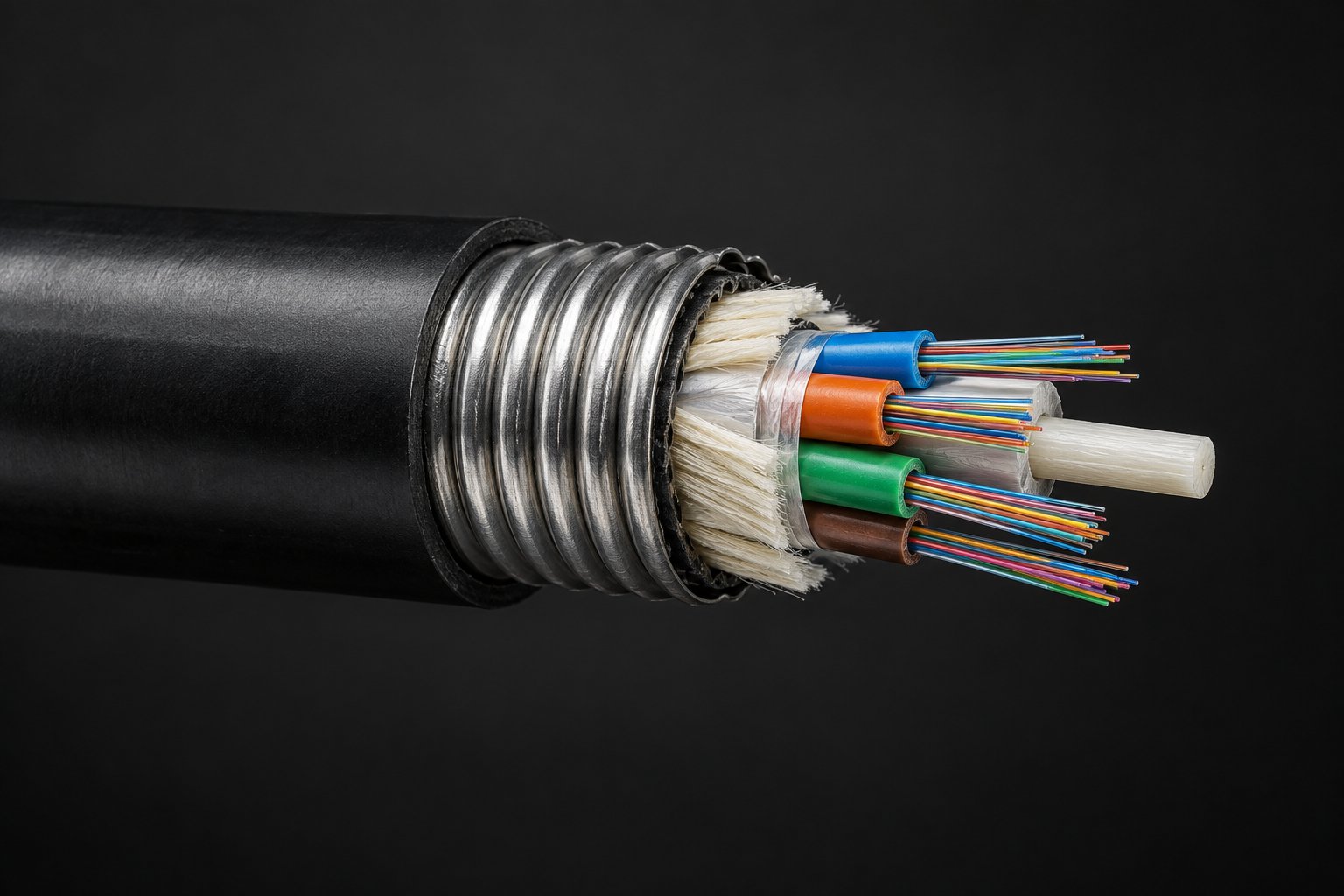
Armored Fiber Cable Protection: Matching Armor to the Route
Where armored fiber earns its cost: duct, direct-burial and rodent-prone routes mapped to the right armor construction, with the crush and bend criteria to confirm before ordering.
Armored fiber optic cable costs more than standard loose-tube cable, and on the right route it pays for itself in avoided re-lays. On the wrong route it adds stiffness, weight and cost for no benefit. This guide maps the three route classes where armor earns its cost, and lists the protection checklist we walk through with buyers before quoting an armored fiber patch cable or outdoor armored run.
Matching armor to the route
| Route | Main threat | Recommended construction |
|---|---|---|
| Indoor trunking, ceilings and risers | Rodents, accidental impact | Corrugated steel or stainless armor with LSZH outer jacket |
| Direct burial | Crush, moisture, shifting soil | Corrugated steel tape armor, PE outer jacket, water-blocking elements |
| Duct and conduit pulls | Crush at bends, pulling friction | Single corrugated armor with PE jacket; staged pulls with lubrication |
Pre-order risk checklist
- Pull tension vs span. Armor adds stiffness; longer pulls need staged winching and mid-point assistance. Confirm the rated short-term tension on the datasheet for your span.
- Minimum bend radius. Armored constructions typically need a larger dynamic bend radius than non-armored cable of the same diameter — plan duct corners accordingly.
- Grounding and bonding. Metallic armor must be bonded at splice points per local electrical code; flag this in the installation plan, not after the pull.
- Termination. Armored cable ends at a closure or cabinet; specify the gland size so the armor enters cleanly without over-bending the last meter.
Key specifications at a glance
| Parameter | Typical value |
|---|---|
| Fiber type | G.652D single-mode; G.657A2 for tight routes |
| Fiber count | 2–144 cores |
| Crush resistance | ≥1,000 N/100 mm short-term (typical; refer to datasheet) |
| Attenuation @ 1310 / 1550 nm | ≤0.4 / ≤0.3 dB/km (typical) |
| Operation temperature | −40 °C to +70 °C (typical) |
| Armor options | Corrugated steel tape, stainless steel, or double armor for rodent-prone burial |
| MOQ | 100 pcs per SKU |
| Lead time | 7–15 working days after deposit |
| Payment | 30% T/T deposit, balance before shipment |
| Warranty | 12 months from shipment date |
Values marked typical are industry-standard reference figures; the shipped datasheet for your exact SKU governs.
Buyer FAQ
Can armored cable be run indoors?
Yes — indoor armored constructions use an LSZH jacket so smoke and halogen emissions stay low in risers and ceiling spaces. Match the armor grade to the rodent risk, not to the building type.
Is double armor ever necessary?
For direct burial through rodent-prone or rocky ground, double armor reduces re-lay risk. In duct, single armor is usually sufficient once pulling tension is planned.
Do you support custom counts and jacket colors?
Yes — fiber count, armor type and jacket color are OEM/ODM options. Send the route description with your inquiry so the quote matches the build.
أداة القرار
هل يحتاج مسارك إلى درع؟
اختر قرار الحماية — تعيد الإجابة ذكر قواعد الكورد المدرّع الواردة في هذه الصفحة.
اطلب عرض سعر لحل
صف سيناريو النشر وأنواع الموصلات المطلوبة وأعداد الألياف والكميات المستهدفة. كلما كانت مدخلاتك أكثر تحديدًا، تمكن مهندسونا من تأكيد المنتجات المطابقة ومهلة التسليم بشكل أسرع.